Ammonia Fuel ready LNG Fueled Vessel proceeded to Actual Design
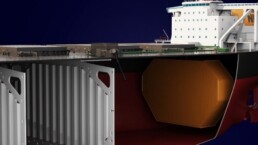

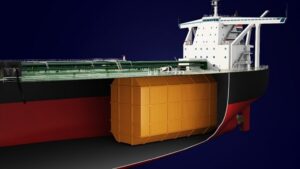
Nippon Yusen Kabushiki Kaisha, MTI and Elomatic Oy have completed the concept design phase of a new capesize bulk carrier and a very large crude oil tanker in a project that aims to build an LNG-fueled vessel that can be efficiently converted to an ammonia-fueled vessel, or ARLFV, an ammonia-fuel ready LNG-fueled vessel. The three companies are positioning ARLFVs as a next-bridge solution for the realization of future zero-emission vessels. In the future, the three companies will proceed with the actual design of an ARLFV with shipyards and marine equipment manufacturers.
A “concept design” includes ship specifications such as overall length and width, load capacity, voyage distance, ship speed, etc, for a vessel building.
NYK has set a long-term target of net-zero emissions of greenhouse gas (GHG) by 2050 for the NYK Group’s oceangoing businesses, and aims at launching zero-emission ships that run on low-environmental-load marine fuels, such as ammonia or hydrogen, in the future. NYK is positioning LNG, a low-carbon marine fuel, as a bridge-solution until future zero-emission ships are realized, and has thus been expanding its fleet of LNG-fueled vessels.
In September 2021, NYK, MTI, and Elomatic launched a project to develop an ARLFV as a “next bridge solution” with the aim of developing zero-emission vessels in the future. In the past, it was generally shipbuilders that implemented concept designs, but in this project, NYK, MTI, and Elomatic have been jointly crafting the concept design of the ARLFV. In March 2022, the concept designs of a pure car carrier and a post-panamax bulk carrier were completed in Phase 1 of the project.
- Announcement on 3 March 2022, “Concept Design for Ammonia-Fuel Ready LNG-Fueled Vessel Completed”
Now, the three companies have completed the concept designs of a capesize bulk carrier and a very large crude oil tanker (VLCC) in Phase 1.5 of the project.
The main challenges in designing and developing ARLFVs are as follows:
- 1.Because of the lower energy density of ammonia compared to LNG, a larger fuel tank capacity is needed in order to maintain the same level of endurance.
- 2.Because of (1), the space for cargo loading, as well as the loadable cargo weight, is reduced.
- 3.A bigger fuel tank and additional fuel tanks affect ship stability and hull strength.
- 4.Due to the extreme toxicity of ammonia, ventilation for the ammonia tanks must be designed according to international conventions and/or domestic laws.
- 5.Conversion from an LNG-fueled vessel to an ammonia-fueled vessel requires additional work periods and costs.
In the Phase 1.5 concept design, NYK, MTI, and Elomatic sought solutions to solve the above issues, and researched and studied the fuel-tank layout and other specifications of the ship. The three companies then completed a concept design that has viable, functional, and safe features.
Compared to a conventional LNG-fueled vessel, the ARLFV in this concept design is expected to feature a conversion-cost reduction of 12% for a capsize bulk carrier and 25% for a VLCC.
In the next step, i.e., Phase 2 of the project, the three companies will work with shipyards and marine equipment manufacturers on the actual design of the ARLFV based on the concept design.



Related News.

Crewing After 2026: How AI Will Take Over the Routine in 2027
The crewing market of late 2026 is not the market of 2025. Artificial intelligence has moved from presentations into daily crewing work, while the…

Dualog launches secure maritime AI service amid surge in seafarer AI use
The new service, Sparks lets crew and shore teams search company emails, documents and conversations without exposing sensitive fleet information to…

Time Ticking: Two weeks for Governments to Green-Light Framework for Cutting Shipping Emissions
As a crucial fortnight of meetings opens at the International Maritime Organization opens in London, the Clean Shipping Coalition calls on member…

“K” LINE signs contract for construction of two LPG dual-fuel VLGCs
Kawasaki Kisen Kaisha, announces today that it has signed agreements with South Korea-based HD Hyundai Samho regarding the construction of two LPG…

Equinor and VNG sign 18-year gas sales agreement for supplies to Germany
Equinor will supply natural gas to the German energy company VNG until the end of 2044. The 18-year agreement is the longest gas sales agreement…

Open letter to MEPs to reject the motion for a resolution and support the inclusion of Indian ship recycling yards on the European List
Dear Members of the European Parliament, Ahead of this week’s plenary vote, European Shipowners | ECSA, BIMCO, the Cruise Lines International…

ShipVet appoints James Stairmand as Chief Executive Officer
Founder Captain Fintan Cullen moves to a non-executive role as the company builds on investment in its vetting team and technology. ShipVet, the…

USD ≈7bn lost per year the hidden cost of how shipping trades
New Torvald Klaveness study quantifies around USD 7bn a year in potentially avoidable costs in dry bulk and product tanker shipping, with a possible…

APM Terminals Maasvlakte II and Port of Rotterdam Authority take next step in terminal development
APM Terminals Maasvlakte II and the Port of Rotterdam Authority are moving forward in terminal’s development with preparations for a new phase of…

ABP inspiring the next generation
ABP host 500 young people to explore maritime and transport careers More than 500 young people from across Hampshire and the Solent explored career…
Subscribe to our newsletter!
if you dont want to swim alone in the ocean of news, sign up for the newsletter, and you will receive daily all the important news of world shipping!
