
As part of their efforts to cut greenhouse gas (GHG) emissions, countries have increased their use of carbon pricing through taxes or emissions trading systems, with coverage increasing across countries and sectors in 2021, according to a new OECD report.
Pricing Greenhouse Gas Emissions: Turning climate targets into climate action finds that more than 40% of GHG emissions were covered by carbon prices in 2021, up from 32% in 2018, with average carbon prices higher in 47 of the 71 countries studied. Average explicit carbon prices from carbon taxes and emissions trading more than doubled over the period to reach EUR 4 per tonne of CO2 equivalent.
The report highlights that larger price increases occurred in countries where carbon prices were already high. This underlines differences in the extent to which countries rely on carbon pricing as a tool to combat climate change, with governments adapting their emissions reduction strategies to fit their specific circumstances.
“Carbon pricing is one of a range of policy approaches that countries employ in their efforts to reduce emissions. This report shows how the share of emissions that is covered by carbon prices has increased in recent years,” OECD Secretary-General Mathias Cormann said. “It is clear too that a diversity of policy approaches can be used to boost mitigation efforts while ensuring energy security and affordability. The OECD’s new Inclusive Forum on Carbon Mitigation Approaches initiative will support the international community to reach net zero emissions by providing better data and information sharing about the comparative effectiveness of a full range of policy approaches beyond carbon pricing.”
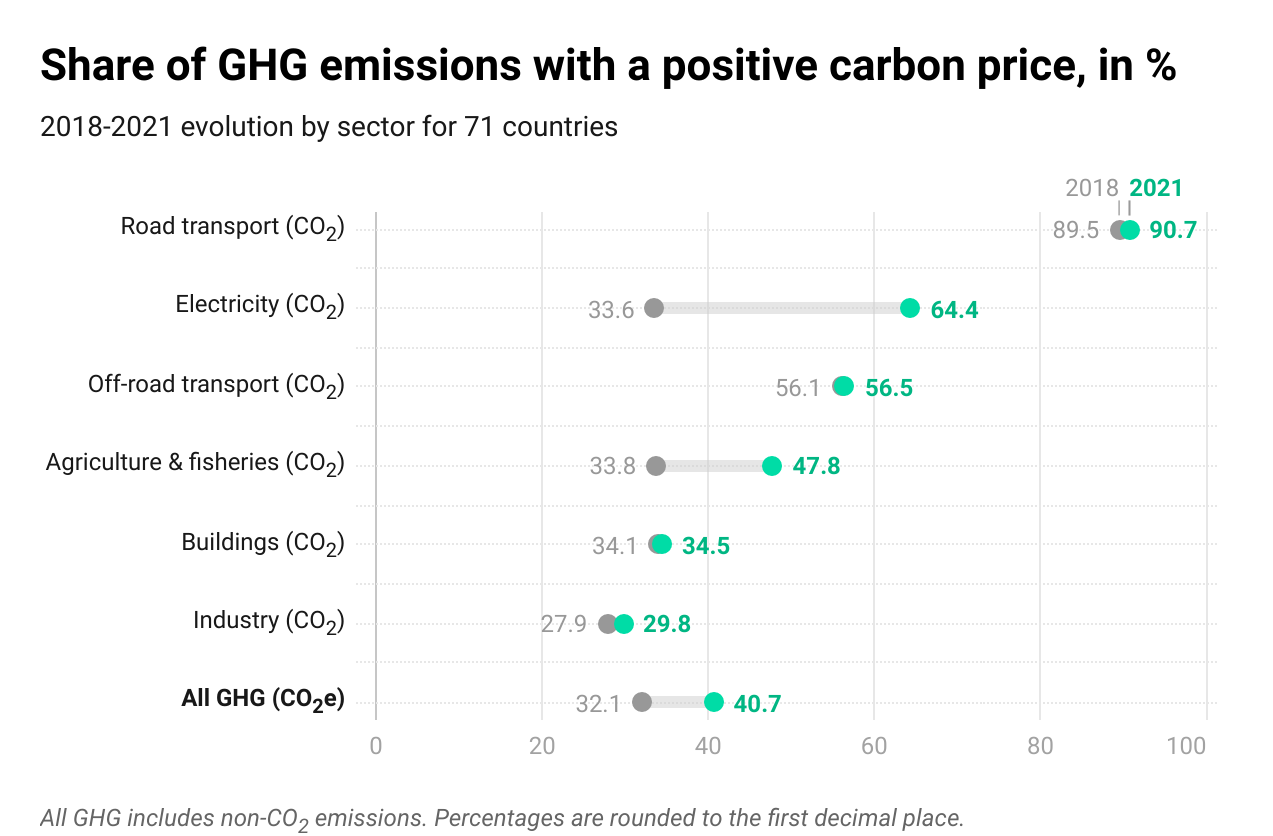
Source: OECD (2022), Pricing Greenhouse Gas Emissions: Turning climate targets into climate action Created with Datawrapper |
Carbon pricing provides incentives for households and businesses to reduce carbon-intensive energy use and shift to cleaner fuels, while also mobilising government revenue. Other policy instruments that can accelerate the shift to net zero include regulation, tax incentives and subsidies for clean technologies. Most countries employ a range of different policy approaches as part of their climate mitigation strategies.
The carbon prices recorded in the report take account of emissions trading systems, carbon taxes, fuel excise taxes and fossil fuel subsidies, which means that they are only a partial measure of the climate mitigation policies employed by governments. One of the objectives of the Inclusive Forum on Carbon Mitigation Approaches is to develop tools to improve the measurement and comparability of a broader range of policy instruments.
Some countries have responded to the energy price shocks driven by supply constraints and Russia’s war of aggression in Ukraine by reducing energy taxes. While this has been important in shielding households and businesses from rapid price hikes, it has reduced some of the effective carbon rates recorded in this report.
Pricing Greenhouse Gas Emissions covers 71 countries, including the OECD’s 38 member countries and the G20 countries except Saudi Arabia. It considers various indicators, including the Effective Carbon Rate (the sum of ETS permit prices, carbon taxes and fuel excise taxes) and the Net Effective Carbon Rate (which subtracts fossil fuel subsidies from the ECR to account for negative carbon prices, i.e. pre-tax price reductions, resulting from fossil fuel subsidies).
Key findings in the report include:
- The average net ECR increased in 47 of the 71 countries studied, through the introduction of new pricing systems or the strengthening of existing ones.
- Across the 71 countries studied, 25% of GHG emissions were covered by an ETS, a carbon tax, or both, in 2021.
- The share of GHG emissions covered by fuel excise taxes, an implicit form of carbon pricing most common in the road transport sector, stood unchanged at 24% in 2021.
- Fossil fuel subsidies that counteract the carbon price signals provided by the other instruments apply to approximately 22% of GHG emissions, the same level as in 2018.
- Of the 71 countries studied, 39 have explicit carbon pricing instruments (ETS or carbon tax) in place at either the national or subnational level or participate in the EU’s Emissions Trading System.
- Carbon prices have increased across all fossil fuels, however, the average Net ECR on fuels used mainly in road transport is much higher than those on other fuels. With a net ECR of EUR 72 and EUR 88 per tonne of CO2e, respectively, diesel and gasoline are both priced more than ten times as much as coal at EUR 6.
See the full report, data, and country notes
Source: OECD



Related News.
India joins ISF Verify, bringing trusted digital certification within reach of 30 per cent of the global seafarer workforce
Agreement with the world’s second-largest seafarer supply country marks a major milestone for global digital certification. The Directorate General…

OpenGate Capital to acquire Maersk Training, the Global Safety Training and Gas-Safety Services Business of Maersk
OpenGate Capital, a global private equity firm, announced today that it has signed a definitive agreement to acquire Maersk Training and its…

Can AI Save the Planet? Planet Classroom examines AI’s Climate Impact, Energy Demands and Clean Energy Solutions
C. M. (Cathy) Rubin and The Nest Campus CEO Peter Gilmer explore AI's growing environmental footprint, billions in climate investment, and the…

Smart Port Market Size to be valued at USD 23.10 Billion by 2034; Increasing Volume of International Maritime Trade to Boost Market Development: Fortune Business Insights™
The global smart port market size was valued at USD 3.4 billion in 2025 and is expected to be worth USD 4.2 billion in 2026. The market is projected…
Closer cooperation with India can strengthen Danish shipping
Minister of Business and Competitiveness Martin Lidegaard is leading a Danish business delegation to India. Green shipping is among the…
IRClass Academy and PIP Makassar strengthen Executive Maritime Capability through IMPDP 2026
Indian Register of Shipping , through its professional training and development arm IRClass Academy, has further strengthened its engagement in…

MOL, Sharp, IOM Implement Solar Panel Donation Project
Move Will Enhance Living Conditions in Power-short Areas of Kenya Mitsui O.S.K. Lines, announced the donation of solar power panels to communities in…

Intermodal Report Week 44 2026
Pls find below the Intermodal Report - Week 44 2026 Intermodal Report Week 44 2026

Allied Weekly Market Review Week 44
Pls find below the Allied - Weekly Market Review - Week 44 ALLIED - Weekly Market Report- Week 44

Nor-Shipping partners with Marketing in Maritime to deliver Marketing & Communications day and awards in 2027
Nor-Shipping is partnering with Marketing in Maritime to deliver a dedicated Marketing & Communications Day and awards initiative at the 2027…
Subscribe to our newsletter!
if you dont want to swim alone in the ocean of news, sign up for the newsletter, and you will receive daily all the important news of world shipping!
