The Right Data in the Right Way


This Data-Driven Team Is Charting a Course for Marine Energy, and the Country, To Decarbonize the Grid
As climate change alters the planet, it is causing massive changes to our oceans. Because these waters absorb excess heat and energy from our atmosphere, the ocean has soaked up 90% of the heat generated from greenhouse-gas emissions. All that heat is causing marine heatwaves, melting sea ice, and sea-level rise, which pose big risks to marine wildlife, ecosystems, and coastal communities.
But one form of renewable energy could draw from the ocean’s power to help fight climate change and protect the planet’s vulnerable waters. Marine energy—power generated from ocean waves as well as ocean and river currents and tides—could be a valuable part of the world’s carbon-free renewable energy portfolio. Yet, marine energy technologies are still in the early stages of development, in part because there is little data to guide their progress toward commercial success.
That is why researchers at the National Renewable Energy Laboratory (NREL) are developing data-gathering tools to help accelerate the development of these promising technologies.
“Marine energy technologies could be a big help in fighting climate change,” said NREL water power researcher Casey Nichols. “The faster we can get marine energy technologies up and running, the faster they could help us power the blue economy, energize isolated communities, and move us to a renewable energy grid.”
Nichols, along with fellow water power researcher Andrew Simms and a broader NREL team, builds tools that collect high-quality data for marine energy developers. Called Modular Ocean Data Acquisition (or MODAQ), these data collection systems can provide information on a vast variety of marine energy prototypes, including their potential energy production and performance characteristics (like, for example, how they move and respond to ocean waves).
With MODAQ, users can assess their prototypes’ promise all the way from the lab bench to the open ocean to quickly hone their designs.
“To have a successful deployment,” Nichols said, “you need to collect the right data in the right way. If you don’t, you can lose a ton of money and a ton of time. It could really hinder your project. We developed MODAQ to use the highest-quality measurement equipment while following industry standards to ensure the data collected is accurate.”
MODAQ consists of three distinct products: MODAQ Field, MODAQ Cloud, and MODAQ Web. Together, these tools offer everything from in-the-field data acquisition and remote control of ocean bound devices to data storage and processing. Users can access a clean, easy-to-understand data summary almost as quickly as the data is collected. And, because MODAQ is marine-energy-standards compliant, developers can use the tool to conduct accredited tests—third-party verifications of a device’s performance—which can help boost investor and customer confidence in the technology.
“MODAQ is like Lego blocks for data acquisition,” said Simms, who, along with fellow technician Mark Murphy, built MODAQ’s hardware (what he calls its “brains”). Simms and the NREL MODAQ team can tailor each Lego block to meet the specific needs of each prototype.
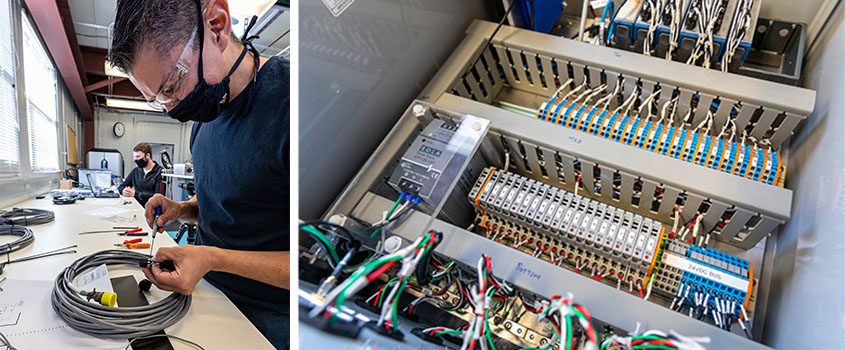
These custom-built MODAQs are in high demand, too, which is why Nichols recently found himself on a beach in Hawaii—arguably one of the best places to collect marine energy data. The state’s waves carry the equivalent of 25 times its energy needs. Harnessing just a portion of that clean energy could help offset the high costs of shipping crude oil to the islands.
And one research team at the University of Hawaii is aiming to do just that. With their custom MODAQ, the researchers are refining a small-scale version of their wave energy prototype, the Hawaiʻi Wave Surge Energy Converter (HAWSEC, for short), which could someday power Hawaii’s coastal communities. The team’s MODAQ enabled them to collect reliable data at the lab bench, in wave tank tests at Oregon State University, and in an open water field test at Hawaii’s Makai Research Pier. “We basically built one hardware system for three device deployments, which we’ve never done before,” Simms said.
“We spent a lot of time making MODAQ safe and reliable to use in the wave tank area and on the beach,” Nichols added. “Saltwater environments are harsh on many materials, so we designed the system to live through all that.”
So far, the Hawaii team’s MODAQ data has closely matched models generated with NREL’s Wave Energy Converter Simulator (also known as WEC-Sim)—a sign that WEC-Sim’s theoretical models provide realistic results. “The simulation and experimental data were very close, which was exciting to see,” Nichols said. That’s exciting for the HAWSEC team, too, which can confidently rely on all that sound data to build a larger prototype for their next wave tank tests.
For the HAWSEC team and other marine energy developers, MODAQ systems provide accurate, reliable, and standardized data to assess their devices’ performance so they can avoid building their own data collection systems from scratch (often at great expense). Because the MODAQ team is continually improving their system, developers can start with a solid foundation and simply add components to evaluate the unique features of their device.
“Marine energy technology developers are basically trying do something entirely new in one of the harshest environments on earth,” Simms said. “Data is one of the best tools we have to improve the reliability and reduce the cost of marine energy industry deployments.”
In the next couple of years, Nichols, Simms, and the rest of NREL’s MODAQ team are developing MODAQ 2.0, an even more accessible and cost-effective version of the system. But for now, Nichols is excited to see more developers use MODAQ 1.0 during device deployments.
“There are so many uses for this technology,” Nichols said, “and I’m very excited to see where it will go.”



Related News.
Intelligent Skies, Secure Seas: Navigating Connectivity, Cyber Resilience, and AI Liability at the 5th CSN Greece ICT Conference
The 5th CSN Greece ICT Conference, held on 19th November 2026 at the Ploes Floating Venue in Paleo Faliro, Athens, successfully convened maritime…

EU moves to ban tankers insured in Russia, repair services at Russian refineries
EU targets Russian-insured tankers, refineries Von der Leyen announces 22nd sanctions package All 27 member states must approve new…
IMO tackling fraudulent registries together
Strong national systems and international information sharing are crucial to tackling fraudulent registries and fraudulent ship registration…
Open letter on freedom of navigation and the protection of seafarers
Dear High Representative Kallas, Dear Foreign Affairs Ministers, European Shipowners | ECSA, BIMCO, the Cruise Lines International Association…
Davies Turner warns of Rising Asia-UK Container Disruption and European Port Congestion
Davies Turner, one of the UK’s largest independent freight forwarding and logistics companies, says that disruption to container shipments from Asia…
Disruptions still dominate tanker market outlook
"This year, tanker markets have been affected by disruption to transits through the Strait of Hormuz, the Houthi blockade of Saudi Arabian Red Sea…
Panama’s President called on to match COP31 Heroism with action at shipping climate talks
As a series of crucial meetings tasked with cutting greenhouse gas emissions from global shipping takes place this week and next, environmental NGOs…

Trafigura appoints Helio Cumbi as Executive Director, Mozambique
Trafigura has appointed Helio Cumbi as Executive Director, Mozambique, and Business Development Lead for East and Southern Africa Oil. Helio is a…

“K” LINE holds FY2026 Global Dry Bulk Meeting
Kawasaki Kisen Kaisha, announces that it held a global meeting for its dry bulk business at the company’s head office on November 9 and 10. The…
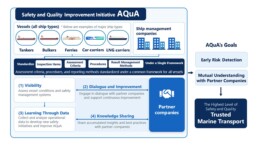
MOL launches ‘AQuA’ safety and quality improvement initiative
Standardizing Group-wide Safety and Quality Assessment Criteria to Enhance Vessel Safety and Quality Mitsui O.S.K. Lines, announced the launch of…
Subscribe to our newsletter!
if you dont want to swim alone in the ocean of news, sign up for the newsletter, and you will receive daily all the important news of world shipping!
