Aviation decarbonisation aims underpinned by satellite communications, new report finds
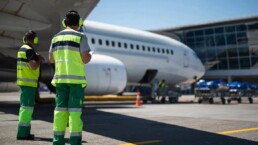

‘Plotting the route to a greener future’ report examines how satcom-enabled technologies can reduce the aviation industry’s emissions now, while new fuels, technologies developed for longer-term goals
The aviation industry is exploring a number of longer-term solutions to meet its commitment for net zero emissions by 2050, including a transition from fossil fuels. However, a new whitepaper by Inmarsat and award-winning aviation journalist Elan Head highlights that the number of practical, immediately-viable options is limited to only two: either simply reduce flying or optimise the efficiency of flight operations.
The 2050 decarbonisation target was outlined by the International Air Transport Association (IATA) last year and reinforced during its recent 2022 Annual General Meeting in Qatar, where governments were asked to support a move from commitment to action. However, aviation has long been recognised as a challenging sector to decarbonise due to the lack of suitable alternatives for fossil fuel in the market. Sustainable Aviation Fuels (SAF), hydrogen and batteries all hold promise for achieving deeper emission reductions in the long-term, but will not be available at the required scale in the near- or medium-term.
IATA predicts that 1.8 gigatons of carbon will need to be mitigated given the aviation industry’s projected scale in 2050, which requires trillions of dollars in investments across the value chain. Inmarsat’s latest report, ‘Plotting the route to a greener future’, explores the important role that connectivity can play in boosting the efficiency of individual flight operations and the wider air traffic system as a whole. The findings confirm that airlines can leverage satellite communications to maximise fuel-saving opportunities and cut emissions almost immediately, while laying the groundwork for future decarbonisation.
Niels Steenstrup, Deputy President of Inmarsat Aviation, said: “The aviation industry has long been focused on sustainability and its commitment to achieve net zero emissions by 2050 should be applauded. There is also a clear understanding that action cannot be limited to the long-term, as advancements in sustainable fuel technologies and avionics will take time to evolve. Therefore, it is vital that the industry explores measures that are readily available today, such as utilising the power of satellite connectivity to optimise flight operations. As a key partner of the aviation industry, Inmarsat is pioneering a range of new innovations that support decarbonisation, including our Iris programme to modernise air traffic management, leading to a range of fuel, CO2 and congestion-saving benefits. This is a prime example of how we can use technology at our disposal today to make a better tomorrow.”
The research paper argues that utilising satellite communication technology for operational and infrastructure gains may seem like small measures, but the need for airlines and the wider industry to commit to such initiatives is integral to meeting the 2050 net zero emissions target. Not only is satellite connectivity vital for the long-term success of an industry under pressure to reduce its CO2 output, it can also be implemented in a much faster timeframe than advancements in airframe and engine technologies.
Inmarsat’s Iris programme delivers high-bandwidth, cost-effective satellite-based data link communications across Europe. This ground-breaking air traffic management programme, with the European Space Agency (ESA), is a key component of modernising and digitalising the aviation industry. Powered by SB-S, Inmarsat’s award-winning broadband platform for the cockpit, Iris uses secure IP connectivity to relieve pressure on congested VHF radio links, which are near capacity. This supports the Single European Skies ATM Research (SESAR) masterplan for next-generation air traffic management and creates a number of power benefits for airlines and Air Navigation Service Providers (ANSPs) across Europe, such as minimising flight delays, saving fuel and reducing the environment impact of air travel.
Wider findings of the report include demonstrating that air traffic management modernisation has the potential to influence roughly 10% of European aviation emissions, and how the provision of winds uplink to all flights could result in annual global fuel savings of around 850 million litres – and two million tonnes in CO2 emissions. In addition, the whitepaper explores how creative future innovations such as contrail avoidance and formation flying could also be key to driving aviation’s decarbonisation.
Inmarsat’s ‘Plotting the route to a greener future’ whitepaper can be downloaded here.



Related News.
Intelligent Skies, Secure Seas: Navigating Connectivity, Cyber Resilience, and AI Liability at the 5th CSN Greece ICT Conference
The 5th CSN Greece ICT Conference, held on 19th November 2026 at the Ploes Floating Venue in Paleo Faliro, Athens, successfully convened maritime…

EU moves to ban tankers insured in Russia, repair services at Russian refineries
EU targets Russian-insured tankers, refineries Von der Leyen announces 22nd sanctions package All 27 member states must approve new…
IMO tackling fraudulent registries together
Strong national systems and international information sharing are crucial to tackling fraudulent registries and fraudulent ship registration…
Open letter on freedom of navigation and the protection of seafarers
Dear High Representative Kallas, Dear Foreign Affairs Ministers, European Shipowners | ECSA, BIMCO, the Cruise Lines International Association…

Davies Turner warns of Rising Asia-UK Container Disruption and European Port Congestion
Davies Turner, one of the UK’s largest independent freight forwarding and logistics companies, says that disruption to container shipments from Asia…

Disruptions still dominate tanker market outlook
"This year, tanker markets have been affected by disruption to transits through the Strait of Hormuz, the Houthi blockade of Saudi Arabian Red Sea…
Panama’s President called on to match COP31 Heroism with action at shipping climate talks
As a series of crucial meetings tasked with cutting greenhouse gas emissions from global shipping takes place this week and next, environmental NGOs…

Trafigura appoints Helio Cumbi as Executive Director, Mozambique
Trafigura has appointed Helio Cumbi as Executive Director, Mozambique, and Business Development Lead for East and Southern Africa Oil. Helio is a…

“K” LINE holds FY2026 Global Dry Bulk Meeting
Kawasaki Kisen Kaisha, announces that it held a global meeting for its dry bulk business at the company’s head office on November 9 and 10. The…
MOL launches ‘AQuA’ safety and quality improvement initiative
Standardizing Group-wide Safety and Quality Assessment Criteria to Enhance Vessel Safety and Quality Mitsui O.S.K. Lines, announced the launch of…
Subscribe to our newsletter!
if you dont want to swim alone in the ocean of news, sign up for the newsletter, and you will receive daily all the important news of world shipping!
