InconsistENCy, inconveniENCe, inefficiENCy, let’s bring ENCs ashore says Paul Elgar NAVTOR ‘s OEM Business Relations
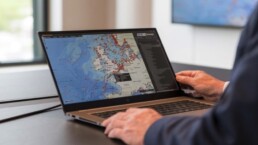

Paul Elgar, OEM Business Relations, NAVTOR believes it’s “time to end the ENC madness”. Why, heasks, isn’t there a seamless, commercially viable way of utilizing the same charts in the offices of shipping companies as fleets use at sea? If we’re going to plan a sustainable, safe and profitable way forward for the industry surely we all need to follow the same route?
Imagine you’re a shipowner, operator or fleet manager.
Maybe you already are.
You have 30 vessels plying competitive routes on the seven seas and want to ensure the optimal safety, efficiency, profitability and operational success for each and every one of them. As a forward-thinking business you’ve invested in digital solutions to create a ‘joined-up’ organization, whereby you can share data, optimize performance and, wherever possible, enhance decision making.
Your ships, being SOLAS vessels, use official ENC on their ECDIS systems as mandated. So, you think, maybe your shore-side teams should utilize the same charts to ensure seamless understanding and enable better in-office planning for at sea operations.
That makes perfect sense, so it must be pretty simple to do, right?
Unfortunately, you could not be more wrong.
Out of step
After over 20 years of hard work, the maritime community succeeded in transitioning the world fleet from paper charts into the 21st century with ENCs.
The IMO ECDIS Mandate ran from 2012 to 2018 and heralded a new age of efficiency, safety and simplicity for crews worldwide.
But shoreside operations have been left woefully out of step with developments. And, largely speaking, it’s due to an approach to pricing that pushes the boundaries of sanity.
To illustrate, consider what my company NAVTOR (the industry’s largest ENC distributor) has to quote a client ringing up to ask about land-based ENC access.
The same customer using ECDIS systems together with our NavStation software at sea might pay an average of say USD 5000 for worldwide Pay-As-You Sail (PAYS) ENC licenses for a single vessel. This solution allows them to use only the charts they need for sailing, with free access to all charts for planning purposes. It is simple, cost effective and seamless (with immediate access to the latest charts).
Now, we step ashore. Here, our valued customer asks us for the same portfolio of charts in the office of the shipowner/manager, with access for five separate users. Obviously, we can’t charge on a PAYS basis, as the office isn’t setting sail, so there has to be a standard fee. Which is… wait for it… USD 250,000 a year.
There’s no typo here, it’s 250k per annum. Why? Because the Hydrographic Offices that issue the ENCs do not differentiate pricing between vessels and offices, so it’s a one-price fits all (or not, in this case).
By this point, of course, the phone line is dead.
Don’t Google it
ENCs are essential for optimal on-shore planning purposes and fleet operations, but prohibitive pricing makes this common sense approach insanely expensive. Software developers eager to access them to provide breakthrough solutions for an industry committed to a sustainable transition also need them – for applications such as vessel tracking, situational awareness, route planning, emergency response, and more – but face exactly the same problems. This is a major barrier to progress.
And on that point, what happens when it comes to autonomous shipping – often touted as the future of sustainable, hyper-efficient maritime operations? How do you operate these ships without official charts in the control rooms? Surely the IMO and IHO don’t want businesses to resort to unofficial databases?
Because, stepping back from the future to the present day, that’s what the majority are doing now. In fact, we’ve heard of many frustrated owners and operators resorting to Google Maps to monitor voyages, plan, and even coordinate emergency response activity.
Is this really the best way forward for an industry that, quite literally, keeps the global economy in motion?
Evolving demands
We have to realize that maritime is changing, and yesterday’s approaches are no longer sufficient for today’s, and tomorrow’s, operations. In a connected world, planning is increasingly conducted onshore and then transferred to vessels via secure communications, so onshore ENCs are essential.
NAVTOR urges the Hydrographic Office community, led by the IHO, to recognize that ENC is not just for SOLAS vessel navigation, and to work with the commercial maritime industry to allow ENC to be used in many different applications, in many different scenarios, and at acceptable prices. This can only be for the benefit of everyone.
Hydrographic Offices would see their revenues increase significantly, distributors like NAVTOR would be able to service the entire maritime community with ENC, and finally, it would increase safety and efficiency… for everyone.
Surely that’s the route we all want to chart for the future of this industry?
So, let’s make a differENCe, together.



Related News.

Navigating the Multi-Orbit Era: In Conversation with Intellian’s Jon Harrison at SMM 2026
At SMM 2026 in Hamburg, the rapid evolution of maritime satellite communications took centre stage. Across the exhibition halls, discussions among…
Cyprus ports need joint energy and investment strategy, shipping agents chief says
Cyprus needs a coordinated strategy for shipping, energy and environmental protection to support port investment and modernisation, Cyprus shipping…

MASO Public Affairs introduces MASO Regulatory Intelligence
A new subscription service helping businesses understand what is changing and what it means for them MASO Public Affairs introduces MASO Regulatory…
Anglo-Eastern helps turn CMBTECH’s ammonia ambition into an operational reality
From early feasibility study and risk-based design to newbuilding supervision, crew readiness and technical management, Anglo-Eastern drew on its…

Escalation of attacks threatens to derail recovery in Middle East oil exports
World oil demand is forecast to fall by 2.5 mb/d y-o-y in 4Q26 and 2.6 mb/d on average in 2026. As the Iran war manifests itself through restricted…
New study finds shipping pays twice its share to EU ETS earmarked revenues should triple to help build market for sustainable fuels and technologies
Shipping is responsible for around 10% of EU ETS emissions but pays almost 20% of the ETS bill. Unlike other sectors, it has never received free…

MSARC strengthens maritime mass rescue readiness through training and national live exercise off Dakar, Senegal
Joint MSARC–FHAS programme combines three days of SAR training with a national multi-agency live exercise The Maritime Search and Rescue Council ,…
Sogese report deliveries are still being delayed as container freight rates fluctuate
FOR IMPORTERS Spot rates into the Mediterranean are back at January levels, Far East to Europe reliability sits at pandemic lows, and nearly…

Glencore begins trading on Australian Securities Exchange
Glencore has begun trading on the Australian Securities Exchange under the ASX code GLC. Gary Nagle, Glencore’s CEO, said it was an exciting day for…
BIMCO Shipping Number of the Week
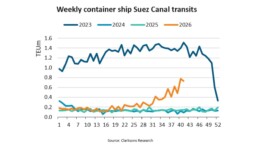
Suez Canal container ship transits exceed 50% of pre-disruption levels "During the first two weeks of October, weekly container ship capacity…
Subscribe to our newsletter!
if you dont want to swim alone in the ocean of news, sign up for the newsletter, and you will receive daily all the important news of world shipping!
