Fleet safety to modernise maritime distress communication


As the successor to Inmarsat’s industry-leading maritime safety service, Inmarsat C, Fleet Safety will facilitate a more proactive approach to distress communication based on unparalleled performance, advanced functionality, and an intuitive user interface.
Marine safety is part of Inmarsat’s DNA. The company was founded in 1979 by the International Maritime Organization to establish a satellite communications network for protecting the lives of seafarers. With the launch of Inmarsat C in 1991, it became the first satellite operator to meet the stringent requirements of the IMO’s Global Maritime Distress and Safety System – a set of marine safety procedures that Inmarsat helped to define – for ship security alert systems .
To this day, Inmarsat C forms the backbone of the GMDSS. With over 100,000 terminals at sea, it has been safeguarding the lives of mariners for over 30 years. However, like safety, innovation is central to Inmarsat’s identity, and the company has also spearheaded steps to bring distress communication services into the digital era of shipping.
Marking a turning point for the way satellite communications ensure the preservation of life at sea, Inmarsat’s forthcoming maritime safety service, Fleet Safety, will offer unmatched speed and reliability, advanced functionality, and an intuitive user interface.
Since there can be no shortcuts in developing a solution dedicated to the protection of seafarers, Fleet Safety has been several years in the making. Planning began in 2015, and the IMO granted GMDSS approval in 2018. With its launch now imminent, Fleet Safety has passed initial sea trials and is in the process of securing wheelmark certification.
The solution will be delivered via a combination of a Maritime Safety Terminal and existing FleetBroadband or Fleet One data services, with the supporting satellite connectivity providing high speeds, global coverage, and 99.9% global network availability.
In addition, Fleet Safety’s new user interface will optimise usability, making it easier for seafarers to navigate the system, access critical functionality, and communicate with maritime rescue coordination centres (MRCCs) in an emergency. A network of over 50 global MRCCs will be available to contact, by voice or instant messaging, at the touch of a button.
Alongside the updated design and improved accessibility, two value-added features will set Fleet Safety apart from existing SSASs: an innovative Maritime Safety Information (MSI) interface and a Distress Chat function.
Fleet Safety’s MSI feature will allow users to clarify and control the stream of MSI broadcasts, which include meteorological, navigational, and search-and-rescue warnings, based on a standardised Inmarsat interface. By defining a specific meteorological or navigational area, users can reduce the volume of incoming broadcasts to ensure they only receive messages that are relevant to their operations. Moreover, broadcasts can be accessed on demand and downloaded even if the terminal is offline.

The Distress Chat capability will enable the creation of chat rooms between ships in distress, assisting vessels, and MRCCs. Users can have several chat rooms open at once to support real-time search-and-rescue planning, coordination, and execution with multiple parties. Confirmation messages, which can take up to four minutes to arrive through a traditional SSAS, are delivered instantly, and rescue authorities can track the stricken vessel’s location in real time.
Given the range of innovative functionality and features available to Fleet Safety users, Inmarsat has invested considerable time and resources in training seafarers to extract the solution’s full potential. More than simply teaching them how the system works, this means educating vessel crew in the importance of a proactive approach to maritime distress communications.
In a precarious situation, notifying rescue authorities early can prove pivotal in saving the ship and, more importantly, the lives of the crew on board. Seafarers will generally do their utmost to rectify an issue before requesting assistance, but Inmarsat is encouraging and – through Fleet Safety – facilitating a culture where vessel personnel report situations they are struggling to manage rather than those already beyond their control.
In the years ahead, the Internet of Things and onboard sensors will elevate proactive maritime safety communications to new levels, allowing any anomalies in vessel machinery or systems to be reported automatically to MRCCs. The technology to support this exists today, and the processes involved can be implemented using relatively simple logic.
Through digitalisation, the shipping industry has the opportunity to simplify and optimise how incidents at sea are communicated and managed. Inmarsat’s Fleet Safety offers the tools for seizing that opportunity and, in doing so, provides a safer working environment for the 1.6 million seafarers who help keep the wheels of global trade in motion.



Related News.

Navigating the Multi-Orbit Era: In Conversation with Intellian’s Jon Harrison at SMM 2026
At SMM 2026 in Hamburg, the rapid evolution of maritime satellite communications took centre stage. Across the exhibition halls, discussions among…
Cyprus ports need joint energy and investment strategy, shipping agents chief says
Cyprus needs a coordinated strategy for shipping, energy and environmental protection to support port investment and modernisation, Cyprus shipping…

MASO Public Affairs introduces MASO Regulatory Intelligence
A new subscription service helping businesses understand what is changing and what it means for them MASO Public Affairs introduces MASO Regulatory…
Anglo-Eastern helps turn CMBTECH’s ammonia ambition into an operational reality
From early feasibility study and risk-based design to newbuilding supervision, crew readiness and technical management, Anglo-Eastern drew on its…

Escalation of attacks threatens to derail recovery in Middle East oil exports
World oil demand is forecast to fall by 2.5 mb/d y-o-y in 4Q26 and 2.6 mb/d on average in 2026. As the Iran war manifests itself through restricted…

New study finds shipping pays twice its share to EU ETS earmarked revenues should triple to help build market for sustainable fuels and technologies
Shipping is responsible for around 10% of EU ETS emissions but pays almost 20% of the ETS bill. Unlike other sectors, it has never received free…

MSARC strengthens maritime mass rescue readiness through training and national live exercise off Dakar, Senegal
Joint MSARC–FHAS programme combines three days of SAR training with a national multi-agency live exercise The Maritime Search and Rescue Council ,…

Sogese report deliveries are still being delayed as container freight rates fluctuate
FOR IMPORTERS Spot rates into the Mediterranean are back at January levels, Far East to Europe reliability sits at pandemic lows, and nearly…

Glencore begins trading on Australian Securities Exchange
Glencore has begun trading on the Australian Securities Exchange under the ASX code GLC. Gary Nagle, Glencore’s CEO, said it was an exciting day for…
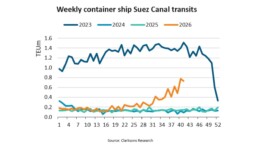
BIMCO Shipping Number of the Week
Suez Canal container ship transits exceed 50% of pre-disruption levels "During the first two weeks of October, weekly container ship capacity…
Subscribe to our newsletter!
if you dont want to swim alone in the ocean of news, sign up for the newsletter, and you will receive daily all the important news of world shipping!
