The future of lower-emission transportation fuels


For 30 years, Russ Green has worked primarily in ExxonMobil’s fuels and lubricants businesses. Today Russ is focused on developing lower-emission fuels for the highest emitting industries. Energy Factor recently spoke with Russ about the future of transportation and innovations he’s working on to help lower emissions.
Energy Factor: Russ, thanks for talking to us about the landscape of lower-emission fuels. Tell us a little bit about your career with the company.
Russ Green: For the majority of my career, I have been a part of our fuels and lubricants businesses. In those businesses I’ve helped develop and deploy products and customer solutions for our leading Exxon, Esso, Mobil, Mobil 1 and Federal brands. I’ve had the great privilege to work with partners like General Motors, Toyota, Porsche, Red Bull Racing in Formula 1, NASCAR and the NBA, as well as our fantastic distributors and branded wholesalers. Throughout my career, I’ve also had the opportunity to engage with our world-class technology and manufacturing teams, who drive our product differentiation and logistical expertise.
EF: Can you talk about what ExxonMobil is doing with lower-emission fuels and what that means for your role amidst the energy transition?
RG: We plan to play a leading role in how the world decarbonizes. We are investing in fuel production with lower emissions, including biofuels and eFuel, which is a synthetic fuel made from hydrogen and captured CO2, carbon dioxide from carbon capture. From our renewable diesel project in Strathcona, Canada, to our investment in Norway’s Biojet AS, a company that turns wood waste into biofuel, we have a number of projects in motion that will one day serve many markets around the world.
Our customers are also looking to reduce their emissions, and we’re partnering with them to deliver lower-emission fuel solutions as we all work to achieve society’s net zero goals. It’s exciting to be part of this effort. Like others I work with in ExxonMobil’s Product Solutions Company and Low Carbon Solutions businesses, I’m applying the expertise we’ve developed over decades of working in traditional fuels along with new thinking to this new world of next generation fuels.
EF: You’ve outlined ExxonMobil’s commitment in providing these solutions. Can you talk about how the company views the transportation sector?
RG: A key focus of ours is to identify some of the highest-emitting sectors of the economy to see how we can apply innovative solutions and products to help decarbonize them.
Today, transportation makes up 23% of the world’s energy-related carbon dioxide emissions. Of that, about 52% comes from heavy transportation, like trucks, planes and ships. So, within the transportation sector, we are looking to develop alternative fuels that lower emissions across the heavy-duty trucking, aviation and shipping industries.
In addition to progressing projects utilizing conventional biofeeds for production, we are also advancing toward the future deployment of scalable technologies to upgrade advanced biofeeds, such as forestry residues, or renewable liquids produced from hydrogen and carbon dioxide, into transportation fuels. It’s our desire to be a leader and we are focused on delivering the fuels that our customers desire across all transportation sectors.
If you look at the “Advancing Climate Solutions” report, you’ll see the commitment from the company. For example, we are planning to produce more than 40,000 barrels per day of lower-emission fuels by 2025 – and then approximately 200,000 barrels per day by 2030. Achieving those goals would help the world reduce more than 25 million metric tons of greenhouse gas emissions.
EF: That’s an impressive macro look at the work being done and how it could apply to the world of transportation; can you talk specifics on what’s in the works?
RG: Absolutely – let’s look at aviation and the work we’re doing within that industry. When most people consider emissions from transportation, they look to the road. But, when you think about the air, there’s no practical way we can fly on electric planes today due to a whole host of reasons. And prototype hydrogen-fueled planes have some large technical challenges to overcome.
So, in order to reduce emissions quickly, the world will need to significantly increase the production of sustainable aviation fuel, or SAF, at multiple locations around the globe.
EF: What is sustainable aviation fuel?
RG: When we talk about sustainable fuel, in general, we’re really looking at how we refine sustainable feeds into fuels. Specifically, we’re looking at making fuels from different feedstocks like vegetable oils, used cooking oils and forestry residues, among other renewable sources. These biofuels will play an important part in a lower-emission future and are a key area of our strategy.
In the aviation world, we’re working closely with our airline customers to help ensure that SAF products, which are subject to strict quality regulations, are “engine ready” fuels that can be used in today’s existing fleet. This means that they can be integrated easily into the current infrastructure that supports the aviation sector.
EF: That sounds like no small feat but certainly an important challenge to solve. How do you see ExxonMobil progressing this?
RG: We have the strategy and industry-leading capabilities needed to succeed. Today, through our expertise in the supply and distribution of jet fuel, we are working with third parties to deliver SAF to customers in France, Singapore and the U.K. to meet near-term needs. Over time, we expect to produce SAF in multiple locations around the world to more fully meet our customers’ sustainable fuel needs.
As employees, we keep talking about how this is the right place to contribute to the energy transition because there are ongoing technical and market challenges that need continued innovation to scale up our production of lower-emission fuels.
EF: Sounds like exciting times ahead, for sure. Thanks for your time, Russ.
RG: My pleasure. We have great people who are ready to make it happen!
Source: Energy Factor/ExxonMobil



Related News.

Navigating the Multi-Orbit Era: In Conversation with Intellian’s Jon Harrison at SMM 2026
At SMM 2026 in Hamburg, the rapid evolution of maritime satellite communications took centre stage. Across the exhibition halls, discussions among…
Cyprus ports need joint energy and investment strategy, shipping agents chief says
Cyprus needs a coordinated strategy for shipping, energy and environmental protection to support port investment and modernisation, Cyprus shipping…

MASO Public Affairs introduces MASO Regulatory Intelligence
A new subscription service helping businesses understand what is changing and what it means for them MASO Public Affairs introduces MASO Regulatory…
Anglo-Eastern helps turn CMBTECH’s ammonia ambition into an operational reality
From early feasibility study and risk-based design to newbuilding supervision, crew readiness and technical management, Anglo-Eastern drew on its…

Escalation of attacks threatens to derail recovery in Middle East oil exports
World oil demand is forecast to fall by 2.5 mb/d y-o-y in 4Q26 and 2.6 mb/d on average in 2026. As the Iran war manifests itself through restricted…

New study finds shipping pays twice its share to EU ETS earmarked revenues should triple to help build market for sustainable fuels and technologies
Shipping is responsible for around 10% of EU ETS emissions but pays almost 20% of the ETS bill. Unlike other sectors, it has never received free…

MSARC strengthens maritime mass rescue readiness through training and national live exercise off Dakar, Senegal
Joint MSARC–FHAS programme combines three days of SAR training with a national multi-agency live exercise The Maritime Search and Rescue Council ,…
Sogese report deliveries are still being delayed as container freight rates fluctuate
FOR IMPORTERS Spot rates into the Mediterranean are back at January levels, Far East to Europe reliability sits at pandemic lows, and nearly…

Glencore begins trading on Australian Securities Exchange
Glencore has begun trading on the Australian Securities Exchange under the ASX code GLC. Gary Nagle, Glencore’s CEO, said it was an exciting day for…
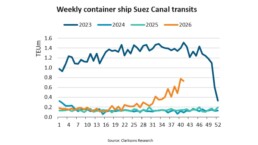
BIMCO Shipping Number of the Week
Suez Canal container ship transits exceed 50% of pre-disruption levels "During the first two weeks of October, weekly container ship capacity…
Subscribe to our newsletter!
if you dont want to swim alone in the ocean of news, sign up for the newsletter, and you will receive daily all the important news of world shipping!
