New Conceptual Designs for LNG-fueled and Battery-Powered Energy-Saving Bulk Carriers
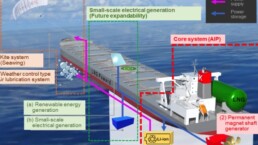

~Approvals in Principle (AIP) Obtained from ClassNK~
Kawasaki Kisen Kaisha, jointly developed two conceptual designs for LNG-fueled and battery-powered energy-saving bulk carriers and obtained Approvals in Principle from Japan’s ship classification society Nippon Kaiji Kyokai . “K” LINE developed a conceptual design for 200,000 ton class capesize bulk carrier in collaboration with Namura Shipbuilding and Taiyo Electric . The other design was jointly created by “K” LINE, Shin Kurushima Sanoyas Shipbuilding , and Taiyo Electric for 90,000 ton class post-Panamax bulk carrier.
By selecting low-carbon LNG as the primary fuel source, an energy-saving vessel has been designed that helps reduce greenhouse gas emissions. The design was further enhanced by adopting permanent magnet (PM) shaft generator (Note 2) technology, along with lithium-ion batteries, which are already being used in a wide range of fields in the society. Moreover, by utilizing batteries as part of the platform for power supply on board, the aim is to further reduce emissions going forward by later adding green energy sources with energy-saving technology.
[AIP technical features and their benefits]
- Utilizing LNG fuel
- Reduction of greenhouse gas emissions by 25% to 30% compared to the use of conventional heavy fuel oil.
- Adoption of shaft generator technology
- By producing electricity with shaft generator technology, fuel efficiency is improved compared to power generation with a conventional dual fuel generator. (By using shaft generator and battery technologies, an emissions reduction of about 2.5% to 3.0% is expected, compared to an LNG-powered vessel without those two technologies.)
- By eliminating the need to operate generators during voyages, the maintenance workload for the ship’s crew will be significantly reduced along with the associated maintenance costs.
- By adopting PM shaft generators, efficiency is improved by about 10% compared to conventional shaft generators.
- Battery technology adoption
- Small-capacity batteries (reducing emissions during voyages)
Small-capacity batteries with excellent charge and discharge rates will be used for auxiliary power during peak hours of onboard demand. They will also be utilized to store surplus electricity.
- Large-capacity batteries (reducing emissions during cargo handling)
In the new post-Panamax carrier design, emissions will be reduced by using large-capacity batteries instead of a dual fuel generator during cargo loading and unloading. (The number of dual fuel generators installed can be reduced by one.)
In the new capesize carrier design, the battery capacity will be greater due to amount of power required during cargo handling. Here emissions during cargo handling will also be reduced by enabling vessel connection to shore power
Last November, “K” LINE partially revised its Environmental Vision 2050 and decided to take on the challenge of achieving net-zero greenhouse gas emissions. “K” LINE views this challenge as one of the concrete initiatives that will help achieve its vision by 2050.
While public attention to the greenhouse gas emissions including from shipping is becoming increasing, “K” LINE will actively work to reduce environmental impact by researching, developing, and introducing ships with excellent environmental performance to achieve our goal set on “K” LINE Environmental Vision 2050 .



Related News.

Greece has the most to lose from delays in shipping’s green transition, new analysis finds
UCL and WWF Greece report finds the IMO Net-Zero Framework offers Greek ship owners the clarity they need, and the best protection against a…

Snow Land joins Cool Carriers as the world’s first reefer with a gate rudder, a new chapter for sustainable and efficient reefer shipping
Cool Carriers, the world’s largest operator of specialised reefer vessels, took delivery of Snow Land from Kitanihon Shipbuilding in Japan on 12…

IBIA launches Marine Energy Outlook Survey as Annual Convention in New York
IBIA - The International Bunker Industry Association officially launched its Marine Energy Outlook Survey during the IBIA Annual Convention in New…

Why did ITF staff vote to strike again?
Staff at the International Transport Workers’ Federation (ITF) headquarters in London have voted to give their union a strike mandate. According to…

Nearly half of maritime crew tickets booked a week ahead are cancelled
Two new C Teleport reports show when maritime and aircrew teams book crew flights, how often they cancel, and what late booking costs, with a…

Kpler completes $1.5bn+ Sixth Street investment and continues accelerating growth
Investment backs Kpler's bold ambition to shape the future of global trade intelligence. Kpler, a leading provider of global physical trade…

How SAL and DNV are strengthening heavy-lift shipping
From classification and newbuilding support to operational tools and advisory expertise, SAL and DNV have been collaborating for decades. The…

PSA Singapore breaks ground on Tuas Port Phase Two to strengthen Global Trade Connectivity
PSA Singapore marked the groundbreaking of Tuas Port Phase Two, a significant step in the development of the world’s largest fully automated…

 …

BIFA welcomes UK–EU trade progress and calls for clarity on implementation
The British International Freight Association (BIFA) has welcomed progress made at today's UK–EU Summit in Brussels, highlighting the potential…
Subscribe to our newsletter!
if you dont want to swim alone in the ocean of news, sign up for the newsletter, and you will receive daily all the important news of world shipping!
