
- Converting renewable electricity into hydrogen and e-methane to foster the development of low-carbon solutions.
- Sharing expertise and R&D to facilitate the development of energy sources of the future.
- Lessons learned from Jupiter 1000 should open the way for the large-scale production of low-carbon e-methane for the CMA CGM Group’s ships.
The CMA CGM Group, a global leader in sea, land, air and logistics solutions, is joining the partners of the Jupiter 1000 industrial demonstrator project piloted by GRTgaz in Fos-sur-Mer. This innovative installation aims to produce green hydrogen from renewable power and also e-methane, a synthetic gas using this hydrogen and CO2 captured from the industrial process. Through its participation in the project, CMA CGM aims to further accelerate the pace of its fleet’s transition to new very low-carbon fuel sources.
Jupiter 1000: a key challenge for the development of low-carbon solutions
With Jupiter 1000, GRTgaz intends to provide solutions to the challenge of decarbonizing gas networks and the intermittent nature of renewable energies. The idea is to convert a portion of renewable power, at times when it is abundant, into low-carbon energy (hydrogen and e-methane) so it can be stored on a large scale and for lengthy periods.
Following a study phase, plus the award of administrative, then building permits, the first electrolyzer (producing hydrogen from water and renewable power) injected hydrogen into GRTgaz’s gas transmission network in February 2020. A second electrolyzer, employing a different technology from the previous one, successfully entered service at the beginning of November 2021.
Beyond producing hydrogen, Jupiter 1000 also recycles CO2 by converting it into synthetic gas. The CO2 produced by the boiler at Asco Industrie, a steelmaking plant located nearby, is captured at the foot of the chimney stack by equipment developed by Leroux&Lotz. The CO2 is then piped to the Jupiter 1000 site. Rather than being discharged into the atmosphere, the CO2 is recycled with hydrogen in a methanation unit installed by Khimod. The syngas produced can be used instead of fossil fuel gas and employed freely across all transport and distribution networks. The hydrogen methanation facilities are due to be commissioned in June 2022.
A project with global reach integrated with the local ecosystem and built on expertise sharing
The Jupiter 1000 demonstrator project, which is perfectly integrated with the local ecosystem, benefits from the expertise of several partners. Compagnie Nationale du Rhône generates the renewable power, RTE handles the power transmission, McPhy supplies the electrolyzers, Leroux&Lotz captures and stores the CO2, Khimod handles the methanation process, CEA-Liten is piloting the trials, GRTgaz and Teréga supply the green gas to the conventional gas network and the Port of Marseille houses the project. CMA CGM will bring to the Jupiter 1000 project its expertise in shipping and logistics, as well as guidance and fresh insights from its perspective on customer needs.
Jupiter 1000 is a project that has regularly attracted visits from international delegations since it was commissioned (Netherlands, Germany, Spain, Quebec, California, etc.).
A key milestone in efforts to find alternatives to hydrocarbons
The CMA CGM Group is committed to the energy transition and has set itself the goal of Net zero carbon emissions by 2050. In pursuit of this goal, the Group is focusing on low-carbon fuels to power its ships. By providing access to the results of its green hydrogen production, methanation and CO2 capture, Jupiter 1000 will enable CMA CGM to accelerate development of the production sector for synthetic methane, a key fuel for the decarbonization of its operations.
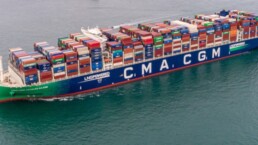
CMA CGM already has 28 “e-methane ready” dual-fuel, LNG-powered containerships and will have a total of 44 vessels of this type in service by the end of 2024. Liquefied Natural Gas (LNG) reduces sulfur oxide emissions by 99%, fine particle emissions by 91% and nitrogen oxide emissions by 92%. That makes a significant contribution to improve air quality. Thanks to the dual-fuel gas-powered technology developed by CMA CGM, which currently runs on LNG, bioLNG and synthetic methane can already be used by its ships.
Christine Cabau Woehrel, Executive Vice-President of the CMA CGM Group, in charge of Industrial Assets and Operations, commented:
“The Jupiter 1000 project is of great interest to the CMA CGM Group as part of our efforts to find very low-carbon new fuel sources. To help us meet our Net zero target by 2050, we are resolutely committed to searching for and industrializing innovative non-fossil fuel gas solutions, with biomethane and synthetic methane. The Jupiter 1000 project will give us access to one of the first demonstrator projects of the kind. Moreover, it is located at Fos-sur-Mer, where we recently completed our first LNG bunkering operations. We intend to support the potential emergence of a whole new industry.”
Thierry Trouvé, Chief Executive Officer of GRTgaz, added:
“I’m delighted the Jupiter 1000 consortium is bringing in new expertise. The interest shown by the likes of CMA CGM, a world leader in shipping and logistics, represents a major endorsement of the renewable and low-carbon gas industry’s credibility and of its efforts to rise to the challenges posed by the energy transition. CMA CGM, which has a clear vision for the future of the shipping industry, will help us to scale up the industrial performance of the technologies we are trialing.



Related News.

Greece has the most to lose from delays in shipping’s green transition, new analysis finds
UCL and WWF Greece report finds the IMO Net-Zero Framework offers Greek ship owners the clarity they need, and the best protection against a…

Snow Land joins Cool Carriers as the world’s first reefer with a gate rudder, a new chapter for sustainable and efficient reefer shipping
Cool Carriers, the world’s largest operator of specialised reefer vessels, took delivery of Snow Land from Kitanihon Shipbuilding in Japan on 12…

IBIA launches Marine Energy Outlook Survey as Annual Convention in New York
IBIA - The International Bunker Industry Association officially launched its Marine Energy Outlook Survey during the IBIA Annual Convention in New…

Why did ITF staff vote to strike again?
Staff at the International Transport Workers’ Federation (ITF) headquarters in London have voted to give their union a strike mandate. According to…

Nearly half of maritime crew tickets booked a week ahead are cancelled
Two new C Teleport reports show when maritime and aircrew teams book crew flights, how often they cancel, and what late booking costs, with a…

Kpler completes $1.5bn+ Sixth Street investment and continues accelerating growth
Investment backs Kpler's bold ambition to shape the future of global trade intelligence. Kpler, a leading provider of global physical trade…

How SAL and DNV are strengthening heavy-lift shipping
From classification and newbuilding support to operational tools and advisory expertise, SAL and DNV have been collaborating for decades. The…

PSA Singapore breaks ground on Tuas Port Phase Two to strengthen Global Trade Connectivity
PSA Singapore marked the groundbreaking of Tuas Port Phase Two, a significant step in the development of the world’s largest fully automated…

 …

BIFA welcomes UK–EU trade progress and calls for clarity on implementation
The British International Freight Association (BIFA) has welcomed progress made at today's UK–EU Summit in Brussels, highlighting the potential…
Subscribe to our newsletter!
if you dont want to swim alone in the ocean of news, sign up for the newsletter, and you will receive daily all the important news of world shipping!
