How we got to a 2-Tier Due Diligence World

The U.S. Office of Foreign Assets Control offered guidance on “deceptive shipping practices” in May 2020 – advising shipping companies, traders, banks, etc. to review counterparties for how they operate their vessels. This included screening for ship-to-ship transfers, “dark activity” and other factors.
Despite the guidance, many shipping companies and other players in the maritime ecosystem didn’t feel the urgency to implement OFAC’s recommended measures, until Russia’s invasion of Ukraine fundamentally changed the shipping and maritime worlds (and many other spheres)…
From a trade restrictions/sanctions perspective, a new framework for judging business decisions has quickly emerged.
Environmental, Social, and Governance (ESG) programs have immediately been boosted. The question is no longer what is merely “legal” – consumers, investors, partners and industry insiders care deeply about what’s moral and wise, taking into account reputational and stakeholder management considerations. In this murky environment, you could find your organization splashed across leading news websites or featured by popular social media accounts for doing business that is completely legal.
The same goes for running a trading operation – it seems like that on top of the changing prices, credit crunch and self-sanctioning of banks – CFOs, general counsel and COOs now have additional worries while attempting to do business.
A two-tier business world is emerging – those who will do business with Russia and Russia-affiliated entities, and those who will not. Temptation is high – shipowners and charterers report they are being offered 8-10 times the market rate just for lifting crude oil from Russia!
The Problem with Separate Counterparty Due Diligence
Shipping has always used complex corporate structures, making it more difficult for shipping companies to understand who they are doing business with. But in this current climate, shipping companies and other maritime ecosystem players will not be allowed to plead ignorance. They will be expected to know exactly who they are doing business with, despite the complexities involved, and this includes a drill-down to counterparties on the periphery. This means counterparty entities such as factories, ports, refineries, mines, trucking companies, etc., as well as the key employees of these organizations.
In the banking space, it has been the norm for years to have two sets of systems in place – a shipping data and compliance system, and a separate counterparty due diligence platform that is central to operations, but requires expensive, customized IT platforms. In addition to being costly and time-consuming (training, manual work, support, etc.), such an arrangement does not promote holistic, seamless or comprehensive processes and outcomes, a lesson that has been learned by many in the shipping world recently.
Teaming with LexisNexis Risk Solutions to Fill the Void
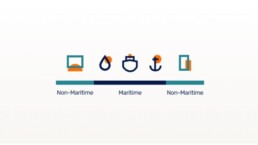
In the last few months, our clients and users – as well as practically everyone in shipping and trading – have been under tremendous pressure to up their game very quickly on everything related to counterparty due diligence. Listening to their challenges and requirements, we have built crucial and complementary due diligence capabilities into our market-leading AI maritime platform. By utilizing LexisNexis Risk Solutions’ best-in-class data, our Counterparty Due Diligence (CDD) capability provides Windward’s customers with a screening feature that enables them to go beyond the maritime ecosystem and screen all companies and individuals, both non-maritime and maritime. It will empower our users with a one-stop-shop, enabling them to:
- Possess an integrated search capability – merging Windward’s proprietary ownership and vessel databases with LexisNexis Risk Solutions’ global database. So when users search for a person or a company, they’ll receive a single list, instead of running two searches constantly and then having to manage the delta
- Screen any person or company in the world for adverse media coverage and politically-exposed persons or entities (PEPs), and utilize watchlists. This expands Windward’s pool of screenable entities by two orders of magnitude
- Case manage, investigate and save audit reports
- Set up repeating watch lists to ensure on an ongoing basis that counterparties are not implicated in immoral or illegal behavior
This new counterparty due diligence capability offers additional user benefits – no need to work with two vendors, use two UXs, set up complex standard operating procedures (SOPs) or resolve different outputs from platforms. Windward customers can utilize a holistic and convenient platform that provides a single source of truth on the world’s constantly evolving due diligence requirements for shipping.
At the beginning of the Russia-Ukraine war, Windward offered organizations access to our platform for a period of two weeks. We discovered that a large segment of the shipping and trading ecosystem has remained underserved in everything related to due diligence and compliance. We believe that our new capability is another important step towards supporting the shipping companies, traders and other key players in the maritime ecosystem to trade with confidence.
Source: Windward by Ami Daniel, Windward’s Co-Founder & CEO



Related News.

Greece has the most to lose from delays in shipping’s green transition, new analysis finds
UCL and WWF Greece report finds the IMO Net-Zero Framework offers Greek ship owners the clarity they need, and the best protection against a…

Snow Land joins Cool Carriers as the world’s first reefer with a gate rudder, a new chapter for sustainable and efficient reefer shipping
Cool Carriers, the world’s largest operator of specialised reefer vessels, took delivery of Snow Land from Kitanihon Shipbuilding in Japan on 12…

IBIA launches Marine Energy Outlook Survey as Annual Convention in New York
IBIA - The International Bunker Industry Association officially launched its Marine Energy Outlook Survey during the IBIA Annual Convention in New…

Why did ITF staff vote to strike again?
Staff at the International Transport Workers’ Federation (ITF) headquarters in London have voted to give their union a strike mandate. According to…

Nearly half of maritime crew tickets booked a week ahead are cancelled
Two new C Teleport reports show when maritime and aircrew teams book crew flights, how often they cancel, and what late booking costs, with a…

Kpler completes $1.5bn+ Sixth Street investment and continues accelerating growth
Investment backs Kpler's bold ambition to shape the future of global trade intelligence. Kpler, a leading provider of global physical trade…

How SAL and DNV are strengthening heavy-lift shipping
From classification and newbuilding support to operational tools and advisory expertise, SAL and DNV have been collaborating for decades. The…

PSA Singapore breaks ground on Tuas Port Phase Two to strengthen Global Trade Connectivity
PSA Singapore marked the groundbreaking of Tuas Port Phase Two, a significant step in the development of the world’s largest fully automated…

 …

BIFA welcomes UK–EU trade progress and calls for clarity on implementation
The British International Freight Association (BIFA) has welcomed progress made at today's UK–EU Summit in Brussels, highlighting the potential…
Subscribe to our newsletter!
if you dont want to swim alone in the ocean of news, sign up for the newsletter, and you will receive daily all the important news of world shipping!
