Newly launched Alfa Laval E-PowerPack converts waste heat into power, enabling energy savings and compliance
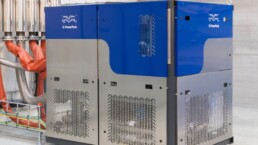

By converting waste heat directly into electrical power, the Alfa Laval E‑PowerPack is a game-changing advance in marine sustainability. An all-in-one unit for improving a vessel’s Energy Efficiency Index and Carbon Intensity Indicator , it removes many tonnes of CO2 per year – and significantly lowers fuel costs.
Straight from waste heat to electricity
Waste heat is a readily available but under-utilized energy source on board. Heat in the engine exhaust gas accounts for 50% of the energy from combusted fuel, and there is additional heat to recover from steam and liquids. With the launch of the Alfa Laval E‑PowerPack, shipowners can put all these heat sources to work for savings and compliance with sustainability requirements.
The E-PowerPack uses Organic Rankine Cycle (ORC) technology to turn waste heat into clean electrical power. By means of a liquid-gas phase change, it can generate power from both high-temperature and low-temperature heat sources, ranging from engine exhaust gas at 550°C to jacket cooling water at 75°C. It is also a modular solution, allowing units with a net electrical output of up to 100 kW or 200 kW to be combined in a larger system.
“The E-PowerPack is compact, extraordinarily versatile and suitable for all vessels and fuels,” says Alfa Laval’s Danny Ingemann, Head of Global Sales. “That makes it a powerful addition to Alfa Laval’s other waste heat recovery solutions, which have supported energy efficiency for decades. By applying energy that would otherwise go lost, shipowners can save money, boost their environmental profile and stay competitive as regulations tighten.”
Cost-saving compliance with sustainability requirements
By producing power from waste heat, the E-PowerPack reduces fuel consumption and use of the auxiliary engines, which provides payback in as little as 2–3 years. The same reductions improve EEDI/EEXI and CII, making the E-PowerPack a simple way to protect long-term vessel profitability.
“The E-PowerPack helps shipowners achieve the necessary index and retain a favourable CII rating for longer,” explains Ingemann. “That lets them avoid imposed operating limits, but it also supports a greener profile and potentially higher charter values. Such advantages add to the immediate E-PowerPack benefits of reduced fuel costs and emissions.”
An enabler for tomorrow’s zero-carbon operations
As the marine industry continues to decarbonize, the E-PowerPack will play an even wider role. Because fuels like carbon-neutral methanol and carbon-free ammonia will be more expensive, shipowners will need savings to offset their higher costs. Moreover, solutions like the E‑PowerPack will be key to using these fuels at all.
“Methanol and ammonia contain less energy than today’s marine fuels, and it will be a challenge to produce sufficient amounts for the world fleet using only renewable energy sources,” says Ingemann. “This is yet another reason for vessels to maximize their fuel efficiency, ensuring that little or none of the fuel energy goes to waste. The E-PowerPack will make a critical contribution to that balance, alongside fuel cells and other solutions that Alfa Laval has in the pipeline.”



Related News.

Greece has the most to lose from delays in shipping’s green transition, new analysis finds
UCL and WWF Greece report finds the IMO Net-Zero Framework offers Greek ship owners the clarity they need, and the best protection against a…

Snow Land joins Cool Carriers as the world’s first reefer with a gate rudder, a new chapter for sustainable and efficient reefer shipping
Cool Carriers, the world’s largest operator of specialised reefer vessels, took delivery of Snow Land from Kitanihon Shipbuilding in Japan on 12…

IBIA launches Marine Energy Outlook Survey as Annual Convention in New York
IBIA - The International Bunker Industry Association officially launched its Marine Energy Outlook Survey during the IBIA Annual Convention in New…

Why did ITF staff vote to strike again?
Staff at the International Transport Workers’ Federation (ITF) headquarters in London have voted to give their union a strike mandate. According to…

Nearly half of maritime crew tickets booked a week ahead are cancelled
Two new C Teleport reports show when maritime and aircrew teams book crew flights, how often they cancel, and what late booking costs, with a…

Kpler completes $1.5bn+ Sixth Street investment and continues accelerating growth
Investment backs Kpler's bold ambition to shape the future of global trade intelligence. Kpler, a leading provider of global physical trade…

How SAL and DNV are strengthening heavy-lift shipping
From classification and newbuilding support to operational tools and advisory expertise, SAL and DNV have been collaborating for decades. The…

PSA Singapore breaks ground on Tuas Port Phase Two to strengthen Global Trade Connectivity
PSA Singapore marked the groundbreaking of Tuas Port Phase Two, a significant step in the development of the world’s largest fully automated…

 …

BIFA welcomes UK–EU trade progress and calls for clarity on implementation
The British International Freight Association (BIFA) has welcomed progress made at today's UK–EU Summit in Brussels, highlighting the potential…
Subscribe to our newsletter!
if you dont want to swim alone in the ocean of news, sign up for the newsletter, and you will receive daily all the important news of world shipping!
