Improving Consenting to accelerate UK Offshore Wind Deployment


As part of its updated energy strategy to increase energy security and accelerate the energy transition, the UK is expected to increase its offshore wind targets, which currently stand at 40GW by 2030 and 100GW by 2050.
Westwood Global Energy Group is already tracking projects that could add 82.5GW to the existing 10.5GW of operational capacity, and so there is clearly no shortage of appetite. However, the question is how fast can these come online?
The speed with which a project is built is influenced by several factors, which can vary greatly based on regulations, project size, location and ownership. The UK government has provided a framework to support projects, which has been strengthened over time, including recently committing to annual rather than bi-annual Contract for Difference (CfD) auctions.
If we consider speed is of importance however, there has been a call from industry for the government to amend the current consenting regime. As Figure 1 shows, there is no clear pattern with regards to how long it takes an offshore wind project to receive consent in the UK. Ranging from 198 to 1751 days, this creates uncertainty for project developers.
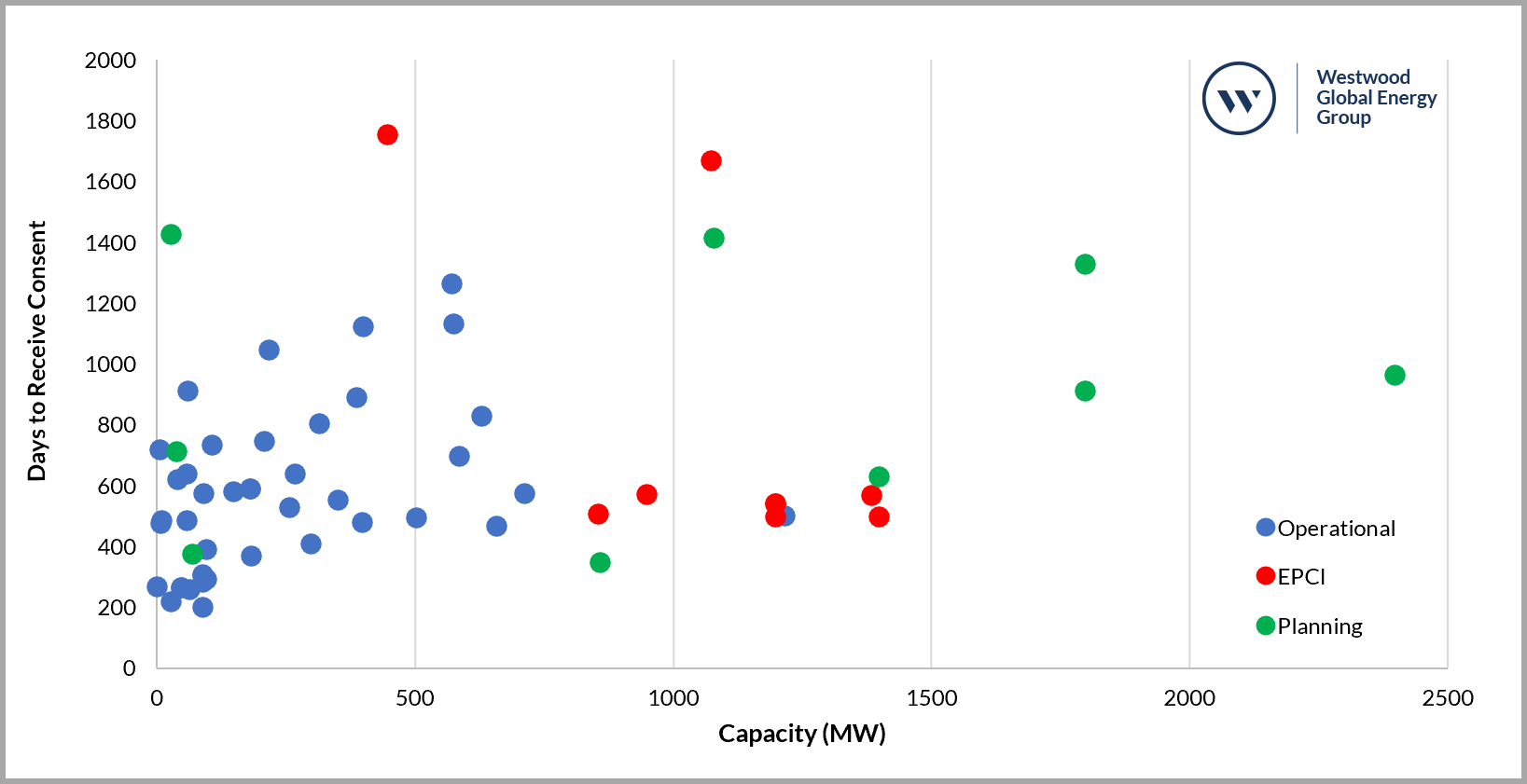
FIGURE 1: TIME TAKEN TO RECEIVE CONSENT BY OFFSHORE WIND PROJECT CAPACITY (UK)
CHART PLOTS ALL THE OFFSHORE WIND PROJECTS THAT HAVE RECEIVED CONSENT AS OF 24 MARCH 2022
SOURCE: WESTWOOD, BEIS RENEWABLE ENERGY PLANNING DATABASE
Planning delays have caused the 800MW East Anglia One North and 900MW East Anglia Two projects to miss out on applying for a CfD subsidy in Allocation Round 4 (AR4) which is currently underway. Projects are also vulnerable to being delayed even if they receive a consent. The 1.8GW Norfolk Vanguard wind farm is an example of this. The project received a consent from the Secretary of State on 1 July 2020, however this was then quashed at the High Court on 18 February 2021. The Secretary of State granted a new consent to the project on 11 February 2022. This project has now missed the deadline to participate in the CfD AR4 and it must now wait until CfD AR5.
Despite the sizable pipeline, achieving 40GW by 2030 (let alone a higher target) is not a given. With 10.5GW existing operational capacity, almost 10GW in the EPCI stage and a further 9.8GW having received planning consent; an extra 10GW of projects still need to receive consent by the middle of the decade for them to come online by the end of decade.
With projects having taken on average 659 days (or almost two years) to receive consent, the government can work to reduce this as much as possible and create greater certainty in the length of time the consenting process will take. This will be essential if the UK wants to meet its targets, and drive towards a more secure energy system.



Related News.

Navigating the Multi-Orbit Era: In Conversation with Intellian’s Jon Harrison at SMM 2026
At SMM 2026 in Hamburg, the rapid evolution of maritime satellite communications took centre stage. Across the exhibition halls, discussions among…
Cyprus ports need joint energy and investment strategy, shipping agents chief says
Cyprus needs a coordinated strategy for shipping, energy and environmental protection to support port investment and modernisation, Cyprus shipping…

MASO Public Affairs introduces MASO Regulatory Intelligence
A new subscription service helping businesses understand what is changing and what it means for them MASO Public Affairs introduces MASO Regulatory…
Anglo-Eastern helps turn CMBTECH’s ammonia ambition into an operational reality
From early feasibility study and risk-based design to newbuilding supervision, crew readiness and technical management, Anglo-Eastern drew on its…

Escalation of attacks threatens to derail recovery in Middle East oil exports
World oil demand is forecast to fall by 2.5 mb/d y-o-y in 4Q26 and 2.6 mb/d on average in 2026. As the Iran war manifests itself through restricted…
New study finds shipping pays twice its share to EU ETS earmarked revenues should triple to help build market for sustainable fuels and technologies
Shipping is responsible for around 10% of EU ETS emissions but pays almost 20% of the ETS bill. Unlike other sectors, it has never received free…

MSARC strengthens maritime mass rescue readiness through training and national live exercise off Dakar, Senegal
Joint MSARC–FHAS programme combines three days of SAR training with a national multi-agency live exercise The Maritime Search and Rescue Council ,…
Sogese report deliveries are still being delayed as container freight rates fluctuate
FOR IMPORTERS Spot rates into the Mediterranean are back at January levels, Far East to Europe reliability sits at pandemic lows, and nearly…

Glencore begins trading on Australian Securities Exchange
Glencore has begun trading on the Australian Securities Exchange under the ASX code GLC. Gary Nagle, Glencore’s CEO, said it was an exciting day for…
BIMCO Shipping Number of the Week
Suez Canal container ship transits exceed 50% of pre-disruption levels "During the first two weeks of October, weekly container ship capacity…
Subscribe to our newsletter!
if you dont want to swim alone in the ocean of news, sign up for the newsletter, and you will receive daily all the important news of world shipping!
