Move Cargo while striving for Zero Emissions
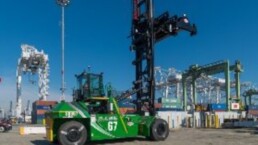

Seaports have a duty to protect the communities they serve from air pollution associated with goods movement, Port of Long Beach Executive Director Mario Cordero told a gathering of industry leaders recently at the American Association of Port Authorities Legislative Summit in Washington, D.C.
Speaking in his capacity as the AAPA Board of Directors chairman, Cordero urged port authorities to commit to “environmental social governance” – developing policies to decarbonize and convert cargo-handling and drayage truck fleets to zero emissions.
“We must recognize that protecting the health of our neighboring communities from harmful emissions due to port operations is a paramount responsibility,” said Cordero. “As port executives you can make a difference, the only question is whether you will choose to make a difference.”
Long Beach Harbor Commission President Steven Neal applauded Cordero for amplifying the Port of Long Beach’s Green Port philosophy at the international event.
“Although we’re always working on doing better, at the Port of Long Beach we’ve shown it’s possible to have both good jobs and environmental sustainability,” said Neal. “Our diesel particulate emissions are down 90% since 2005, even while cargo has increased more than 20%, because of the landmark Green Port Policy and the Clean Air Action Plan.”
On Friday, April 1, the ports of Long Beach and Los Angeles launched the Clean Truck Fund rate. The rate – $10 per twenty-foot equivalent unit on loaded import and export cargo containers hauled by drayage trucks as they enter or leave container terminals – will be collected from beneficial cargo owners and will help fund and incentivize the changeover to cleaner trucks. Exemptions to the CTF rate will be initially provided for containers hauled by zero-emission trucks and low-nitrogen oxide-emitting trucks. It is expected to generate up to $90 million in the first year.
Learn more about the Port of Long Beach’s environmental initiatives at www.polb.com/environment and the Clean Truck Fund rate here.
The Port of Long Beach is one of the world’s premier seaports, a gateway for trans-Pacific trade and a trailblazer in goods movement and environmental stewardship. As the second-busiest container seaport in the United States, the Port handles trade valued at more than $200 billion annually and supports 2.6 million trade-related jobs across the nation, including 575,000 in Southern California.



Related News.

Navigating the Multi-Orbit Era: In Conversation with Intellian’s Jon Harrison at SMM 2026
At SMM 2026 in Hamburg, the rapid evolution of maritime satellite communications took centre stage. Across the exhibition halls, discussions among…
Cyprus ports need joint energy and investment strategy, shipping agents chief says
Cyprus needs a coordinated strategy for shipping, energy and environmental protection to support port investment and modernisation, Cyprus shipping…

MASO Public Affairs introduces MASO Regulatory Intelligence
A new subscription service helping businesses understand what is changing and what it means for them MASO Public Affairs introduces MASO Regulatory…
Anglo-Eastern helps turn CMBTECH’s ammonia ambition into an operational reality
From early feasibility study and risk-based design to newbuilding supervision, crew readiness and technical management, Anglo-Eastern drew on its…

Escalation of attacks threatens to derail recovery in Middle East oil exports
World oil demand is forecast to fall by 2.5 mb/d y-o-y in 4Q26 and 2.6 mb/d on average in 2026. As the Iran war manifests itself through restricted…
New study finds shipping pays twice its share to EU ETS earmarked revenues should triple to help build market for sustainable fuels and technologies
Shipping is responsible for around 10% of EU ETS emissions but pays almost 20% of the ETS bill. Unlike other sectors, it has never received free…

MSARC strengthens maritime mass rescue readiness through training and national live exercise off Dakar, Senegal
Joint MSARC–FHAS programme combines three days of SAR training with a national multi-agency live exercise The Maritime Search and Rescue Council ,…
Sogese report deliveries are still being delayed as container freight rates fluctuate
FOR IMPORTERS Spot rates into the Mediterranean are back at January levels, Far East to Europe reliability sits at pandemic lows, and nearly…
Glencore begins trading on Australian Securities Exchange
Glencore has begun trading on the Australian Securities Exchange under the ASX code GLC. Gary Nagle, Glencore’s CEO, said it was an exciting day for…
BIMCO Shipping Number of the Week
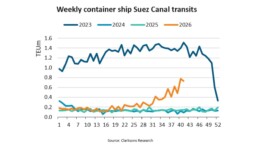
Suez Canal container ship transits exceed 50% of pre-disruption levels "During the first two weeks of October, weekly container ship capacity…
Subscribe to our newsletter!
if you dont want to swim alone in the ocean of news, sign up for the newsletter, and you will receive daily all the important news of world shipping!
