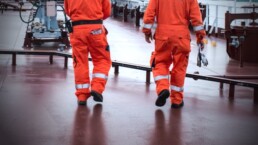

After months of being trapped at sea due to the pandemic, the current war in Ukraine is holding hundreds of thousands of seafarers hostage from the global merchant fleet. There are indeed many seafarers of both Ukrainian and Russian nationalities working on board ships. Many Ukrainian seafarers yearn to go home whilst the sanctions are making it harder to sign on Russian seafarers.
This can have a major impact on maritime transport. Together, Russia and Ukraine account for nearly 15 percent of the world’s 1.89 million seafarers. According to the latest Seafarers Workforce Report from 2021, both countries are also among the top five countries with the highest number of seafarers: Russia has 198,123 seafarers, while Ukraine has 76,442. A significant majority of them – in the case of Ukraine – are officers. Many of these work on gas or oil tankers and on container ships.
The International Chamber of Shipping, the global organisation that represents 80 percent of the merchant fleets, is not at ease with the situation. Last week, it warned that the labour shortage in global shipping will only worsen following Russia’s invasion of Ukraine.
Wilfred Lemmens, Managing Director of the Royal Belgian Shipowners’ Association, was very forthcoming about the consequences: “It will be a major challenge to find sufficient seafarers worldwide if the war continues. That could cause a huge disruption to the entire global maritime transport.” Around 5,000 seafarers who work on Belgian merchant ships with no less than a fifth coming from either of the two countries.
Ukrainian seafarers are currently facing a horrific dilemma. Many of them come from cities by or near the Black Sea, such as Kherson and Mariupol, and these cities are currently undergoing massive destructions from the fighting. These seafarers therefore want to go back as soon as possible to evacuate their families to safer places. Others want to take up arms to defend their country.
According to the President of the Ukrainian trade union for maritime transport workers, Oleg Grygoriuk, who was quoted in the Financial Times last week, around 55 to 60 percent of the 80,000 Ukrainian seafarers are currently at sea. About a fifth of them want to go ashore as soon as possible to defend their country.
Meanwhile, the growing isolation of Russia makes it increasingly difficult – if not impossible – to pay the wages of the Russian seafarers, due to the severe restrictions to the country’s access to Swift, the main international payment system. At the same time, it is becoming harder to get them to where they are needed, due to the closure of many air connections to and from Russia.
*This article was originally published in Dutch in the Belgian paper ‘De Standaard’, written by Pascal Sertyn.



Related News.

Navigating the Multi-Orbit Era: In Conversation with Intellian’s Jon Harrison at SMM 2026
At SMM 2026 in Hamburg, the rapid evolution of maritime satellite communications took centre stage. Across the exhibition halls, discussions among…

Cyprus ports need joint energy and investment strategy, shipping agents chief says
Cyprus needs a coordinated strategy for shipping, energy and environmental protection to support port investment and modernisation, Cyprus shipping…

MASO Public Affairs introduces MASO Regulatory Intelligence
A new subscription service helping businesses understand what is changing and what it means for them MASO Public Affairs introduces MASO Regulatory…

Anglo-Eastern helps turn CMBTECH’s ammonia ambition into an operational reality
From early feasibility study and risk-based design to newbuilding supervision, crew readiness and technical management, Anglo-Eastern drew on its…

Escalation of attacks threatens to derail recovery in Middle East oil exports
World oil demand is forecast to fall by 2.5 mb/d y-o-y in 4Q26 and 2.6 mb/d on average in 2026. As the Iran war manifests itself through restricted…

New study finds shipping pays twice its share to EU ETS earmarked revenues should triple to help build market for sustainable fuels and technologies
Shipping is responsible for around 10% of EU ETS emissions but pays almost 20% of the ETS bill. Unlike other sectors, it has never received free…

MSARC strengthens maritime mass rescue readiness through training and national live exercise off Dakar, Senegal
Joint MSARC–FHAS programme combines three days of SAR training with a national multi-agency live exercise The Maritime Search and Rescue Council ,…

Sogese report deliveries are still being delayed as container freight rates fluctuate
FOR IMPORTERS Spot rates into the Mediterranean are back at January levels, Far East to Europe reliability sits at pandemic lows, and nearly…

Glencore begins trading on Australian Securities Exchange
Glencore has begun trading on the Australian Securities Exchange under the ASX code GLC. Gary Nagle, Glencore’s CEO, said it was an exciting day for…

BIMCO Shipping Number of the Week
Suez Canal container ship transits exceed 50% of pre-disruption levels "During the first two weeks of October, weekly container ship capacity…
Subscribe to our newsletter!
if you dont want to swim alone in the ocean of news, sign up for the newsletter, and you will receive daily all the important news of world shipping!
