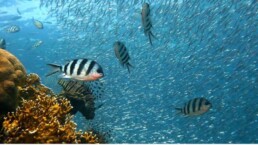

The introduction of invasive species into new marine environments is a major challenge for international shipping, and one that Höegh Autoliners takes seriously. Being at the forefront of environmental protection at sea, the company has taken vital steps to ensure these pests are not carried either in the vessel’s ballast water or on the vessel’s hull.
Invasive aquatic species can cause enormous damage if introduced to new marine environments. They can quickly multiply into pest proportions and are extremely hard to get rid of. The problem has intensified over the last few decades, as the volume of global trade has increased, and it is now impacting marine biodiversity on a global scale. To stop the spread of these unwanted guests, Höegh Autoliners takes necessary steps through compliant Ballast Water Treatment Systems and anti-fouling system.
How do Ballast Water Treatment Systems (BWTS) help?
Ballast water is essential to commercial shipping as it provides stability, reduces stress on the hull and improves both propulsion and manoeuvrability. The problem arises when discharging ballast water to compensate for weight loss due to cargo operations or fuel and water consumption. If the ballast water was taken on board in a different part of the world, this will potentially release non-native species into the local environment.
A BWTS ensures that there are non-invasive species in ballast water when it is discharged. Höegh Autoliners has chosen its BWTS with intensive UV light as it is an environmentally friendly treatment method which uses no chemicals. It works by UV lamps emitting short wave radiation into the water. This will expose any organisms or pathogens with a high dose of UV light. The UV-exposure will kill or inactivate the remainder of plankton as well as any bacteria/viruses.
All Höegh Autoliners vessels soon to include BWTS
At Höegh Autoliners, we have incorporated BWTS into our shipbuilding projects since 2014. In addition, we began retrofitting systems on our existing vessels in 2017, long before the International Maritime Organisation (IMO) rules came into force. By the end of the year, all our vessels will have advanced BWTS installed. To ensure maximum environmental protection, we only use BWTSs certified by the International Maritime Organization (IMO) and US Coast Guard (USCG).
If the vessel’s hull is not clean, it can offer a ‘taxi ride’ to invasive species
Biofouling is also considered one of the main routes for bio-invasions. Biofouling is the process when invasive aquatic species such as microorganisms, plants, algae, or animals gather on a vessel’s hull and are transported to another area where they can potentially destroy the make-up of the eco system. Höegh Autoliners uses anti-fouling paints which are applied on the hull of the vessel to maintain a smooth hull and reduce the accumulation of invasive aquatic species. This not only protects the marine environment but also reduces frictional resistance which leads to reduced emissions of air pollutants and greenhouse gases.
How do hull paints reduce biofouling?
Modern hull paints are designed to stop invasive species from building up on the vessel’s hull. The best is extremely effective, essentially keeping the hull entirely fouling free for 60 months or more.
Most work in one of three ways:
• Biocide release paints contains tiny amounts of biocide. This is slowly released as the paint degrades, dissuading marine organisms from attaching to the hull.
• Silicone paints give the hull a very smooth surface that organisms can’t hold onto.
• Silicon-hydrogel paints combine silicon with a special hydrogel surface that appears like water, essentially rendering it invisible to fouling organisms.
Whatever the mechanism, the outcome is essentially the same. The vessel’s hull remains smooth, which means no free rides for invasive aquatic species.
The spread of invasive species is recognised as one of the greatest threats to the ecological and the economic well-being of the planet. Protecting life below sea is a priority at Höegh Autoliners and we actively work to protect our ocean’s biodiversity and ecosystems.



Related News.

Navigating the Multi-Orbit Era: In Conversation with Intellian’s Jon Harrison at SMM 2026
At SMM 2026 in Hamburg, the rapid evolution of maritime satellite communications took centre stage. Across the exhibition halls, discussions among…
Cyprus ports need joint energy and investment strategy, shipping agents chief says
Cyprus needs a coordinated strategy for shipping, energy and environmental protection to support port investment and modernisation, Cyprus shipping…

MASO Public Affairs introduces MASO Regulatory Intelligence
A new subscription service helping businesses understand what is changing and what it means for them MASO Public Affairs introduces MASO Regulatory…
Anglo-Eastern helps turn CMBTECH’s ammonia ambition into an operational reality
From early feasibility study and risk-based design to newbuilding supervision, crew readiness and technical management, Anglo-Eastern drew on its…

Escalation of attacks threatens to derail recovery in Middle East oil exports
World oil demand is forecast to fall by 2.5 mb/d y-o-y in 4Q26 and 2.6 mb/d on average in 2026. As the Iran war manifests itself through restricted…
New study finds shipping pays twice its share to EU ETS earmarked revenues should triple to help build market for sustainable fuels and technologies
Shipping is responsible for around 10% of EU ETS emissions but pays almost 20% of the ETS bill. Unlike other sectors, it has never received free…
MSARC strengthens maritime mass rescue readiness through training and national live exercise off Dakar, Senegal
Joint MSARC–FHAS programme combines three days of SAR training with a national multi-agency live exercise The Maritime Search and Rescue Council ,…
Sogese report deliveries are still being delayed as container freight rates fluctuate
FOR IMPORTERS Spot rates into the Mediterranean are back at January levels, Far East to Europe reliability sits at pandemic lows, and nearly…
Glencore begins trading on Australian Securities Exchange
Glencore has begun trading on the Australian Securities Exchange under the ASX code GLC. Gary Nagle, Glencore’s CEO, said it was an exciting day for…
BIMCO Shipping Number of the Week
Suez Canal container ship transits exceed 50% of pre-disruption levels "During the first two weeks of October, weekly container ship capacity…
Subscribe to our newsletter!
if you dont want to swim alone in the ocean of news, sign up for the newsletter, and you will receive daily all the important news of world shipping!
