Government support Critical if Hydrogen and Carbon Capture are to deliver Net Zero, says ABS Chairman, President and CEO
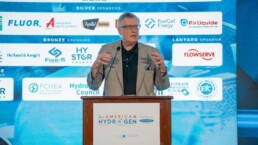

“Transportation and safety, as well as standards and regulation, are going to be nothing short of boundary conditions in this energy transition.”
That was the message for the hydrogen industry from Christopher J. Wiernicki, ABS Chairman, President, and CEO in a keynote speech to open the American Hydrogen Forum.
“The biggest challenge we all face in terms of realizing ambitious net zero commitments is the sheer gradient of the curve ahead of us. The pace of the development of hydrogen and carbon value chains is going to be key to managing that curve. Quite frankly, the curve is so steep, and the cost is such that, in order to achieve the required velocity, government support is a pre-requisite so these value chains can develop in time to deliver.”
Hydrogen and carbon capture are critical to achieving net zero and the development of both value chains are intertwined.
“Even though they are quite diverse, the carbon and hydrogen value chains have several points of intersection in the area of fuel technology. One method of carbon capture involves removing CO2 directly from the air, in what is called Direct Air Capture, a technology that is still in the refinement stages. Carbon captured in that way can be combined with green hydrogen to produce completely net-zero synthetic fuels – green methanol, green LNG, etc.
“This makes carbon capture a developmental cornerstone for net-zero hydrogen and underlines how the value chains are deeply intertwined. There are many unknowns before us today, but one thing seems fairly certain: if hydrogen and carbon technologies are essential to achieving net-zero emissions, then hydrogen and carbon value chains will be essential to achieving a net-zero global economy.”
He emphasized how regulation and standards will need to keep pace with technological development to ensure safety is at the forefront.
“We are entering an era where regulations and standards need to move at the same pace as technological breakthroughs. And there is an equally growing need for standardization and globally accepted frameworks that will be used for the adoption of the technologies that will support these value chains. Furthermore, a universally accepted approach to the calculation and verification or life cycle carbon footprint will provide the necessary credibility to the hydrogen value chain projects. On the other hand, carbon accounting standards and GHG inventory will provide the proper tools for verification of the impact the carbon value chain operations will have on the transition.
“On this journey, safety must continue to be the common denominator in all that we do, with the safety and scalability of decarbonization technologies functioning as boundary conditions. We must also continue to guard against the unintended safety consequences that will inevitably be born out of the rush for lower carbon operations.”



Related News.

Navigating the Multi-Orbit Era: In Conversation with Intellian’s Jon Harrison at SMM 2026
At SMM 2026 in Hamburg, the rapid evolution of maritime satellite communications took centre stage. Across the exhibition halls, discussions among…
Cyprus ports need joint energy and investment strategy, shipping agents chief says
Cyprus needs a coordinated strategy for shipping, energy and environmental protection to support port investment and modernisation, Cyprus shipping…

MASO Public Affairs introduces MASO Regulatory Intelligence
A new subscription service helping businesses understand what is changing and what it means for them MASO Public Affairs introduces MASO Regulatory…
Anglo-Eastern helps turn CMBTECH’s ammonia ambition into an operational reality
From early feasibility study and risk-based design to newbuilding supervision, crew readiness and technical management, Anglo-Eastern drew on its…

Escalation of attacks threatens to derail recovery in Middle East oil exports
World oil demand is forecast to fall by 2.5 mb/d y-o-y in 4Q26 and 2.6 mb/d on average in 2026. As the Iran war manifests itself through restricted…
New study finds shipping pays twice its share to EU ETS earmarked revenues should triple to help build market for sustainable fuels and technologies
Shipping is responsible for around 10% of EU ETS emissions but pays almost 20% of the ETS bill. Unlike other sectors, it has never received free…

MSARC strengthens maritime mass rescue readiness through training and national live exercise off Dakar, Senegal
Joint MSARC–FHAS programme combines three days of SAR training with a national multi-agency live exercise The Maritime Search and Rescue Council ,…

Sogese report deliveries are still being delayed as container freight rates fluctuate
FOR IMPORTERS Spot rates into the Mediterranean are back at January levels, Far East to Europe reliability sits at pandemic lows, and nearly…

Glencore begins trading on Australian Securities Exchange
Glencore has begun trading on the Australian Securities Exchange under the ASX code GLC. Gary Nagle, Glencore’s CEO, said it was an exciting day for…
BIMCO Shipping Number of the Week
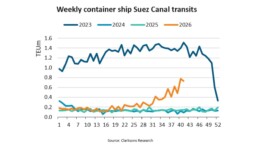
Suez Canal container ship transits exceed 50% of pre-disruption levels "During the first two weeks of October, weekly container ship capacity…
Subscribe to our newsletter!
if you dont want to swim alone in the ocean of news, sign up for the newsletter, and you will receive daily all the important news of world shipping!
