Brittany Ferries presents LNG-powered Salamanca
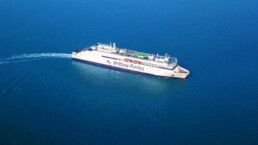

The first LNG powered passenger-ferry to operate from the UK arrives in Portsmouth on 25 March. Ahead of her arrival – and the first commercial departure for Bilbao the following Sunday – Brittany Ferries publishes the low-down on this cleaner, greener ship. The headline is a positive message for all: Salamanca is a cleaner ship , but she could be even greener tomorrow.
That’s because Salamanca is what can be described as fuel agnostic. LNG is certainly the best fuel available to shipping companies today. But when even more renewable options like e-methane or bio-methane come on stream, Salamanca will be ready to run on them.
The ship will therefore automatically become greener in the years to come, as advances in fuel technology and supply emerge.
Of course, cleaner fuel is not the only thing that makes Salamanca a more efficient ship. Pleasing to the eye, her long, slender hull hints at advances below the surface: E-Flexer class vessels like Salamanca (and sister-ship Galicia) have been optimised to deliver a high level of hydrodynamic performance. In addition, powerful real-time data analysis on board the ship and the development of machine learning, mean energy efficiency can be optimised at all times during her operation (further details in Salamanca press pack – link).
Investment in a cleaner fleet
Fleet renewal is one of the pillars of Brittany Ferries’ recovery from the Covid crisis. Salamanca is the first of four new LNG-powered ships destined for the Brittany Ferries family. A second named Santoña arrives in 2023. Both ships will serve Portsmouth to Spain routes, with Salamanca linking Portsmouth with Bilbao, and Santoña with Santander, the capital of Cantabria.
Further investment has been made in two LNG-hybrid vessels, arriving in 2024 and 2025. Brittany Ferries’ hybrids will replace two of the oldest (but much loved) ships in the Brittany Ferries fleet, Bretagne and Normandie. They will serve UK-France routes and will operate on the same principle as a hybrid car. At sea, power will come from cleaner LNG. But in a first on the Western Channel, they will also operate partially or completely on battery power, for example when arriving and departing ports.
Crucially they will also be ready to plug-in to shore-side power, when investment in the infrastructure to support it is made. This will allow recharging of batteries while at berth, as well as power for systems like air conditioning, heating and lighting on board.
“Brittany Ferries is proud to be taking a lead by investing in technologies of tomorrow,” said Christophe Mathieu Brittany Ferries CEO. “We have a responsibility to bring cleaner vehicles to market and that is what we have done. But it’s not just shipping companies like ours that have a role to play on our journey to a more sustainable future. An integrated approach is essential, one that includes fuel companies, port partners and governments to support the necessary investment in infrastructure like shore-side power. The more we join-up, the greater the benefits will be.”
Fuelling the future
Brittany Ferries is working with long-term fuel partner Repsol and the ports of Bilbao and Santander for refuelling its LNG ships. Investment of €10m will see the completion of facilities in each terminal ready for the arrival of Salamanca and Santoña. Both Spanish terminals are being co-financed by the European Commission through the CEF- Connecting Europe Facilities Programme.
Brittany Ferries has also started discussions with ports like Portsmouth, Plymouth, Ouistreham and St Malo as well as government stakeholders on both sides of the Channel, to push for the rapid development of shore side power infrastructure. This would allow hybrid vessels to plug-in while docked and to recharge their batteries, thus delivering zero emissions in port and boosting all-electric power while manoeuvring.
LNG power and its benefits
Although Salamanca is not the first ship to be powered by LNG, she will be the first regularly operating on the Channel. Ferry services powered by LNG already operate in the Baltic Sea and the technology is tried, tested and safe.
As the name implies Liquefied Natural Gas is a liquid that is created from naturally occurring gas. The gas is cooled to temperatures of -162 degrees Celsius, which shrinks it by a factor of 600 in volume, creating a liquid.
Colourless and odourless, the fuel powers thousands of cars and commercial vehicles around the world. It’s a more efficient combustion process than burning traditional fossil fuels, with around 20% fewer carbon dioxide emissions from the funnel. More significant benefits come from reductions in air quality pollutants. Sulphur and particulate (soot) emissions are virtually eliminated, while nitrogen dioxide NOx emissions are cut by around 90%.
LNG is now increasingly common as a fuel for passenger ships. Ferry lines such as Viking Line and Tallink, as well as cruise lines like Carnival, Aida and MSC, have turned to LNG.
Ships operating on LNG have an excellent safety record and are required to comply with a new set of regulations known as the IGF code*. This has been specifically developed for the use of gas as a propellant, with safety elements drawn directly taken from ocean-going LNG carriers. This sector has operated without major incident for the last forty years, with many LNG carriers able to handle up to 120 000 m3 of LNG. By comparison, Salamanca’s LNG tanks have a capacity of 783 m3.
LNG is clearly a fuel for the future. It is favoured by regulators and everyone who is concerned about protecting our planet. The European Commission’s Energy Roadmap 2050 for example, points to natural gas as key to aspirations for clean energy targets in 2050.



Related News.

Navigating the Multi-Orbit Era: In Conversation with Intellian’s Jon Harrison at SMM 2026
At SMM 2026 in Hamburg, the rapid evolution of maritime satellite communications took centre stage. Across the exhibition halls, discussions among…
Cyprus ports need joint energy and investment strategy, shipping agents chief says
Cyprus needs a coordinated strategy for shipping, energy and environmental protection to support port investment and modernisation, Cyprus shipping…

MASO Public Affairs introduces MASO Regulatory Intelligence
A new subscription service helping businesses understand what is changing and what it means for them MASO Public Affairs introduces MASO Regulatory…
Anglo-Eastern helps turn CMBTECH’s ammonia ambition into an operational reality
From early feasibility study and risk-based design to newbuilding supervision, crew readiness and technical management, Anglo-Eastern drew on its…

Escalation of attacks threatens to derail recovery in Middle East oil exports
World oil demand is forecast to fall by 2.5 mb/d y-o-y in 4Q26 and 2.6 mb/d on average in 2026. As the Iran war manifests itself through restricted…
New study finds shipping pays twice its share to EU ETS earmarked revenues should triple to help build market for sustainable fuels and technologies
Shipping is responsible for around 10% of EU ETS emissions but pays almost 20% of the ETS bill. Unlike other sectors, it has never received free…
MSARC strengthens maritime mass rescue readiness through training and national live exercise off Dakar, Senegal
Joint MSARC–FHAS programme combines three days of SAR training with a national multi-agency live exercise The Maritime Search and Rescue Council ,…
Sogese report deliveries are still being delayed as container freight rates fluctuate
FOR IMPORTERS Spot rates into the Mediterranean are back at January levels, Far East to Europe reliability sits at pandemic lows, and nearly…

Glencore begins trading on Australian Securities Exchange
Glencore has begun trading on the Australian Securities Exchange under the ASX code GLC. Gary Nagle, Glencore’s CEO, said it was an exciting day for…
BIMCO Shipping Number of the Week
Suez Canal container ship transits exceed 50% of pre-disruption levels "During the first two weeks of October, weekly container ship capacity…
Subscribe to our newsletter!
if you dont want to swim alone in the ocean of news, sign up for the newsletter, and you will receive daily all the important news of world shipping!
