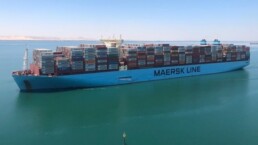

A.P. Moller Maersk has in collaboration with the National Meteorological Service of Germany, Deutscher Wetterdienst , installed automated weather stations on 50 of its vessels. While crossing the largest oceans, the vessels transmit live data helping forecast weather and climate.
In the largest project of its kind, A.P. Moller – Maersk (Maersk) has installed automated weather stations (AWS) on 50 of its vessels creating a pulsating oceanic web of weather and climate observations. All collected data is transmitted live to the National Meteorological Service of Germany, DWD, supporting their weather forecasts and climate science.
Maersk and DWD have collaborated on the project since 2019 with the German service providing the 50 systems being installed on the vessels.
“There is no doubt that climate change is one of the biggest challenges facing the global community and it impacts our business as well as the societies and customers we serve and partner with to enable trade. We have an ambitious strategy for our business to achieve net zero greenhouse gas emissions in 2040, and we are proud to have our vessels and crews help researchers in gaining a better understanding of this key global challenge and the impact it has on our surroundings,” said Aslak Ross, Head of Marine Standards at Maersk.
As a part of Maersk’s ESG strategy, the company has committed itself to contribute to climate science. Maersk vessels have also for years been operating within the global Voluntary Observing Ship (VOS) Scheme under the Global Ocean Observing System (GOOS) providing regular weather observations, but it has been done manually resulting in a slow process of data sharing. By implementing AWS, the vessels can deliver precise high-quality and standardized data in real-time giving DWD useful insights about the current meteorological situation at sea. The data provided is shared globally with all members of the World Meteorological Organization (WMO).
“The collaboration with Maersk continues to have a positive impact on the maritime industry,” said Darin Figurskey, the global lead for Ship Observations Team (SOT) under GOOS and a forecaster himself at the U.S. National Oceanic and Atmospheric Administration (NOAA).
“Additional observations on more vessels will help forecasters become more situationally aware, provide added information for forecasts, warnings, and numerical weather prediction, and ultimately help scientists understand more about our oceans and climate,” said Darin Figurskey.
Even today, where much of the meteorological data is acquired by satellites, the real-time data from the world’s oceans provides essential input to all weather models used for forecasts and warnings. Especially the surface atmospheric pressure is of high importance since it cannot be measured by satellites. AWS on ships provides a constant feed of high-quality data at sea and serves as the backbone for all numerical weather models.
Improving safety
Weather and sea state observations have been gathered and shared on a systematic basis for over 150 years. They provide essential data on meteorological conditions at sea for weather forecasts and, over long-time scales, help climate scientists understand climate change. Ship observations, alongside other ocean, land-based, and satellite observations, are used in global and regional climate analyses, and are combined with atmospheric-ocean climate models, that depict the evolution of our environment. These observations also help to ensure safety at sea by allowing better forecasting of storms and other extreme ocean-related events for seafarers and nations.
“As a global container logistics company, we are moving millions of containers across the oceans every year, and weather routing is extremely important to ensuring safe travel of our crew and our customers’ cargo. If we can help facilitate even marginal improvements to the quality of weather routing services, these will be important levers in our constant efforts to improve the safety of our crews and assets,” said Aslak Ross.
Approximately 300 fully owned Maersk vessels are gathering and sharing their weather and sea-state observations with the VOS.
Recently, Maersk also announced that it releases all historical and future ocean weather observations into the public domain for free use by the scientific community around the globe.
Source: Maersk



Related News.

Navigating the Multi-Orbit Era: In Conversation with Intellian’s Jon Harrison at SMM 2026
At SMM 2026 in Hamburg, the rapid evolution of maritime satellite communications took centre stage. Across the exhibition halls, discussions among…

Cyprus ports need joint energy and investment strategy, shipping agents chief says
Cyprus needs a coordinated strategy for shipping, energy and environmental protection to support port investment and modernisation, Cyprus shipping…

MASO Public Affairs introduces MASO Regulatory Intelligence
A new subscription service helping businesses understand what is changing and what it means for them MASO Public Affairs introduces MASO Regulatory…

Anglo-Eastern helps turn CMBTECH’s ammonia ambition into an operational reality
From early feasibility study and risk-based design to newbuilding supervision, crew readiness and technical management, Anglo-Eastern drew on its…

Escalation of attacks threatens to derail recovery in Middle East oil exports
World oil demand is forecast to fall by 2.5 mb/d y-o-y in 4Q26 and 2.6 mb/d on average in 2026. As the Iran war manifests itself through restricted…

New study finds shipping pays twice its share to EU ETS earmarked revenues should triple to help build market for sustainable fuels and technologies
Shipping is responsible for around 10% of EU ETS emissions but pays almost 20% of the ETS bill. Unlike other sectors, it has never received free…

MSARC strengthens maritime mass rescue readiness through training and national live exercise off Dakar, Senegal
Joint MSARC–FHAS programme combines three days of SAR training with a national multi-agency live exercise The Maritime Search and Rescue Council ,…

Sogese report deliveries are still being delayed as container freight rates fluctuate
FOR IMPORTERS Spot rates into the Mediterranean are back at January levels, Far East to Europe reliability sits at pandemic lows, and nearly…

Glencore begins trading on Australian Securities Exchange
Glencore has begun trading on the Australian Securities Exchange under the ASX code GLC. Gary Nagle, Glencore’s CEO, said it was an exciting day for…

BIMCO Shipping Number of the Week
Suez Canal container ship transits exceed 50% of pre-disruption levels "During the first two weeks of October, weekly container ship capacity…
Subscribe to our newsletter!
if you dont want to swim alone in the ocean of news, sign up for the newsletter, and you will receive daily all the important news of world shipping!
