
Premium understanding
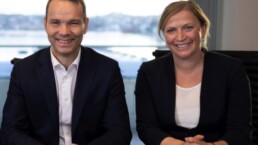
Sustainability shouldn’t be a consideration, or an add-on issue, it should be at the very heart of all strategic decision making for today’s ocean businesses. Leading marine insurer Gard sets out its core values ahead of Nor-Shipping 2022, with CEO Rolf Thore Roppestad and sustainability chief Live Jacob Sydness in the hotseat.
Gard is the world’s leading marine insurer. With 13 offices in ten countries, and over 580 employees, the mutual provides liability and hull risk insurance for a staggering 50% of the world fleet. It has a foothold in every major shipping segment, with a burgeoning customer base in renewables (especially floating offshore wind assets and support services), and over 100 years of industry expertise, having been founded in 1907.
“Insurance is only a small part of the everyday life of shipowners and operators,” admits CEO Rolf Thore Roppestad, “but we’re obviously a big part of that. And with such a large, geographically diverse membership and customer base we have influence throughout the industry.”
“We have reach and a responsibility to make a difference” adds Live Jacob Sydness, VP, Head of Sustainable Business, “not just in protecting people, assets and the environment, but also as an enabler for positive change.
“Together with our members and clients, we are here to enable sustainable maritime development. That is a driving ambition for Gard, and one that sits at the very heart of everything we do.”
This, it quickly becomes apparent, is anything but a sales pitch, it is an utter conviction.
Gard wants to use its position of power to help steer maritime’s green transition. And after all, as Roppestad says, that’s “good for business.”
Which he means in more ways than one…
Safeguarding progress
Roppestad and Sydness are talking ahead of Gard’s appearance at Nor-Shipping’s Blue Economy Hall, part of the international exhibition and activity programme, running from 4-7 April in Lillestrøm and Oslo. The firm has taken the position of main partner for the hall, which focuses on showcasing and enabling sustainable ocean solutions.
This, it turns out, is a perfect fit for the Norwegian-headquartered firm.
“Think about marine insurance in general,” Roppestad explains. “We protect. People and assets are one thing, and the environment is another. In our case we work extremely hard alongside authorities and businesses setting up frameworks to prepare for when accidents happen – to act swiftly, mitigate damage and safeguard society. We are also very proactive in ensuring they don’t happen in the first place!
“That is good for the environment, clearly, but also for our members and customers, preventing losses and keeping costs down when they do occur. We now have industry leading low claims costs, and consequently low premium levels, because of that approach. That helps drive more business to us, and we then help those businesses avoid and prepare for incidents, and so it continues.
“It becomes a virtuous circle. It’s good for everyone.”
Apart, you could argue, for their competitors.
Walk the walk
But how does this sustainability focus work in reality?
Sydness explains that the Gard board, made up with representatives from 25 leading global shipowners, decided to put sustainability at the core of business strategy back in 2018. The idea was to see value creation holistically – viewing it not solely through a financial lens, but by removing the blinkers to open up the whole spectrum of ‘value’- from environmental impact, to human impact, and overall contribution to society.
“Long-term value is about more than a series of short-term results,” she says. “It requires commitment. And it requires concrete measures.”
A good example of this is Gard’s common approach to ship recycling, which was also introduced in 2018.
This saw the firm become the first in its segment to commit to a policy of sustainable ship recycling, making it an integral part of both underwriting assessment and claims handling, with clear corporate minimum requirements.
“Initiatives like this,” notes Sydness, “in addition to our proactive role in the development of the Poseidon Principles for Marine insurance and our commitment to be transparent on the emissions of our H&M portfolio, show our willingness to ‘walk the walk’. It’s a good example of how we prioritize action over perfection. And that’s something we’ll be looking to highlight at Nor-Shipping, especially during the ‘Blue Talks’ in the exhibition hall.”
But does that mean the firm will only work with owners and operators showing similar commitment?
Roppestad steps into field this one.
Stronger together
“That depends,” he says. “ESG considerations are integral in every business decision we make. We conduct due diligence on all members and clients, and we sometimes have to draw a line. However, we have to remember that this is a transition, and, as discussed, we are here as an enabler.”
Meaning?
“Meaning it’s far better to work together with our members and clients, as partners, to improve standards, rather than being restrictive on membership. If you choose not to work with someone because they have a different approach, then you forfeit your chance to influence them – to understand them, and their risks and opportunities.”
He continues: “To make this industry sustainable, to make it fit for the future, we have to work together, we have to collaborate. This is a fundamental change, and no one player can do it alone.
“Inclusion over exclusion, that’s the way ahead.”
The difference of data
On the subject of staying ‘ahead’, Gard aims to be as strong proactively as it is reactively when it comes to looking after both its members and the environment. Its investment in data driven loss prevention is a testimony to that.
The size of the business gives it access to an immense amount of operational data – data it can utilise to understand risk, analyse trends and take meaningful action to reduce incidents and accidents. For example, it now shares data with members regarding collision and grounding risks in key global hotspots.
On a more detailed level, it can also, for example, utilise geofencing, weather data and cargo information to send alerts to ships loading cargoes with a potential to liquify (e.g. nickel ore with a high moisture content) and ensure samples are taken prior to loading.
“This may not sound like a big deal, but it’s critically important,” Roppestad says. “These cargoes destabilise ships and lead to capsizing. In fact, in the last decade around 100 seafarers have lost their lives this way. In addition, there are significant, environmental implications.
“So, if we can use data proactively like this it’s another way to help our members, while also enhancing industry sustainability. The two things go hand-in-hand.”
And, at the end of the day, that’s Roppestad and Sydness’ core message here.
Sustainability and good business can’t be separated – especially in an atmosphere of increasing awareness, stakeholder demand and the opportunity inherent in a transforming industry. Integration unlocks opportunity and, for Gard and its members, it is a cost saver, not a driver, while also creating competitive advantage in terms of positioning.
“Sometimes you either lead or get left behind,” concludes Roppestad. And Gard, it is clear, has no intention of relinquishing pole position.



Related News.

Navigating the Multi-Orbit Era: In Conversation with Intellian’s Jon Harrison at SMM 2026
At SMM 2026 in Hamburg, the rapid evolution of maritime satellite communications took centre stage. Across the exhibition halls, discussions among…

Cyprus ports need joint energy and investment strategy, shipping agents chief says
Cyprus needs a coordinated strategy for shipping, energy and environmental protection to support port investment and modernisation, Cyprus shipping…

MASO Public Affairs introduces MASO Regulatory Intelligence
A new subscription service helping businesses understand what is changing and what it means for them MASO Public Affairs introduces MASO Regulatory…

Anglo-Eastern helps turn CMBTECH’s ammonia ambition into an operational reality
From early feasibility study and risk-based design to newbuilding supervision, crew readiness and technical management, Anglo-Eastern drew on its…

Escalation of attacks threatens to derail recovery in Middle East oil exports
World oil demand is forecast to fall by 2.5 mb/d y-o-y in 4Q26 and 2.6 mb/d on average in 2026. As the Iran war manifests itself through restricted…

New study finds shipping pays twice its share to EU ETS earmarked revenues should triple to help build market for sustainable fuels and technologies
Shipping is responsible for around 10% of EU ETS emissions but pays almost 20% of the ETS bill. Unlike other sectors, it has never received free…

MSARC strengthens maritime mass rescue readiness through training and national live exercise off Dakar, Senegal
Joint MSARC–FHAS programme combines three days of SAR training with a national multi-agency live exercise The Maritime Search and Rescue Council ,…

Sogese report deliveries are still being delayed as container freight rates fluctuate
FOR IMPORTERS Spot rates into the Mediterranean are back at January levels, Far East to Europe reliability sits at pandemic lows, and nearly…

Glencore begins trading on Australian Securities Exchange
Glencore has begun trading on the Australian Securities Exchange under the ASX code GLC. Gary Nagle, Glencore’s CEO, said it was an exciting day for…

BIMCO Shipping Number of the Week
Suez Canal container ship transits exceed 50% of pre-disruption levels "During the first two weeks of October, weekly container ship capacity…
Subscribe to our newsletter!
if you dont want to swim alone in the ocean of news, sign up for the newsletter, and you will receive daily all the important news of world shipping!
