MSM Ocean and Sonardyne partner on tsunami early warning system
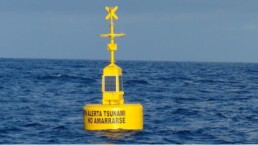

Metocean and environmental data measurement specialist MSM Ocean and marine technology company Sonardyne have agreed to team-up on the supply of a complete solution for warning coastal communities of a tsunami.
The two companies can now jointly provide at-risk coastal nations with a single source of supply of tsunami early warning systems.
The agreement combines MSM Ocean’s expertise in oceanographic measurement buoys, on-board data processing and telecommunications and Sonardyne’s highly precise deep water pressure measurement and acoustic through-water telemetry capabilities.
Together, these allow minute changes in deep water pressure at the seafloor that indicate a tsunami to be reliably detected, triggering a direct alert to national emergency organisations via acoustic and satellite communications, all within seconds.
The tsunami early warning system is fully International Association of Marine Aids to Navigation and Lighthouse Authorities (IALA) compliant and can be deployed in areas of up to 7,000 m water depth.
Through the teaming agreement, MSM Ocean and Sonardyne have also agreed to explore further possibilities for combining their technologies in support of remotely connecting ocean scientists to their instruments on the seafloor via buoys.

Sonardyne has been supplying integrated Bottom Pressure Recorders (BPRs) configured for deepwater tsunami detection to organisations around the world since 2007. Combining precise sensing, long-life battery and reliable communications in one easy to deploy and recover instrument, they were developed following the devasting 2004 Indian Ocean tsunami. For the past decade, these have been integrated into MSM Ocean’s buoy-based Tsunami Early Warning Systems, which have been successfully installed along the Pacific coast of South America.
This includes two systems deployed off Ecuador which detected the January 15 tsunami, caused by the Hunga-Tonga submarine volcano eruption, 10,000 km away in the South Pacific. Alerts were raised by MSM Ocean’s buoys with the National Tsunami Warning Center of Ecuador just 35 seconds after the wave was detected by Sonardyne’s Bottom Pressure Recorder.
Tsunamis present a threat to numerous coastal countries around the world mostly located around the Pacific Ring of Fire, but also in other areas maybe less present in our minds, such as in Europe and the Caribbean for example. Reliable and available systems of detection and early warning are a key component in the complex equation to mitigate the risk to the population. And this is exactly such a system, field-proven, that we have developed combining Sonardyne’s highly precise Bottom Pressure Recorder technology with our instrumented buoys’ expertise.
Cecile Zanette, CEO at MSM Ocean
Geraint West, Head of Science at Sonardyne, says, “We have been working closely with MSM Ocean for more than a decade and together we recognised the benefit of providing a fully integrated and supported seafloor-to surface-to shore solution. By formalising our relationship, we can now offer a one-stop-shop for this critical capability to a wider range of coastal communities. Organisations can now approach either company for their remote tsunami early warning system configured to match their exact needs.”



Related News.

Greece has the most to lose from delays in shipping’s green transition, new analysis finds
UCL and WWF Greece report finds the IMO Net-Zero Framework offers Greek ship owners the clarity they need, and the best protection against a…

Snow Land joins Cool Carriers as the world’s first reefer with a gate rudder, a new chapter for sustainable and efficient reefer shipping
Cool Carriers, the world’s largest operator of specialised reefer vessels, took delivery of Snow Land from Kitanihon Shipbuilding in Japan on 12…

IBIA launches Marine Energy Outlook Survey as Annual Convention in New York
IBIA - The International Bunker Industry Association officially launched its Marine Energy Outlook Survey during the IBIA Annual Convention in New…

Why did ITF staff vote to strike again?
Staff at the International Transport Workers’ Federation (ITF) headquarters in London have voted to give their union a strike mandate. According to…

Nearly half of maritime crew tickets booked a week ahead are cancelled
Two new C Teleport reports show when maritime and aircrew teams book crew flights, how often they cancel, and what late booking costs, with a…

Kpler completes $1.5bn+ Sixth Street investment and continues accelerating growth
Investment backs Kpler's bold ambition to shape the future of global trade intelligence. Kpler, a leading provider of global physical trade…

How SAL and DNV are strengthening heavy-lift shipping
From classification and newbuilding support to operational tools and advisory expertise, SAL and DNV have been collaborating for decades. The…

PSA Singapore breaks ground on Tuas Port Phase Two to strengthen Global Trade Connectivity
PSA Singapore marked the groundbreaking of Tuas Port Phase Two, a significant step in the development of the world’s largest fully automated…

 …

BIFA welcomes UK–EU trade progress and calls for clarity on implementation
The British International Freight Association (BIFA) has welcomed progress made at today's UK–EU Summit in Brussels, highlighting the potential…
Subscribe to our newsletter!
if you dont want to swim alone in the ocean of news, sign up for the newsletter, and you will receive daily all the important news of world shipping!
