Ocean’s Future to 2050
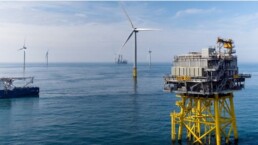

The exponential growth of offshore wind power will be the main driver of a nine-fold increase in demand for ocean space by the middle of the century, according to DNV’s Ocean’s Future to 2050 report.

The report forecasts that by midcentury, offshore wind will require ocean space which is the equivalent to the landmass of Italy. The growth will be particularly pronounced in regions with long coastlines and presently have low penetration of offshore wind. Demand for ocean space is set to grow 50-fold in the Indian Subcontinent and 30-fold in North America.
The rise of wind will be pivotal to the transformation of the Blue Economy. Currently, 80 percent of capital expenditure (capex) in the Blue Economy is invested in the offshore oil and gas sector, but by 2050 that number will have dropped to 25 percent. By then, offshore wind will receive the largest investments, accounting for half of all capital expenditure (capex). The decreasing prominence of oil and gas will be largely responsible for capex inflows into the Blue Economy being less in 2050 than today, whilst operating expenditure will increase below GDP growth. The Blue Economy will be more focused on Asia with Greater China set to account for more than a quarter of capex by 2050 as it builds out its offshore wind capacity and marine aquaculture.

“The Blue Economy is entering a period of sectoral and geographic diversification,” said Remi Eriksen, Group President and CEO of DNV. “Currently, the regions which benefit most from the ocean in economic terms are those with access to oil and gas fields off their coastlines. But as the world decarbonizes and the need for renewable energy grows, countries not able to be part of the age of fossil fuel can be part of the age of wind”
The growing economic strength of Asia and the energy transition will also impact the maritime sector. After years of faster-than-GDP growth, seaborne trade will only grow 35% to 2050, while global GDP almost doubles. Bulk will remain the largest segment in the merchant fleet, despite reduced demand for coal transportation. Tankers will be overtaken by container vessels as the second largest segment, even if demand for gas tankers remains robust. COVID 19 will have no long-term impact on cruise industry and berth capacity will triple by 2050.
Aquaculture production will more than double by the middle of the century, approaching the level of wild catch. But seafood (inland and marine) will account for only 9% of global protein demand in 2050. Total annual catch is forecast to be 95 million metric tonnes by mid-century, exceeding the maximum sustainable yield of marine capture fisheries and stressing the need for optimal fisheries management. Ocean’s Future to 2050 is a holistic forecast of the Blue Economy and covers areas as diverse as food, energy, shipping, tourism, desalination, ocean health and spatial planning.
Source: DNV



Related News.
Global study finds Cyprus ranks SEVENTH and set for $1.1 billion AI GDP boost
Cyprus beats India and New Zealand to come SEVENTH in major AI study – with potential €1.1 billion GDP boost and youth jobs opportunity Some 86% of…

Global shipping’s trillion dollar climate bill according to Zero Carbon Analytics
A new study by Zero Carbon Analytics finds that emissions from international shipping cost the global economy around USD 963 billion between 1990…

Keeping Children Safe Online at Sea Seafy® earns friendly WiFi Certification across 26 vessels
Seafy becomes Friendly WiFi’s first partner in the maritime sector, helping protect kids from harmful content online. Friendly WiFi is delighted…

ShipManager joins Star Information Systems to accelerate the maritime industry’s transition to cloud
CFARER, a DNV Company selects Star Information Systems as the longterm home for ShipManager and its cloud future Star Information Systems (Star)…
Seafarer experience must shape maritime technology, initial STEER Project report finds
New research finds technology can shift rather than remove risk as The Nautical Institute, with support from Lloyd’s Register Foundation, calls for…

New LR service targets cargo disruption when trade routes fail
New LR Advisory service helps ports, governments and logistics operators respond to disruption, protect critical cargo flows and strengthen trade…

DORIC WEEKLY INSIGHT 06 NOVEMBER 2026
Please find below the DORIC Market Insight for the week ending 06th November 2026. Weekly Report 06.11.2026
BIMCO Shipping Number of the Week
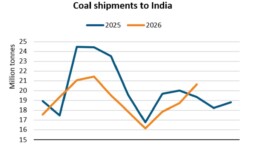
Coal shipments to India drop 7%, but limited recovery may lie ahead "Between January and October, coal shipments to India dropped 7% y/y due to the…
Hapag-Lloyd marks 20 years in South Africa and targets further growth
South Africa has become a cornerstone of Hapag-Lloyd's business in Africa Hapag-Lloyd surpasses 1 million TEU in Africa for the first time in its…
Subscribe to our newsletter!
if you dont want to swim alone in the ocean of news, sign up for the newsletter, and you will receive daily all the important news of world shipping!
