

A newly signed project is set to provide pilot projects in developing countries in order to demonstrate technical solutions for biofouling management in developing countries, address the transfer of invasive aquatic species and help reduce greenhouse gas emissions from ships.
Biofouling is the accumulation of aquatic organisms on wetted or immersed surfaces such as ships and other offshore structures.
The TEST (Transfer of Environmentally Sound Technologies) Biofouling Project will run for four years (2022-2025), following an agreement signed (on 8 December) by International Maritime Organization (IMO) Secretary-General Kitack Lim and the Norwegian Agency for Development Cooperation (Norad). Norad funding amounts to around US$4 million.
The project complements the existing Global Environment Facility (GEF)/United Nations Development Programme (UNDP)/IMO GloFouling Partnerships Project, which aims to support its lead partnering and partnering countries to implement IMO’s Biofouling Guidelines.
The TEST Biofouling Project will focus on demonstrating technical solutions in the GloFouling partner countries*. TEST Biofouling will feature some of the latest advances in technological solutions for managing biofouling, such as remote operated vehicles for in-water cleaning and underwater cameras for monitoring anti-fouling coating status. Additionally, the project will provide capacity building courses in developing countries.
IMO Secretary-General Lim said: “I am pleased to sign this agreement with Norad for the TEST Biofouling Project. We need to showcase solutions to today’s challenges, including preserving the oceans’ biodiversity and tackling climate change. In 2022, IMO’s World Maritime Theme will be ‘New technologies for greener shipping’, so it is particularly pertinent to launch a project which is going to focus on demonstrating just what can be done. This project will work with developing countries, ensuring that they can lead in demonstrating solutions.”
IMO has been a global leader on addressing Biofouling, through the Guidelines for the control and management of ships’ Biofouling to minimize the transfer of invasive aquatic species (Biofouling Guidelines) (resolution MEPC.207(62)), which are intended to provide a globally consistent approach to the management of Biofouling.
Biofouling is a major vector for the introduction of alien species – Invasive Aquatic Species (IAS) – that may severely impact marine biodiversity.
Studies show that biofouling on ships is responsible for between 55.5% and 69.2% of the established coastal and estuarine invasive species globally. IAS can dominate benthic habitats, pred on, compete with and disturb native communities, and displace local species. IAS have caused significant harm to the marine and coastal environment and are considered one of the leading causes of marine biodiversity loss. Once established in a marine environment, IAS are very difficult and often impossible or prohibitively expensive to eradicate, hence prevention of introductions through good ships’ biofouling management is key.
In addition, managing biofouling by keeping hulls clean from the build-up of species can be a major contributor to reducing ships’ fuel consumption and resulting greenhouse gas emissions. In effect, biofouling on ships’ hulls increases their surface roughness, which in turn increases frictional resistance and ultimately fuel consumption and emissions.
The preliminary results of a recent study on the Impact of Ships’ Biofouling on Greenhouse Gas Emissions shows that a layer of slime as thin as 0.5 mm covering up to 50% of a hull surface can trigger an increase of GHG emissions in the range of 20 to 25%, depending on ship characteristics, speed and other prevailing conditions. The study was carried out by the Global Industry Alliance (GIA) for Marine Biosafety, which operates under the framework of the GEF-UNDP-IMO GloFouling Partnerships project.
The TEST Biofouling Project is the latest to be signed in a rapidly expanding portfolio of global projects under IMO’s Department for Partnerships and Projects and demonstrates IMO’s increasing efforts to promote inclusive innovation, technology demonstration and diffusion to support implementation of IMO instruments.



Related News.
Navigating the Multi-Orbit Era: In Conversation with Intellian’s Jon Harrison at SMM 2026
At SMM 2026 in Hamburg, the rapid evolution of maritime satellite communications took centre stage. Across the exhibition halls, discussions among…
Cyprus ports need joint energy and investment strategy, shipping agents chief says
Cyprus needs a coordinated strategy for shipping, energy and environmental protection to support port investment and modernisation, Cyprus shipping…

MASO Public Affairs introduces MASO Regulatory Intelligence
A new subscription service helping businesses understand what is changing and what it means for them MASO Public Affairs introduces MASO Regulatory…
Anglo-Eastern helps turn CMBTECH’s ammonia ambition into an operational reality
From early feasibility study and risk-based design to newbuilding supervision, crew readiness and technical management, Anglo-Eastern drew on its…

Escalation of attacks threatens to derail recovery in Middle East oil exports
World oil demand is forecast to fall by 2.5 mb/d y-o-y in 4Q26 and 2.6 mb/d on average in 2026. As the Iran war manifests itself through restricted…
New study finds shipping pays twice its share to EU ETS earmarked revenues should triple to help build market for sustainable fuels and technologies
Shipping is responsible for around 10% of EU ETS emissions but pays almost 20% of the ETS bill. Unlike other sectors, it has never received free…
MSARC strengthens maritime mass rescue readiness through training and national live exercise off Dakar, Senegal
Joint MSARC–FHAS programme combines three days of SAR training with a national multi-agency live exercise The Maritime Search and Rescue Council ,…
Sogese report deliveries are still being delayed as container freight rates fluctuate
FOR IMPORTERS Spot rates into the Mediterranean are back at January levels, Far East to Europe reliability sits at pandemic lows, and nearly…
Glencore begins trading on Australian Securities Exchange
Glencore has begun trading on the Australian Securities Exchange under the ASX code GLC. Gary Nagle, Glencore’s CEO, said it was an exciting day for…
BIMCO Shipping Number of the Week
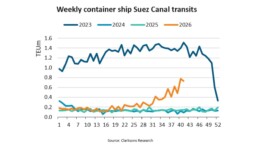
Suez Canal container ship transits exceed 50% of pre-disruption levels "During the first two weeks of October, weekly container ship capacity…
Subscribe to our newsletter!
if you dont want to swim alone in the ocean of news, sign up for the newsletter, and you will receive daily all the important news of world shipping!
