ESA selects Airbus for exoplanet mission Ariel
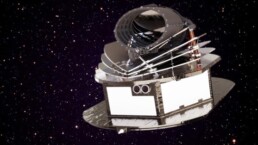

he European Space Agency has signed a contract with Airbus to build the Atmospheric Remote-sensing Infrared Exoplanet Large-survey mission. Ariel is the fourth medium-class mission in ESA’s Cosmic Vision programme.
Ariel will study the composition of exoplanets, how they formed and how they evolve, by surveying a diverse sample of about 1000 extrasolar planets in visible and infrared wavelengths. It is the first mission dedicated to measuring precisely the chemical composition and thermal structures of transiting exoplanets. The contract is valued at around € 200 million.
“Airbus has extensive experience of leading ground-breaking science missions, including JUICE, Gaia, Solar Orbiter, LISA Pathfinder and CHEOPS, on which we are building for ESA’s latest science mission, Ariel,” said Jean-Marc Nasr, Head of Space Systems at Airbus.
“In our Toulouse facilities, the largest space site in Europe, we have all the resources, facilities and expertise to design, manufacture and integrate the spacecraft and actively support ESA with payload development. Airbus Stevenage is fully integrated in the prime team for the engineering of the avionics, Radio Frequency communication and electrical design of the platform, as successfully proven for the development of Gaia”.
Airbus will lead the European industrial consortium with more than 60 contractors for building the satellite and provide expertise and support to ESA for the development of the payload module.
“With this milestone for the Ariel mission we celebrate the continuation of the outstanding relationship with our industry partners to keep Europe at the forefront of excellence in the field of exoplanet research well into the next decade and beyond,” said Günther Hasinger, ESA’s Director of Science.
More than 5,000 exoplanets have been identified since the first observation in 1995, but little is known about the chemical composition of their atmospheres. Existing space science missions are delivering results on exoplanets (such as the Airbus-built CHEOPS for ESA), but Ariel will be the first mission dedicated to studying the atmospheres of a large number of exoplanets, including main atmospheric component determination and cloud characterisation. Observations of these worlds will give insights into the early stages of planetary and atmospheric formation, and their subsequent evolution, in turn contributing to the understanding of our own Solar System. They could help us find out whether there is life elsewhere in our universe and if there is another planet like Earth.
The mission will focus on warm and hot planets, ranging from super-Earths to gas giants orbiting close to their parent stars, taking advantage of their well-mixed atmospheres to decipher their bulk composition.
After its launch, in 2029 on an Ariane 6 launcher, Ariel will be injected onto a direct transfer trajectory to the second Lagrangian point (L2). Thanks to its very stable thermal and mechanical design, the spacecraft will be able to carry out long term observations of the same planet/star system for a duration of between 10 hours and up to three days. Its mission will last four years with a possible extension of at least two years.
Airbus was prime contractor for ESA’s mission CHEOPS. Launched in December 2019, its goal is to characterise exoplanets orbiting nearby stars, observing known planets in the size range between Earth and Neptune and precisely measuring their radii to determine density and composition.



Related News.

Greece has the most to lose from delays in shipping’s green transition, new analysis finds
UCL and WWF Greece report finds the IMO Net-Zero Framework offers Greek ship owners the clarity they need, and the best protection against a…

Snow Land joins Cool Carriers as the world’s first reefer with a gate rudder, a new chapter for sustainable and efficient reefer shipping
Cool Carriers, the world’s largest operator of specialised reefer vessels, took delivery of Snow Land from Kitanihon Shipbuilding in Japan on 12…

IBIA launches Marine Energy Outlook Survey as Annual Convention in New York
IBIA - The International Bunker Industry Association officially launched its Marine Energy Outlook Survey during the IBIA Annual Convention in New…

Why did ITF staff vote to strike again?
Staff at the International Transport Workers’ Federation (ITF) headquarters in London have voted to give their union a strike mandate. According to…

Nearly half of maritime crew tickets booked a week ahead are cancelled
Two new C Teleport reports show when maritime and aircrew teams book crew flights, how often they cancel, and what late booking costs, with a…

Kpler completes $1.5bn+ Sixth Street investment and continues accelerating growth
Investment backs Kpler's bold ambition to shape the future of global trade intelligence. Kpler, a leading provider of global physical trade…

How SAL and DNV are strengthening heavy-lift shipping
From classification and newbuilding support to operational tools and advisory expertise, SAL and DNV have been collaborating for decades. The…

PSA Singapore breaks ground on Tuas Port Phase Two to strengthen Global Trade Connectivity
PSA Singapore marked the groundbreaking of Tuas Port Phase Two, a significant step in the development of the world’s largest fully automated…

 …

BIFA welcomes UK–EU trade progress and calls for clarity on implementation
The British International Freight Association (BIFA) has welcomed progress made at today's UK–EU Summit in Brussels, highlighting the potential…
Subscribe to our newsletter!
if you dont want to swim alone in the ocean of news, sign up for the newsletter, and you will receive daily all the important news of world shipping!
