Triggering more lockdowns, Omicron could cost oil demand almost 3 million bpd in early 2022
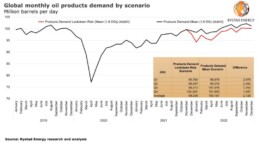

The new Omicron variant of Covid-19 could cost the global oil market as much as 2.9 million barrels per day (bpd) of demand in the first quarter of 2022, bringing total expected demand down from 98.6 million bpd to 95.7 million bpd, if it triggers more lockdowns or restrictions, Rystad Energy projects.
If the variant spreads rapidly, causing a rise in Covid cases and the reintroduction of lockdowns, Rystad Energy predicts that oil demand could fall from an expected 99.1 million bpd to 97.8 million bpd in December 2021 alone – a drop of 1.3 million bpd. Demand could tumble further in January 2022, shedding 4.2 million bpd to a level of 94.2 million bpd.
As countries and governments learn to live with Omicron, or vaccine manufacturers adapt existing shots to counter the variant, the full-year impact will likely be less severe. Average 2022 demand would fall to 98 million bpd, a drop of 2.1 million bpd against our current base case – or “mean” – scenario.
In late November, oil demand growth was so strong that even a co-ordinated strategic petroleum reserve release from major oil-importing countries did nothing to quell bullishness surrounding oil prices. However, after governments went on high alert, the price of oil later collapsed by more than 10% as the demand downside is vastly different.
“The likelihood of increasing lockdowns in the coming months has risen dramatically due to the new Omicron variant, and this will undoubtedly impact global oil demand. Given the early stage of the variant outbreak and the unknowns related to contagiousness and vaccine efficacy, we can only hope this scenario turns out to be a false alarm. Still, if the risk is real, the oil market will need to recalibrate accordingly,” says Claudio Galimberti, senior vice president of analysis at Rystad Energy
We first introduced the possibility of the impact of a return to lockdown on oil demand in mid-September. Our initial estimates now appear even more probable given the emergence and spread of the Omicron variant in Africa and related travel bans from countries with high caseloads, not to mention the slow convergence of European countries, starting with Austria, the Netherlands and Germany, enforcing mobility restrictions.
Breaking down the projected impact on specific oil products illuminates how Omicron could affect different elements of the global economic recovery. In the first quarter of 2022, demand for gasoline could fall by up to 1.3 million bpd to 24.2 million bpd, a 5% decrease from the base levels of 25.5 million bpd.
Jet fuel demand would also be significantly impacted as demand for flights and travel slows. Estimates show jet fuel demand could drop 6% in the first quarter of 2022 from the expected 5.5 million bpd to 5.2 million bpd. The second and third quarters would see a deeper plunge, dropping 10% in the second quarter from 6.1 million bpd to 5.6 million bpd, and 11% in the third quarter from 7 million bpd to 6.2 million bpd.
It is worth noting that current global oil demand for road transport, estimated to be about 44.7 million bpd, is almost at pre-pandemic levels, representing 97.4% of demand in the corresponding week in 2019. On the other hand, global demand for oil for aviation lags the equivalent 2019 total and stands at 5.1 million bpd, only 70.4% of the corresponding week in 2019.
Regional reactions
Countries and regions have reacted differently to the pandemic thus far, and we anticipate that trend to continue with the Omicron variant. For instance, countries in North and South America – such as the US, Brazil and Argentina – will likely try to weather the storm and prioritize economic activity. Countries such as China and Australia have in the past displayed a zero-tolerance approach and are expected to continue with this strategy amid future waves. European and Middle Eastern governments are likely to fall in between these two extremes as they try to find equilibrium between economic activity and preserving the health and safety of their populations.
Of course, the status quo could change, and regional reactions will be dictated by vaccination rates, cultural attitudes towards risks and public sentiment. As with earlier outbreaks, restrictions may be primarily dictated by intensive care occupancy rates in hospitals and the availability of hospital beds more broadly. The pandemic has also impacted some regions and countries worse than others for myriad reasons. Consequently, some countries may need to enact more frequent or sweeping lockdowns than before, whereas others may not be as stringent.
For more analysis, insights and reports, clients and non-clients can apply for access to Rystad Energy’s Free Solutions and get a taste of our data and analytics universe.



Related News.

Navigating the Multi-Orbit Era: In Conversation with Intellian’s Jon Harrison at SMM 2026
At SMM 2026 in Hamburg, the rapid evolution of maritime satellite communications took centre stage. Across the exhibition halls, discussions among…

Cyprus ports need joint energy and investment strategy, shipping agents chief says
Cyprus needs a coordinated strategy for shipping, energy and environmental protection to support port investment and modernisation, Cyprus shipping…

MASO Public Affairs introduces MASO Regulatory Intelligence
A new subscription service helping businesses understand what is changing and what it means for them MASO Public Affairs introduces MASO Regulatory…

Anglo-Eastern helps turn CMBTECH’s ammonia ambition into an operational reality
From early feasibility study and risk-based design to newbuilding supervision, crew readiness and technical management, Anglo-Eastern drew on its…

Escalation of attacks threatens to derail recovery in Middle East oil exports
World oil demand is forecast to fall by 2.5 mb/d y-o-y in 4Q26 and 2.6 mb/d on average in 2026. As the Iran war manifests itself through restricted…

New study finds shipping pays twice its share to EU ETS earmarked revenues should triple to help build market for sustainable fuels and technologies
Shipping is responsible for around 10% of EU ETS emissions but pays almost 20% of the ETS bill. Unlike other sectors, it has never received free…

MSARC strengthens maritime mass rescue readiness through training and national live exercise off Dakar, Senegal
Joint MSARC–FHAS programme combines three days of SAR training with a national multi-agency live exercise The Maritime Search and Rescue Council ,…

Sogese report deliveries are still being delayed as container freight rates fluctuate
FOR IMPORTERS Spot rates into the Mediterranean are back at January levels, Far East to Europe reliability sits at pandemic lows, and nearly…

Glencore begins trading on Australian Securities Exchange
Glencore has begun trading on the Australian Securities Exchange under the ASX code GLC. Gary Nagle, Glencore’s CEO, said it was an exciting day for…

BIMCO Shipping Number of the Week
Suez Canal container ship transits exceed 50% of pre-disruption levels "During the first two weeks of October, weekly container ship capacity…
Subscribe to our newsletter!
if you dont want to swim alone in the ocean of news, sign up for the newsletter, and you will receive daily all the important news of world shipping!
