The value of sustainability in the shipping industry


An increase in carbon emissions has seen our planet shifting from working for us, to working against us, and the shipping industry has played an active part in this alarming change. Achieving carbon neutrality by 2050 has become the world’s most urgent mission, and the maritime community is taking the necessary steps to reduce its role as one of the leading CO2 contributors. Or is it?
Achieving sustainability is both a challenge and an opportunity and there is no question that walking a “greener” path is now, more than ever, a necessity.
Let’s look at a few examples of what is being done.
Adhering to environmental regulations
The visible implications of climate change has moved us into a global sustainable movement and the 2015 Paris Agreement on Climate Change provided the catalyst for various governments and organisations to craft regulations that ensure the necessary implementation of environmental structures and support systems continue to aid global conservation goals.
According to the United Nations, the European Union, Japan and the Republic of Korea, together with more than 110 other countries, have pledged carbon neutrality by 2050, and the shipping industry has followed suit with its own goals and targets.
Organisations such as the International Maritime Organization (IMO) and the Sustainable Shipping Initiative are leading the way. Not only are shipowners required to comply with the environmental regulations set forth by government bodies and organisations, but operators are being incentivised through a mandatory A-E rating system drafted by the IMO and The Marine Environment Protection Committee (MEPC) – a move which is aimed at improving the carbon efficiency of vessels.
Diving into the world of alternative fuels
The use of fossil fuels has played a major part in the industry’s contribution to global GHG pollution as it remains responsible for more than 30% of emissions. The development of alternative fuel sources such as green hydrogen has been punted as the leading solution to reducing emissions and meeting the goals of the maritime sector.
Innovation plays a key role in the development of a range of groundbreaking sustainable practices and technologies. The Japanese-based company Eco Marine Power(EMP) unveiled its zero-emissions solution which uses a supplementary propulsion and electrically powered unit to provide an integrated system for vessels to harness energy from the wind and sun, offering fleets the possibility of phasing out bunker fuel in the future. This is just one of the many innovative solutions currently being developed by the shipping industry as it continues to support its commitment to ensuring a sustainable future.
It’s a shared responsibility
The responsibility to mitigate the harmful environmental effects caused by humans lies with each individual. Countless industry-related companies are doing their part to help reduce their impact by implementing eco-conscious standards and goals within their organisations – and equally important, they are involving their employees to reach these targets. It is essential to create a working environment that nurtures these values as it is a crucial requirement when attempting to transform the industry on a larger scale.
GAC is one of many corporate examples that are making incredible strides in this direction. Their Roadmap To Sustainability program is committed to reducing their impact on the environment and to work together towards a better future for the planet and the people. This is bolstered by their support for the call to action to decarbonise international shipping by 2050, which is another reflection of their drive towards protecting the environment and fostering a workplace that places sustainability center stage.
Green technology
Improving vessel energy efficiency has been an extensive talking point within the maritime sector. Countless measures and technologies have been put in place to help improve efficiency which includes the use of cleaner ballast water, utilising alternative fuels and slow steaming, just to name a few.
Regular vessel hull cleaning still remains one of the most effective solutions to ridding ship hulls of biofouling – invasive subaquatic species that cause significant vessel drag and an increase in fuel consumption. HullWiper’s Remotely Operated Vehicle (ROV) provides a green solution for ship operators looking to reduce carbon emissions and improve their vessel’s energy efficiency. Through the use of high-pressure adjustable water jets, marine fouling is dislodged from a ship’s hull and is then collected onboard via its filter system. Adhering to its green mission, HullWiper ensures that the removed residue is disposed of into dedicated drums onshore for safe and eco-friendly disposal.



Related News.

Navigating the Multi-Orbit Era: In Conversation with Intellian’s Jon Harrison at SMM 2026
At SMM 2026 in Hamburg, the rapid evolution of maritime satellite communications took centre stage. Across the exhibition halls, discussions among…
Cyprus ports need joint energy and investment strategy, shipping agents chief says
Cyprus needs a coordinated strategy for shipping, energy and environmental protection to support port investment and modernisation, Cyprus shipping…

MASO Public Affairs introduces MASO Regulatory Intelligence
A new subscription service helping businesses understand what is changing and what it means for them MASO Public Affairs introduces MASO Regulatory…
Anglo-Eastern helps turn CMBTECH’s ammonia ambition into an operational reality
From early feasibility study and risk-based design to newbuilding supervision, crew readiness and technical management, Anglo-Eastern drew on its…
Escalation of attacks threatens to derail recovery in Middle East oil exports
World oil demand is forecast to fall by 2.5 mb/d y-o-y in 4Q26 and 2.6 mb/d on average in 2026. As the Iran war manifests itself through restricted…
New study finds shipping pays twice its share to EU ETS earmarked revenues should triple to help build market for sustainable fuels and technologies
Shipping is responsible for around 10% of EU ETS emissions but pays almost 20% of the ETS bill. Unlike other sectors, it has never received free…

MSARC strengthens maritime mass rescue readiness through training and national live exercise off Dakar, Senegal
Joint MSARC–FHAS programme combines three days of SAR training with a national multi-agency live exercise The Maritime Search and Rescue Council ,…
Sogese report deliveries are still being delayed as container freight rates fluctuate
FOR IMPORTERS Spot rates into the Mediterranean are back at January levels, Far East to Europe reliability sits at pandemic lows, and nearly…
Glencore begins trading on Australian Securities Exchange
Glencore has begun trading on the Australian Securities Exchange under the ASX code GLC. Gary Nagle, Glencore’s CEO, said it was an exciting day for…
BIMCO Shipping Number of the Week
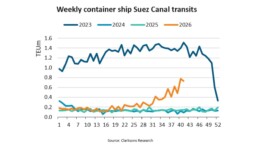
Suez Canal container ship transits exceed 50% of pre-disruption levels "During the first two weeks of October, weekly container ship capacity…
Subscribe to our newsletter!
if you dont want to swim alone in the ocean of news, sign up for the newsletter, and you will receive daily all the important news of world shipping!
