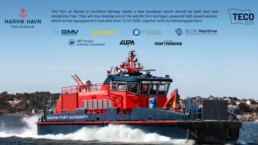

The Port of Narvik in northern Norway needs a new workboat which should be both fast and emissions-free. Together with eight project partners, they are now seeking public funding to build one of the world’s first hydrogen-powered, high-speed vessels.
The boat will be equipped with hydrogen fuel cells from TECO 2030 and will be built by the shipyard Grovfjord Mekaniske Verksted (GMV), which is located near Narvik.
When completed, the boat will replace one of the port’s diesel vessels. As a result, the Port of Narvik will be able to reduce both its diesel consumption and its CO2 emissions significantly.
“A new hydrogen-powered workboat will put the Port of Narvik in a unique position, where we will reduce our own emissions and use pioneering technology that will become important for both national and international shipping in the years to come,” says Børge Edvardsen Klingan, Port Director at the Port of Narvik.
“This project will contribute to economic growth and development in Narvik and its surrounding regions and will also be an important contribution to the green transition in the maritime industry. We are very happy that we are able to take the lead in reducing emissions from ships,” Klingan says.
The boat is planned to be completed in 2023. The Port of Narvik will mainly use it for keeping an overview of the port and the activities there, for emergency preparedness, and for teaching and training of crews.
The Port of Narvik aims to get the boat classified as a long-range, high-speed passenger vessel, and the plan is that it should be able to keep a pace of 23 knots.
The vessel’s fuel cells will be produced in Narvik
The fuel cells that will ensure the boat’s propulsion will be produced at the TECO 2030 Innovation Center in Narvik and will enable it to operate emissions-free. The boat will be one of the first vessels that will get fuel cells from TECO 2030 installed.
“We are thrilled that the Port of Narvik plans to build a hydrogen high-speed boat which will be powered by fuel cells from TECO 2030. We are looking forward to working on this project, and we are happy and grateful that the Port of Narvik has chosen TECO 2030 as supplier of fuel cells to their new hydrogen vessel,” says Tore Enger, CEO of TECO 2030 ASA.
“Now we only need to get support for this project by the Norwegian state enterprise Enova. Everything else has already been prepared, and we are ready to get to work. Hydrogen will be key to reducing greenhouse gas emissions from the maritime industry, but the development of hydrogen technology for ships and other hydrogen infrastructure requires large resources,” says Enger.
“We hope that the Norwegian government will stand by their promise to promote the development of climate and environmentally friendly shipping, and that we will therefore receive support from Enova for this project,” he adds.
UiT in Narvik is a research partner in the project
TECO 2030 has signed an agreement with UiT The Arctic University of Norway – which has a campus in Narvik – to cooperate on enhancing research and education in Norway on hydrogen and fuel cells.
UiT Narvik will therefore participate in the project as a research partner, with the aim of gaining expertise in maritime hydrogen systems. This will ensure that they can provide education that will enable their students to become valuable potential, future employees of the partners in the project.
The maritime engineering company BLOM Maritime, the hydrogen supplier Everfuel, the consultancies Proactima and KUPA, and the company Norinnova Narvik, which specialises in commercialising research results, are also partners in the project.
BLOM Maritime and Proactima will contribute to the development of the boat. BLOM Maritime will provide technical assistance to Grovfjord Mekaniske Verksted during the building of the boat, and Proactima will be responsible for risk assessments and analyses to ensure that it will be safe to use.
Knowledge dissemination will be an important part of the project, and KUPA will focus on disseminating the knowledge about hydrogen boats that will be developed during the boat’s building and testing phase. KUPA is leading a maritime technology cluster in Norway and will pass on lessons learned in the project to its members.
Hydrogen filling station for ships and road transport
The hydrogen boat will become Narvik’s first hydrogen consumer and will need to be refuelled on a regular basis. The project therefore also involves the establishment of a hydrogen filling station.
Everfuel will seek to develop this filling station. The company is currently working to establish hydrogen filling stations for trucks, buses and other heavy-duty transport all across Norway.
Other users of the port will also be able to use the planned filling station in Narvik. About 500 trucks drive through the city every day, and the filling station will therefore not solely be intended to cater for sea traffic.
The goal is that it will become the world’s first hydrogen filling station that can serve both ships and road traffic, and that its establishment will make it possible for more companies and people in the region to switch to climate-friendly hydrogen.
Everfuel will now, together with UiT and Norinnova Narvik, work to find possible new hydrogen users within the municipality and county municipality, such as buses, waste collection vehicles and taxis.
Hydrogen fuel cells: The engines of tomorrow
TECO 2030 is developing hydrogen fuel cells together with the Austrian powertrain technology company AVL. Hydrogen fuel cells are the engines of tomorrow and convert hydrogen into electricity while emitting nothing but water vapour and warm air.
By installing fuel cells, ships and other heavy-duty applications that are powered by diesel engines or generators can switch from fossil fuels to hydrogen and reduce their greenhouse gas emissions to zero.
Hydrogen fuel cells can also be used during port-stay, loading and discharging, enabling zero-emission operation at berth, without having to connect the ship to an onshore power supply.
Green transition in the maritime industry
Norway aims to reduce emissions from domestic shipping by at least 50% by 2030, compared with 1990. This target should be reached through a stronger focus on the development of low- and zero-emission solutions, and by setting emission requirements for ships operating on Norwegian fjords.
Norway plans to introduce requirements for low- and zero-emission solutions in public tenders to speed up the green transition in the maritime industry. Such requirements will be introduced in 2023 in new public tenders for ferry connections, and in 2025 for high-speed vessels.
Moreover, from 2026 only zero-emission cruise ships and ferries will be allowed entry into the Norwegian world heritage fjords.
Ships operating in Norwegian waters will therefore have to reduce their emissions and become more climate-friendly, and TECO 2030 will help them with that.
TECO 2030 is delivering technology that helps ships to reduce their environmental and climate impacts. In addition to hydrogen fuel cells, the company is developing carbon capture and exhaust gas cleaning systems for the maritime industry, which will enable ships running on fossil fuels to reduce their environmental and climate footprints.



Related News.

Global study finds Cyprus ranks SEVENTH and set for $1.1 billion AI GDP boost
Cyprus beats India and New Zealand to come SEVENTH in major AI study – with potential €1.1 billion GDP boost and youth jobs opportunity Some 86% of…
Global shipping’s trillion dollar climate bill according to Zero Carbon Analytics
A new study by Zero Carbon Analytics finds that emissions from international shipping cost the global economy around USD 963 billion between 1990…

Keeping Children Safe Online at Sea Seafy® earns friendly WiFi Certification across 26 vessels
Seafy becomes Friendly WiFi’s first partner in the maritime sector, helping protect kids from harmful content online. Friendly WiFi is delighted…
ShipManager joins Star Information Systems to accelerate the maritime industry’s transition to cloud
CFARER, a DNV Company selects Star Information Systems as the longterm home for ShipManager and its cloud future Star Information Systems (Star)…

Seafarer experience must shape maritime technology, initial STEER Project report finds
New research finds technology can shift rather than remove risk as The Nautical Institute, with support from Lloyd’s Register Foundation, calls for…
New LR service targets cargo disruption when trade routes fail
New LR Advisory service helps ports, governments and logistics operators respond to disruption, protect critical cargo flows and strengthen trade…

DORIC WEEKLY INSIGHT 06 NOVEMBER 2026
Please find below the DORIC Market Insight for the week ending 06th November 2026. Weekly Report 06.11.2026
BIMCO Shipping Number of the Week
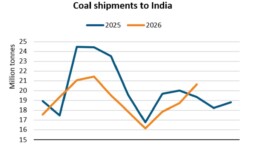
Coal shipments to India drop 7%, but limited recovery may lie ahead "Between January and October, coal shipments to India dropped 7% y/y due to the…
Hapag-Lloyd marks 20 years in South Africa and targets further growth
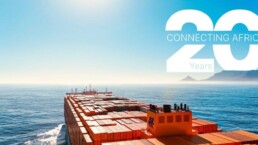
South Africa has become a cornerstone of Hapag-Lloyd's business in Africa Hapag-Lloyd surpasses 1 million TEU in Africa for the first time in its…
Subscribe to our newsletter!
if you dont want to swim alone in the ocean of news, sign up for the newsletter, and you will receive daily all the important news of world shipping!
