Clearing of shore pipelines – a final step in cargo loading operations
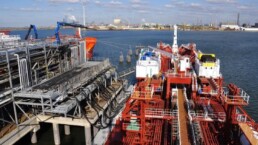

Over pressurization of vessel tanks when shore pipelines are cleared can cause physical distortion and even rupture of the tanks. Overfill of tanks during pipeline clearing can also result in pollution or personal injury when product escapes through the pressure vacuum valve. Pre-planning, training and communication between ship and shore reduce these risks.
Over the years, Gard has seen some extensive structural damage resulting from over pressurization of liquid cargo tanks during shore pipeline clearing either by line blowing or pigging. Line blowing is clearing shore pipeline using compressed air or nitrogen. Pigging is a form of line clearing in which an object, most often in the form of a rubber sphere or cylinder known as a “pig”, is pushed through the shore pipeline by a liquid or by compressed gas. A pig may be used to clear the pipeline completely, in which case it will usually be propelled by compressed gas, or to follow a previous grade of cargo to ensure that the pipeline remains as free of product as possible, in which case it is likely to be propelled by the next grade. Such operation is necessary to prevent mixing of grades or products in the shore pipeline to avoid cargo contamination and to ensure the line is ready for the next operation.
Pigging introduces product through the vessel cargo manifold and line blowing introduces both product and gas through the manifold. The immediate causes of structural damage to the tanks include:
- gas being supplied at a too high volume compared to the capacity of the ship’s tank vent system arrangement
- the amount of cargo being pushed into the ship’s cargo tank is too large compared to the tank ullage available
- the cargo coming at too fast a rate
The procedure for clearing shore pipelines between the shore tank and the ship manifold will depend on the facilities available at each terminal and the type of cargo loaded. Due to the volume being displaced into the cargo tank during pipeline clearing, it is extremely important that this flow is controlled at the manifold with the manifold valve. Ship and terminal procedures will address all relevant aspects of the cargo and line clearing operations, but it has become evident that enforcement of good communication between the involved parties prior to and during the entire operation is a key factor in preventing incidents.
Planning and responsibilities
All cargo operations must be carefully planned and documented well in advance of their execution. The details of the plans must be discussed with all personnel, both on the ship and at the terminal. How responsibility is to be shared between the ship and terminal must be agreed.
The Master should ensure that ship’s personnel assigned to duties during the cargo operations are properly trained and fully aware of the challenges and hazards associated with pipeline clearing operations for the relevant cargoes.
A pre-cargo operation meeting between personnel responsible for the operation from ship and terminal should confirm all critical interface parameters, including those important in the pipeline clearing operation.
The hazards and parameters to be discussed in pre-cargo operation meeting include:
| Hazards to be aware of | Parameters to be discussed in pre-cargo operation meeting |
|
|
At the commencement of loading, and at each change of watch or shift, the Responsible Officer and the Terminal Representative should each confirm that the communications system for the control of loading is understood by the personnel assigned to duties during the cargo operation. During the operation, there should be continuous and direct communication between the terminal and the ship until the operation has been completed and all valves have been closed.
Recommendations
In order to minimize risk of over pressurization:
- Avoid using tanks that that are loaded close to 98% as reception tanks for line clearing and include a safety margin when estimating required ullages for reception tanks to take account of potential inaccuracies in the terminal’s declared “pigging quantities”.
- Consider including provisions for a standby cargo tank to be lined up and ready to be opened should the risk of overfill arise.
- Keep manifold valves closed during idle periods. This will prevent inadvertent over pressurization due to shore error.
- ensure that the vapour return line to shore is open during the operation (when available).
- Monitor the manifold pressure closely and throttle the main manifold valve as required. At the start of the pigging operation, the valve should be opened minimally to control the flow and volume of liquid and propellant gas into the nearly full cargo tank. Gard strongly recommends that only properly trained and experience personnel are assigned duties related to operation of the ship manifold valves.
- Monitor the available amount of cargo tank ullage space and pressure in the tank. If the volume and/or pressure becomes too high, close the manifold valve, and alert the terminal to stop pigging.
- during freezing weather conditions, inspect tank vents (P/V valves) at regular intervals. Some products will freeze and clog the vents thereby creating pressure.
- Close the manifold valves immediately (in agreement with the terminal) once a pig has reached its receiver/trap to avoid compressed propelling gas entering a loaded cargo tank.
- Report immediately to the terminal any abnormalities or deviations from existing procedures.
Conclusion
Awareness of the hazards that arise in clearing of shore pipelines and training for the operation, careful pre-planning with terminal counterparts, and good communication between the ship and terminal personnel reduce the risk of over pressurization and overfill when completing cargo operations by clearing the shore pipeline.
Source: GARD



Related News.

Navigating the Multi-Orbit Era: In Conversation with Intellian’s Jon Harrison at SMM 2026
At SMM 2026 in Hamburg, the rapid evolution of maritime satellite communications took centre stage. Across the exhibition halls, discussions among…

Cyprus ports need joint energy and investment strategy, shipping agents chief says
Cyprus needs a coordinated strategy for shipping, energy and environmental protection to support port investment and modernisation, Cyprus shipping…

MASO Public Affairs introduces MASO Regulatory Intelligence
A new subscription service helping businesses understand what is changing and what it means for them MASO Public Affairs introduces MASO Regulatory…

Anglo-Eastern helps turn CMBTECH’s ammonia ambition into an operational reality
From early feasibility study and risk-based design to newbuilding supervision, crew readiness and technical management, Anglo-Eastern drew on its…

Escalation of attacks threatens to derail recovery in Middle East oil exports
World oil demand is forecast to fall by 2.5 mb/d y-o-y in 4Q26 and 2.6 mb/d on average in 2026. As the Iran war manifests itself through restricted…

New study finds shipping pays twice its share to EU ETS earmarked revenues should triple to help build market for sustainable fuels and technologies
Shipping is responsible for around 10% of EU ETS emissions but pays almost 20% of the ETS bill. Unlike other sectors, it has never received free…

MSARC strengthens maritime mass rescue readiness through training and national live exercise off Dakar, Senegal
Joint MSARC–FHAS programme combines three days of SAR training with a national multi-agency live exercise The Maritime Search and Rescue Council ,…

Sogese report deliveries are still being delayed as container freight rates fluctuate
FOR IMPORTERS Spot rates into the Mediterranean are back at January levels, Far East to Europe reliability sits at pandemic lows, and nearly…

Glencore begins trading on Australian Securities Exchange
Glencore has begun trading on the Australian Securities Exchange under the ASX code GLC. Gary Nagle, Glencore’s CEO, said it was an exciting day for…

BIMCO Shipping Number of the Week
Suez Canal container ship transits exceed 50% of pre-disruption levels "During the first two weeks of October, weekly container ship capacity…
Subscribe to our newsletter!
if you dont want to swim alone in the ocean of news, sign up for the newsletter, and you will receive daily all the important news of world shipping!
