Argentina becomes 100th State Party to MARPOL Annex VI
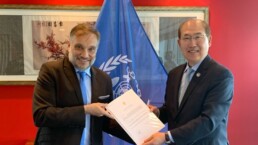

Argentina has become the 100th Contracting State to the mandatory International Maritime Organization (IMO) regulations on cutting air pollution from shipping.
The regulations in Annex VI of the International Convention for the Prevention of Pollution from Ships (MARPOL) address air pollution from ships and include energy efficiency and fuel quality requirements designed to reduce harmful emissions from shipping.
With Argentina’s ratification, the regulations now apply to 96.65% of world merchant shipping by tonnage.
IMO Secretary-General Kitack Lim welcomed the latest ratification. “The Annex VI regulations limit air pollutants from shipping and improve energy efficiency, helping to combat climate change by reducing CO2 emissions from shipping. I am pleased that we now have 100 Contracting States and encourage others who have not yet done so, to become a party to this important treaty,” Mr Lim said.
“We all need to do our part to ensure the health of people and the planet and to tackle climate change. MARPOL Annex VI provides the mandatory regulatory framework to limit harmful emissions from ships,” Mr. Lim said.
Mr. Lim noted that while the majority of ships by tonnage were already covered, all States, including coastal States, could benefit from becoming a party, since they can then exercise port State control over ships flying any flag visiting their ports.
MARPOL Annex VI (Regulations for the prevention of Air Pollution from Ships) sets mandatory limits on sulphur oxide (SOx) and nitrogen oxide (NOx) emissions from ship’s engine exhaust, it regulates onboard incineration and prohibits deliberate emissions of ozone depleting substances. It includes provisions for designated emission control areas with more stringent standards for SOx, NOx and particulate matter.
A chapter 4 adopted in 2011 includes mandatory technical and operational energy efficiency measures aimed at reducing greenhouse gas emissions from ships, which have been extended and strengthened throughout the past decade providing the mandatory regulatory framework that codifies the levels of ambition set out in IMO’s 2018 Initial GHG Strategy.
Parties to MARPOL Annex VI commit to give effect to the provisions of this Annex.
His Excellency Mr. Javier Esteban Figueroa, Ambassador Extraordinary and Plenipotentiary of Argentina deposited the instrument of accession with Mr. Lim on Tuesday, 8 June.
MARPOL Annex VI history
The issue of controlling air pollution from ships – in particular, noxious gases from ships’ exhausts – was discussed in the early 1970s, as IMO developed what would become the 1973 MARPOL Convention. However, it was decided not to include regulations concerning air pollution at the time.
Meanwhile, air pollution was being discussed in other arenas. The 1972 United Nations Conference on the Human Environment in Stockholm marked the start of active international cooperation in combating acidification, or acid rain – largely caused by airborne deposits of sulphur dioxides and nitrogen oxides. Coal and oil-burning power plants were the biggest source of sulphur dioxides while nitrogen oxides came from car, truck – and ship – exhausts.
In 1979, the Convention on Long‑range Transboundary Air Pollution was adopted by 34 governments and the European Community. This was the first international legally binding instrument to deal with problems of air pollution on a broad regional basis. Protocols were later signed on reducing sulphur emissions (1985); nitrogen oxides (1988); volatile organic compounds (1991) and further reducing sulphur emissions (1994).
In 1987 the Montreal Protocol on substances that Deplete the Ozone Layer was drawn up and adopted under the auspices of the United Nations, to cut consumption and production of ozone-depleting substances including chlorofluorocarbons (CFCs) and halons to protect the ozone layer. Protocols were adopted in 1990 and 1992.
At IMO, the Marine Environment Protection Committee (MEPC) in the mid-1980s had been reviewing the quality of fuel oils and the issue of air pollution was discussed.
In 1988, the MEPC agreed to include the issue of air pollution in its work programme. In 1991, IMO adopted Assembly Resolution A.719(17) on Prevention of Air Pollution from Ships. The Resolution called on the MEPC to prepare a new draft Annex to MARPOL on prevention of air pollution.
IMO’s MARPOL Annex VI was adopted at a Conference in September 1997, through a Protocol to the MARPOL Convention, which included the new Annex.
The Conference convened by IMO adopted a number of resolutions, including an important resolution 8 on CO2emissions from ships. This resolution invited the MEPC to consider what CO2 reduction strategies might be feasible in light of the relationship between CO2 and other atmospheric and marine pollutants. The resolution also invited IMO, in cooperation with the UNFCCC, to undertake a study of CO2 emissions from ships for the purpose of establishing the amount and relative percentage of CO2 emissions from ships as part of the global inventory of CO2 emissions.
(Meanwhile, the United Nations Framework Convention on Climate Change (UNFCCC) was adopted in December 1992, entering into force in 1994. In December 1997, the Kyoto Protocol to the UNFCCC was adopted (it entered into force in 2005). Under the Protocol, States agreed to limit and reduce emissions of greenhouse gas emissions not controlled by the Montreal Protocol from aviation and marine bunker fuels, working through the International Civil Aviation Organization (ICAO) and the International Maritime Organization (IMO), respectively (Article 2, paragraph 2))
The Protocol of 1997 (MARPOL Annex VI)
The Protocol including Annex VI of MARPOL entered into force on 19 May 2005. IMO Member States immediately agreed to revise the Annex and update its requirements. This revised annex was adopted in 2008 and entered into force in 2010.
This important revision included more stringent limits on sulphur oxide emissions from ships, bringing in a global 0.50% limit from 2020 – subject to a review. The review was completed – and the date of 2020 confirmed in 2016. The “IMO 2020” sulphur limit has undoubtedly contributed to a major cut in sulphur oxide emissions from ships, as ships switched to very low sulphur fuel oil or have installed exhaust gas cleaning systems to “clean” emissions with an onboard system and meet the requirements.
In 2011, IMO adopted a new chapter on energy efficiency, bringing in mandatory requirements for ships to improve their energy efficiency – and contribute to the fight against climate change by reducing their CO2 emissions.
The Initial IMO strategy on reduction of GHG emissions from ships was adopted in 2018.



Related News.
Navigating the Multi-Orbit Era: In Conversation with Intellian’s Jon Harrison at SMM 2026
At SMM 2026 in Hamburg, the rapid evolution of maritime satellite communications took centre stage. Across the exhibition halls, discussions among…
Cyprus ports need joint energy and investment strategy, shipping agents chief says
Cyprus needs a coordinated strategy for shipping, energy and environmental protection to support port investment and modernisation, Cyprus shipping…

MASO Public Affairs introduces MASO Regulatory Intelligence
A new subscription service helping businesses understand what is changing and what it means for them MASO Public Affairs introduces MASO Regulatory…
Anglo-Eastern helps turn CMBTECH’s ammonia ambition into an operational reality
From early feasibility study and risk-based design to newbuilding supervision, crew readiness and technical management, Anglo-Eastern drew on its…

Escalation of attacks threatens to derail recovery in Middle East oil exports
World oil demand is forecast to fall by 2.5 mb/d y-o-y in 4Q26 and 2.6 mb/d on average in 2026. As the Iran war manifests itself through restricted…
New study finds shipping pays twice its share to EU ETS earmarked revenues should triple to help build market for sustainable fuels and technologies
Shipping is responsible for around 10% of EU ETS emissions but pays almost 20% of the ETS bill. Unlike other sectors, it has never received free…
MSARC strengthens maritime mass rescue readiness through training and national live exercise off Dakar, Senegal
Joint MSARC–FHAS programme combines three days of SAR training with a national multi-agency live exercise The Maritime Search and Rescue Council ,…
Sogese report deliveries are still being delayed as container freight rates fluctuate
FOR IMPORTERS Spot rates into the Mediterranean are back at January levels, Far East to Europe reliability sits at pandemic lows, and nearly…
Glencore begins trading on Australian Securities Exchange
Glencore has begun trading on the Australian Securities Exchange under the ASX code GLC. Gary Nagle, Glencore’s CEO, said it was an exciting day for…
BIMCO Shipping Number of the Week
Suez Canal container ship transits exceed 50% of pre-disruption levels "During the first two weeks of October, weekly container ship capacity…
Subscribe to our newsletter!
if you dont want to swim alone in the ocean of news, sign up for the newsletter, and you will receive daily all the important news of world shipping!
