New Case Study Addressing the Future of Seafaring in Kiribati
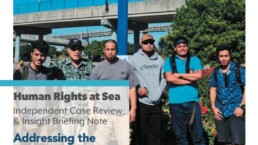

A globally dispersed community of seafarers from Kiribati are at the epicentre of an arduous struggle for repatriation following their displacement during the crew change crisis. Human Rights at Sea has today published a case review addressing their future in the global shipping industry following peer review.
Central to the dilemma is the termination of an agreement between a consortium of shipping companies and the Kiribati government, which has long facilitated the training and recruitment of I-Kiribati seafarers.
To understand the complex nature of the situation and the direct impact on the individuals involved, HRAS has collaborated with Mission to Seafarers Brisbane, who have been supporting 39 I-Kiribati crewmembers stranded in Australia. This is in addition to other i-Kiribati seafarers stranded globally and who are being supported by other welfare organisations, including the Hamburg-based Seemannspfarramt der Nordkirche.
Background
The current challenges faced by Kiribati’s maritime workforce are largely consequential to the international travel restrictions imposed by the global effort to manage the COVID-19 pandemic.
These restrictions disrupted the established ‘crew change’ system with such severity that it caused an apparent humanitarian crisis, which has resulted in up to 400,000 seafarers being stranded on their vessels, with an additional 400,000 unable to join their ships at all.
For Kiribati’s seafarers, the effect of the so-called ‘crew change crisis’ has been amplified by the logistics of traveling to and from the remote Pacific Island nation, and the fact that the country is currently free of COVID cases.
When the few available transit routes to the island were cut off in 2020 as the country’s border closures came into effect, more than 250 I-Kiribati seafarers became stranded internationally, predominantly in Australia, Fiji, Germany, Indonesia, and South Korea.
While shipping companies employing I-Kiribati seafarers have thus far supported the nation’s maritime workforce, the cost and apparent risk of employing them given their challenging circumstances have proved unsustainable.
Integrated shipping company Maersk is among the companies who have made an official decision to freeze the enlistment of I-Kiribati nationals.
As the shipping companies withdraw from their longstanding partnership with the island nation, I-Kiribati seafarers are coming to terms with the potential reality that, when they are eventually repatriated, they may never be employed as seamen again.
I-Kiribati seamen representing the group in Brisbane expressed concerns relating to financial challenges, vaccinations, their futures in the industry, and above all, the welfare of their young families at home.
Vaccination Rates
Group vaccinations are currently underway to prepare for the eventual return home. All crewmembers stranded in Hamburg, Germany; and Nadi, Fiji have been vaccinated, accounting for some 190 seafarers.
In Brisbane, Australia, four individuals have so far been vaccinated, with Mission to Seafarers currently arranging the vaccination of the remaining 35, bringing the total vaccination rate for the displaced crewmembers to around 90%.
Recommendations
HRAS and Mission to Seafarers Brisbane have together outlined three key recommendations to help facilitate the repatriation of I-Kiribati seafarers and secure their futures in the international maritime industry.
- Australia and New Zealand should become instrumental in establishing suitable systems and protocols in conjunction with the Kiribati government to manage the safe repatriation of I-Kiribati seafarers.
- Australia and New Zealand should establish ‘green lanes’ with the Kiribati government to facilitate alternative employment opportunities in the Pacific agriculture industry.
- A COVID-safe travel bubble between the Pacific Islands, Australia and New Zealand should be considered as an alternative to otherwise challenging international crew change systems.
HRAS Comment
“The global crew-change crisis continues unabated and while not always part of international news headlines, the detrimental effect upon I-Kiribati seafarers and their families is now a significant welfare problem that is bringing both their treatment and the restrictive Kiribati state response to the forefront of public awareness.”
CEO, David Hammond, commented: “Despite the restrictions of the COVID pandemic in terms of repatriation of I-Kiribati crew, the continuing uncertainty of them being able to return home continues to extend day-on-day directly impinging on their right to family life.”
“Concerns are also being raised to HRAS as to the mental health of some of the seafarers, and the increasing risk of potentially tragic individual outcomes.”
Mission to Seafarers Brisbane Comment
“The rights of these international workers of the sea, are forever in our minds and hearts,” MTS Brisbane President Ross Nicholls said.
“They are constantly forgotten, ignored or treated as second class citizens while we continue to live our lives enjoying the benefits of a developed economy,” he said.
“Seafarers constantly live in fear they will be replaced without recourse, they will be treated as illegal aliens or they will be left onboard their ship well beyond their contract term. All of these fears are a reality.
“This current situation is just another human injustice to the forgotten seafarer. We will continue to stand up for the welfare of the seafarers and their families who are in need of our love, care and assistance.”
Maersk Comment
“Maersk is fully committed to abide by the Maritime Labour Convention as well as safeguard the well-being of our seafarers, why we have worked extensively and in good faith since the beginning of the outbreak to secure a permanent and acceptable solution for our Kiribati colleagues,” Maersk told HRAS in their official statement.
“Sadly, and to our disappointment, our efforts with local government and authorities have not produced a successful outcome.
“As a result, and in order to safeguard our colleagues from a potential tightening of either national, regional or global travel restrictions, we had to make the decision to repatriate all our seafarers from Kiribati and freeze the enlistment of Kiribati nationals.
“As consequence, we are no longer participating in the partnership between Kiribati, New Zealand and South Pacific Marine Services.”



Related News.

Navigating the Multi-Orbit Era: In Conversation with Intellian’s Jon Harrison at SMM 2026
At SMM 2026 in Hamburg, the rapid evolution of maritime satellite communications took centre stage. Across the exhibition halls, discussions among…

Cyprus ports need joint energy and investment strategy, shipping agents chief says
Cyprus needs a coordinated strategy for shipping, energy and environmental protection to support port investment and modernisation, Cyprus shipping…

MASO Public Affairs introduces MASO Regulatory Intelligence
A new subscription service helping businesses understand what is changing and what it means for them MASO Public Affairs introduces MASO Regulatory…

Anglo-Eastern helps turn CMBTECH’s ammonia ambition into an operational reality
From early feasibility study and risk-based design to newbuilding supervision, crew readiness and technical management, Anglo-Eastern drew on its…

Escalation of attacks threatens to derail recovery in Middle East oil exports
World oil demand is forecast to fall by 2.5 mb/d y-o-y in 4Q26 and 2.6 mb/d on average in 2026. As the Iran war manifests itself through restricted…

New study finds shipping pays twice its share to EU ETS earmarked revenues should triple to help build market for sustainable fuels and technologies
Shipping is responsible for around 10% of EU ETS emissions but pays almost 20% of the ETS bill. Unlike other sectors, it has never received free…

MSARC strengthens maritime mass rescue readiness through training and national live exercise off Dakar, Senegal
Joint MSARC–FHAS programme combines three days of SAR training with a national multi-agency live exercise The Maritime Search and Rescue Council ,…

Sogese report deliveries are still being delayed as container freight rates fluctuate
FOR IMPORTERS Spot rates into the Mediterranean are back at January levels, Far East to Europe reliability sits at pandemic lows, and nearly…

Glencore begins trading on Australian Securities Exchange
Glencore has begun trading on the Australian Securities Exchange under the ASX code GLC. Gary Nagle, Glencore’s CEO, said it was an exciting day for…

BIMCO Shipping Number of the Week
Suez Canal container ship transits exceed 50% of pre-disruption levels "During the first two weeks of October, weekly container ship capacity…
Subscribe to our newsletter!
if you dont want to swim alone in the ocean of news, sign up for the newsletter, and you will receive daily all the important news of world shipping!
