Flying AI assistant to work with astronaut Matthias Maurer aboard the ISS
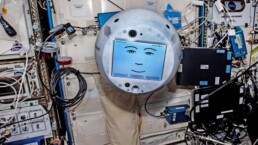

New tasks for the artificial astronaut assistant CIMON-2: The AI-controlled, flying sphere will take on scientific experiments on board the International Space Station ISS with ESA astronaut Matthias Maurer and provide educational services from orbit. CIMON-2 is already on board the ISS and Matthias Maurer is scheduled to launch with ‘Crew-3’ on his ‘Cosmic Kiss’ mission this autumn. The space agency DLR and Airbus have signed a mission contract to provide ‘in-orbit’ missions with four human partners.
After the successful technology demonstration with Alexander Gerst (CIMON-1) in November 2018 and Luca Parmitano (CIMON-2) in February 2020, the focus is now on the operational, scientific use of CIMON. The pilot scientific study, ‘Human interaction with Al and CIMON’, makes CIMON itself the research subject. It includes further activities in support of routine tasks and documentation of complex scientific tasks. These new missions will mark the first time that a complete experimental procedure is guided by CIMON, and more specifically, documented according to the individual wishes of the scientists or the crew.
In addition, scientific support is to be provided by CIMON-2 for an educational experiment known as ‘3D kinetic gas theory’. Kinetic gas theory explains the properties of gases, with the idea that gases consist of a very large number of small particles that are in constant motion.
The contract comprises up to four astronaut missions to secure a comprehensive dataset enabling sound analysis of CIMON-2’s capabilities. The knowledge gained from the new CIMON-2 missions will help enable CIMON for significantly more complex tasks in the future.
CIMON-2 is now being updated: it is receiving new software packages, new scientific procedures and is being adapted to new safety standards. CIMON-2 is also ‘learning’ German as a second language and will use this as part of educational activities from orbit, for example in a quiz for schoolchildren and in an explanatory tour of the ISS with astronaut Maurer.
The CIMON ‘family’
Development and construction of the interactive astronaut assistant CIMON was commissioned by the German Space Agency DLR with funding from the Federal Ministry for Economic Affairs and Energy and implemented by Airbus in Friedrichshafen and Bremen. Watson AI technology from the IBM Cloud serves as the voice-controlled artificial intelligence. The human aspects of the assistance system were co-developed and supervised by scientists from the Ludwig-Maximilians-University Hospital in Munich (LMU). The ESA User Support Centre Biotesc at the Lucerne University of Applied Sciences and Arts in Switzerland has ensured that CIMON also works perfectly in the Columbus module of the ISS and accompanies the astronauts’ collaboration with CIMON from Earth.
CIMON – the idea
CIMON is a technology experiment developed and built in Germany to support and increase the efficiency of an astronaut’s work. CIMON can display and explain information, instructions for scientific experiments and repairs. One advantage is that the astronaut has both hands free because he can access documents and media via voice control. Other applications include using it as a mobile camera to save astronaut working time. Routine tasks in particular could be handled by CIMON, such as documenting experiments, searching for objects and inventorying. CIMON can also see, hear, understand and speak. Its two eyes for orientation are a stereo camera, a high-resolution camera for face recognition and additionally two more lateral cameras for photos and video documentation. Ultrasonic sensors measure distances for collision detection. Its ears are eight microphones for direction recognition plus a directional microphone for good speech recognition. Its mouth is a loudspeaker through which it can speak and play music. At the core of the AI for understanding speech is IBM Watson AI technology from the IBM Cloud. Self-learning by CIMON has been ruled out; it must be actively trained by a human. The AI for autonomous navigation comes from Airbus and is used for motion planning and object recognition. With twelve internal rotors, CIMON can move and rotate freely in all spatial directions. Thus, it can turn towards the astronaut when addressed, nod its head, shake its head and follow spatially autonomously or on command.
*CIMON®, short for Crew Interactive MObile CompanioN, is a scientific project commissioned by the German Space Agency DLR. It is funded by DLR and the Federal Ministry for Economic Affairs and Energy (BMWi). CIMON® is a DLR trademark registered in Germany. The Airbus name as well as Airbus logos, product names and service designations are protected by trademark law. Other product or company names used or mentioned herein may be trademarks of their respective owners.



Related News.
Navigating the Multi-Orbit Era: In Conversation with Intellian’s Jon Harrison at SMM 2026
At SMM 2026 in Hamburg, the rapid evolution of maritime satellite communications took centre stage. Across the exhibition halls, discussions among…
Cyprus ports need joint energy and investment strategy, shipping agents chief says
Cyprus needs a coordinated strategy for shipping, energy and environmental protection to support port investment and modernisation, Cyprus shipping…
MASO Public Affairs introduces MASO Regulatory Intelligence
A new subscription service helping businesses understand what is changing and what it means for them MASO Public Affairs introduces MASO Regulatory…
Anglo-Eastern helps turn CMBTECH’s ammonia ambition into an operational reality
From early feasibility study and risk-based design to newbuilding supervision, crew readiness and technical management, Anglo-Eastern drew on its…

Escalation of attacks threatens to derail recovery in Middle East oil exports
World oil demand is forecast to fall by 2.5 mb/d y-o-y in 4Q26 and 2.6 mb/d on average in 2026. As the Iran war manifests itself through restricted…
New study finds shipping pays twice its share to EU ETS earmarked revenues should triple to help build market for sustainable fuels and technologies
Shipping is responsible for around 10% of EU ETS emissions but pays almost 20% of the ETS bill. Unlike other sectors, it has never received free…
MSARC strengthens maritime mass rescue readiness through training and national live exercise off Dakar, Senegal
Joint MSARC–FHAS programme combines three days of SAR training with a national multi-agency live exercise The Maritime Search and Rescue Council ,…
Sogese report deliveries are still being delayed as container freight rates fluctuate
FOR IMPORTERS Spot rates into the Mediterranean are back at January levels, Far East to Europe reliability sits at pandemic lows, and nearly…

Glencore begins trading on Australian Securities Exchange
Glencore has begun trading on the Australian Securities Exchange under the ASX code GLC. Gary Nagle, Glencore’s CEO, said it was an exciting day for…
BIMCO Shipping Number of the Week
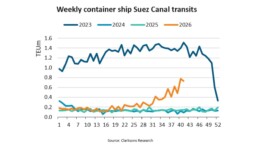
Suez Canal container ship transits exceed 50% of pre-disruption levels "During the first two weeks of October, weekly container ship capacity…
Subscribe to our newsletter!
if you dont want to swim alone in the ocean of news, sign up for the newsletter, and you will receive daily all the important news of world shipping!
