How RightShip’s Vetting Criteria improves standardisation


In this article, RightShip’s Global Marine Standards Manager, Marc Forster, outlines how customers have responded to the expanded Vetting Criteria and how it has helped the industry in recent months
In June, RightShip implemented our expanded Vetting Criteria, building on the previous standard to list 50 assessment items, up from 20 previously. Key additions include drilling down further in terms of incidents and PSC performance and looking at operator performance in more detail. Our team has added separate and brand-new sections for flag and class, ship structures, engineering, and a comprehensive section on human rights.
In addition, we have tried to make clear binary failings. This means if a vet fails on one of these hurdles, the vessel cannot be recommended at all. We’ve worked to ensure the enhanced Vetting Criteria benefits the industry.
Why we expanded the Vetting Criteria
RightShip vets more than 40,000 vessels a year. Increasingly we found that charterers were asking for more bespoke vetting rules in order to go over and above in the existing RightShip due diligence processes. We therefore sought to standardise these bespoke expectations, consolidating key trends found through RightShip’s proprietary vessel vetting service. We also cleansed incident databases and close out reports to better frame acceptability.
This means all vessels will be reviewed and receive an “acceptable” recommendation when they get a positive outcome during a vet. With clearer guidelines and less room for grey areas of safety, sustainability and social welfare practices, standards become higher.
Benefits for charterers and ship owners
Through improved standardisation of the vetting process, many charterers have been able to do away with their bespoke rules because they’re now part of the criteria. This improves efficiency in the vetting process and gives charterers a comprehensive due diligence picture. In addition, we’ve added in clear standards on human rights, which were not part of the last standard.
For example, we have included the following binary criterion: “Any vessel Flagged with a country that has not adopted and ratified the 2006 Maritime Labour Convention and without an equivalent level of compliance (for example a valid ITF Agreement).”
It’s also beneficial for ship owners, with a clear standard of expectation, there are fewer bespoke expectations to prepare for. Owners and operators therefore have a consistent criteria to work with and a clear understanding of what a charterer will be looking for in a vet. For example, we have a clear binary criterion stating that 35 years is the highest vessel age which will receive an “acceptable” recommendation.
Overall, improved vetting standardisation is beneficial for the entire supply chain, with an enhanced criteria, we are providing higher standards to work towards and opportunities to achieve operational excellence, which helps the industry work towards key safety, sustainability and social welfare goals.



Related News.

Navigating the Multi-Orbit Era: In Conversation with Intellian’s Jon Harrison at SMM 2026
At SMM 2026 in Hamburg, the rapid evolution of maritime satellite communications took centre stage. Across the exhibition halls, discussions among…

Cyprus ports need joint energy and investment strategy, shipping agents chief says
Cyprus needs a coordinated strategy for shipping, energy and environmental protection to support port investment and modernisation, Cyprus shipping…

MASO Public Affairs introduces MASO Regulatory Intelligence
A new subscription service helping businesses understand what is changing and what it means for them MASO Public Affairs introduces MASO Regulatory…

Anglo-Eastern helps turn CMBTECH’s ammonia ambition into an operational reality
From early feasibility study and risk-based design to newbuilding supervision, crew readiness and technical management, Anglo-Eastern drew on its…

Escalation of attacks threatens to derail recovery in Middle East oil exports
World oil demand is forecast to fall by 2.5 mb/d y-o-y in 4Q26 and 2.6 mb/d on average in 2026. As the Iran war manifests itself through restricted…
New study finds shipping pays twice its share to EU ETS earmarked revenues should triple to help build market for sustainable fuels and technologies
Shipping is responsible for around 10% of EU ETS emissions but pays almost 20% of the ETS bill. Unlike other sectors, it has never received free…

MSARC strengthens maritime mass rescue readiness through training and national live exercise off Dakar, Senegal
Joint MSARC–FHAS programme combines three days of SAR training with a national multi-agency live exercise The Maritime Search and Rescue Council ,…

Sogese report deliveries are still being delayed as container freight rates fluctuate
FOR IMPORTERS Spot rates into the Mediterranean are back at January levels, Far East to Europe reliability sits at pandemic lows, and nearly…

Glencore begins trading on Australian Securities Exchange
Glencore has begun trading on the Australian Securities Exchange under the ASX code GLC. Gary Nagle, Glencore’s CEO, said it was an exciting day for…
BIMCO Shipping Number of the Week
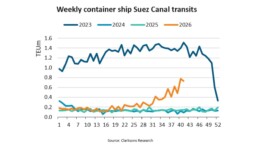
Suez Canal container ship transits exceed 50% of pre-disruption levels "During the first two weeks of October, weekly container ship capacity…
Subscribe to our newsletter!
if you dont want to swim alone in the ocean of news, sign up for the newsletter, and you will receive daily all the important news of world shipping!
