Why doing business as usual can cost us dearly


I am a proud dad of two young kids. Since they were born, the world has experienced a global pandemic, increasing social unrest, numerous political conflicts, and countless natural disasters from heat waves and wildfires to record flooding.
Oftentimes, when we talk about sustainability, we think about it in terms of the distant future. But looking at the past few years alone, it becomes clear that we don’t need solutions in, say, five years. We need them now.
It’s not about what we are doing to make the world better by the time our children are grown up, but about what can we do to make things better right now. What are we doing to make an impact by the time they learn to ride a bike, have their first day in kindergarten, leave school, and enter their first job?
We need to act now to ensure that our children have a sustainable future.
We might think that our individual actions don’t matter. But changes – both big and small –in the way we live our lives can help reduce our own personal carbon footprint, and also encourage other individuals, businesses, and policy makers to act for the good of the planet. Because at the end of the day, everything counts. Every day we act, every step we take, every decision we make can help move the needle. And vice versa: Every step we don’t take today will take us three steps back in the future.
Today is Earth Overshoot Day 2021. It marks the date when humanity has exhausted nature’s budget for the year. From this day forward, we are using an unsustainable amount of the world’s resources. The exact date each year is calculated based on 3 million statistical data points from 200 countries, and the team at Global Footprint Network explains the process here in more detail.
This year’s date is almost as early as in 2019, when it fell on July 26, after being momentarily pushed back in 2020 by lockdowns due to the coronavirus pandemic. So for more than 40 years, we have been using up our planet’s resources in excess. Our desire for every aspect of our lives to become better, faster, and newer is not only stealing from a planet that cannot keep up with the demands of almost 8 billion people, but also costing our future generations an Earth on which they can live and prosper.
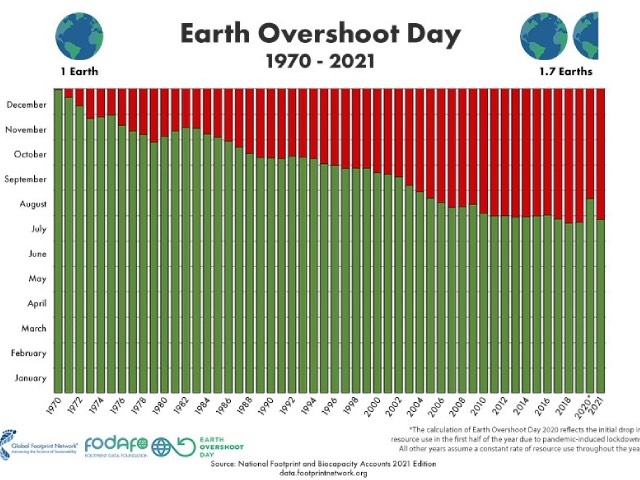
COVID-19 Reset
The graphic above shows what is possible in extreme situations such as with the numerous lockdowns and restrictions due to the COVID-19 pandemic.
Just a few examples: Due to beach closures in Florida, female turtles laid more eggs. In Japan — one of my favorite countries to visit — the Nara deer left the park to find food because the tourists that would normally feed them were no longer there. Air and water quality improved as tourism ground to a halt. For the first time in 30 years, Indians in the city of Jalandhar and the surrounding area could see the Himalayas.
These examples show that our planet could recover relatively quickly if given the chance. However, life in many parts of the world is returning to a new version of normal with more and more people receiving vaccinations. While this is good for humanity, it also has an impact on nature.
Our Responsibility
The private sector for sure has its part to play if we are to combat climate change. Businesses should not focus exclusively on profit maximization, but at turning things around, in the here and now, for current and future generations.
Without any doubt, sustainability is about more than protecting our environment. It is about ensuring the balance between economic growth, environmental care, and social welfare. That said, carbon neutrality is a major driver and key indicator of sustainability.
At SAP, we set our goal to become carbon-neutral in our own operations by the end of 2023, two years earlier than previously stated. The SAP approach is of first avoiding, second reducing, and third compensating for emissions. You can read more about our goal for 2023 here.
But in addition to pursuing our own targets, we also want to help our customers become more sustainable. Because we are convinced: It’s time to build sustainability into the fabric of how we do business. We need to make it a standard dimension of corporate management just like productivity or growth.
We’ve developed various solutions to help businesses embed operational, experiential, and financial data and insights to drive sustainability at scale. With our sustainability portfolio, we support companies on their entire journey across the full spectrum of sustainability – from carbon neutrality to social impact and economic progress.
Additionally, we will drive multi-year innovation roadmaps to ultimately provide our customers with end-to-end visibility around sustainability, integrated into their core business processes. To get to our vision of Chasing Zero, we must act now with the goal of zero waste, zero emissions, and zero inequality.
Given the significance of global supply chains in tackling sustainability, the SAP community truly has the power to protect our planet and create a future our children want to be part of. So, let’s give our planet the chance to recover and #MoveTheDate together.



Related News.

Navigating the Multi-Orbit Era: In Conversation with Intellian’s Jon Harrison at SMM 2026
At SMM 2026 in Hamburg, the rapid evolution of maritime satellite communications took centre stage. Across the exhibition halls, discussions among…
Cyprus ports need joint energy and investment strategy, shipping agents chief says
Cyprus needs a coordinated strategy for shipping, energy and environmental protection to support port investment and modernisation, Cyprus shipping…

MASO Public Affairs introduces MASO Regulatory Intelligence
A new subscription service helping businesses understand what is changing and what it means for them MASO Public Affairs introduces MASO Regulatory…
Anglo-Eastern helps turn CMBTECH’s ammonia ambition into an operational reality
From early feasibility study and risk-based design to newbuilding supervision, crew readiness and technical management, Anglo-Eastern drew on its…

Escalation of attacks threatens to derail recovery in Middle East oil exports
World oil demand is forecast to fall by 2.5 mb/d y-o-y in 4Q26 and 2.6 mb/d on average in 2026. As the Iran war manifests itself through restricted…
New study finds shipping pays twice its share to EU ETS earmarked revenues should triple to help build market for sustainable fuels and technologies
Shipping is responsible for around 10% of EU ETS emissions but pays almost 20% of the ETS bill. Unlike other sectors, it has never received free…
MSARC strengthens maritime mass rescue readiness through training and national live exercise off Dakar, Senegal
Joint MSARC–FHAS programme combines three days of SAR training with a national multi-agency live exercise The Maritime Search and Rescue Council ,…
Sogese report deliveries are still being delayed as container freight rates fluctuate
FOR IMPORTERS Spot rates into the Mediterranean are back at January levels, Far East to Europe reliability sits at pandemic lows, and nearly…
Glencore begins trading on Australian Securities Exchange
Glencore has begun trading on the Australian Securities Exchange under the ASX code GLC. Gary Nagle, Glencore’s CEO, said it was an exciting day for…
BIMCO Shipping Number of the Week
Suez Canal container ship transits exceed 50% of pre-disruption levels "During the first two weeks of October, weekly container ship capacity…
Subscribe to our newsletter!
if you dont want to swim alone in the ocean of news, sign up for the newsletter, and you will receive daily all the important news of world shipping!
