Bloom Energy achieves key milestones on its path to decarbonise the marine industry


Bloom Energy’s solid oxide fuel cells to power an engineless LNG carrier developed by Samsung Heavy Industries
ABS verifies Bloom Energy Server as an alternative power source for vessels as part of the organization’s New Technology Qualification service
Bloom Energy announced the achievement of two key milestones on its path to decarbonize a centuries-old maritime industry. In conjunction with Samsung Heavy Industries (SHI), the companies’ initial design for an engineless, fuel cell-powered liquefied natural gas (LNG) carrier has received Approval in Principle (AiP) from DNV, a premier international maritime classification society. Bloom Energy also received verification as an alternative power source for vessels as part of the American Bureau of Shipping’s (ABS) New Technology Qualification (NTQ) service. This progress is a testament to Bloom Energy’s industry leadership in providing clean, reliable power through its flexible platform technology that can seamlessly adapt to future-forward applications.
The opportunity for fuel cell-powered ships has accelerated in recent years, as the International Maritime Organization (IMO) set aggressive environmental targets to combat climate change. A key objective for international shipping under the IMO’s mandate is to reduce greenhouse gas emissions by half compared to 2008 levels. New technologies and power sources for shipping, like fuel cells, are recognized as viable carbon-reducing solutions to achieving the IMO’s environmental goals.
DNV Approval in Principle Granted for 100 Percent Fuel Cell-Powered LNG Carrier
SHI and Bloom Energy first announced plans in 2019 to design and develop fuel cell-powered ships. Earlier this month, the companies took another step toward realizing that goal with receipt of an Approval in Principle from DNV, an international maritime classification society, for an LNG carrier powered solely by solid oxide fuel cell (SOFC) technology. This fuel cell-propelled LNG carrier eliminates the need for internal combustion engines by replacing the ship’s propulsion and auxiliary engines with fuel cells running on non-combusted natural gas.
“With 80 percent of world trade taking place by sea, Bloom Energy and SHI have developed a novel solution to reduce harmful emissions and modernize one of the world’s oldest forms of trade with cutting edge, clean energy technology,” said Suminder Singh, senior director, engineering, marine applications, Bloom Energy. “Building on the successful deployment of our fuel cells on land powering large loads, Bloom Energy Servers are well-suited to meeting the significant energy requirements of shipping vessels. They are also highly efficient, reduce fuel usage, and in the case of LNG carriers, create enhanced opportunities for operators to sell fuel at port.”
Bloom Energy’s SOFC technology has the added benefit of eliminating harmful air pollutants like sulfur oxides (SOx), nitrogen oxides (NOx), and particulate matter, has negligible methane slippage, and can significantly reduce carbon dioxide emissions from shipping vessels. As such, the new fuel cell-powered LNG carrier is expected to provide operators a more sustainable option to meet international emission reduction targets.
“Our new concept vessel can dramatically reduce air pollutant emissions, as well as noise and vibration and maintenance and repair costs, by replacing an internal combustion engine with fuel cells,” said Jeong Ho-hyeon, head of Samsung Heavy Industries’ Technology Development Division. “We will lead the international standardization of fuel cell propulsion systems.”
SHI plans to conduct tests at LNG demonstration facilities at its shipyard in Geoje, South Korea and will be launching full-scale marketing for global ship developers.
ABS Verifies Bloom Energy’s Fuel Cell Technology for Marine Environment
Bloom Energy’s technology was recently awarded a Concept Verified Statement of Maturity by ABS, a leading global provider of classification and technical advisory services to the marine and offshore industries.
ABS engineers reviewed Bloom Energy’s SOFC technology and verified its potential application as an alternative power source for vessels as part of the ABS New Technology Qualification (NTQ) service. The NTQ service offers guidance on early adoption and efficient implementation of new technologies – demonstrating the technologies’ maturity and risk profile.
“The certification process for marine fuel cells is a rigorous process, requiring new technologies undergo a variety of operating scenarios to ensure they can withstand the harsh conditions at sea,” said Suminder Singh. “This verification demonstrates the durability of Bloom Energy’s technology and serves as an important milestone on our path to commercial application.”
“ABS understands the potential that Bloom Energy has to make a real contribution to shipping’s decarbonization ambitions,” said Patrick Ryan, senior vice president, global engineering and technology, ABS. “Our verification highlights the progress of Bloom Energy’s technology to be used at sea, and it marks our commitment to supporting the industry with the safe adoption of fuel cells that meet the highest of standards.”
Bloom Energy expects to achieve final ABS certification and classification in 2022



Related News.

Global study finds Cyprus ranks SEVENTH and set for $1.1 billion AI GDP boost
Cyprus beats India and New Zealand to come SEVENTH in major AI study – with potential €1.1 billion GDP boost and youth jobs opportunity Some 86% of…

Global shipping’s trillion dollar climate bill according to Zero Carbon Analytics
A new study by Zero Carbon Analytics finds that emissions from international shipping cost the global economy around USD 963 billion between 1990…

Keeping Children Safe Online at Sea Seafy® earns friendly WiFi Certification across 26 vessels
Seafy becomes Friendly WiFi’s first partner in the maritime sector, helping protect kids from harmful content online. Friendly WiFi is delighted…

ShipManager joins Star Information Systems to accelerate the maritime industry’s transition to cloud
CFARER, a DNV Company selects Star Information Systems as the longterm home for ShipManager and its cloud future Star Information Systems (Star)…

Seafarer experience must shape maritime technology, initial STEER Project report finds
New research finds technology can shift rather than remove risk as The Nautical Institute, with support from Lloyd’s Register Foundation, calls for…

New LR service targets cargo disruption when trade routes fail
New LR Advisory service helps ports, governments and logistics operators respond to disruption, protect critical cargo flows and strengthen trade…

DORIC WEEKLY INSIGHT 06 NOVEMBER 2026
Please find below the DORIC Market Insight for the week ending 06th November 2026. Weekly Report 06.11.2026
BIMCO Shipping Number of the Week
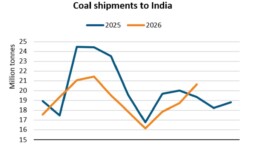
Coal shipments to India drop 7%, but limited recovery may lie ahead "Between January and October, coal shipments to India dropped 7% y/y due to the…

Hapag-Lloyd marks 20 years in South Africa and targets further growth
South Africa has become a cornerstone of Hapag-Lloyd's business in Africa Hapag-Lloyd surpasses 1 million TEU in Africa for the first time in its…
Subscribe to our newsletter!
if you dont want to swim alone in the ocean of news, sign up for the newsletter, and you will receive daily all the important news of world shipping!
