“Ship Carbon Recycling Working Group” of Japan’s Carbon Capture & Reuse Study Group has confirmed that carbon recycled methane can be recognized as zero emission ship fuel
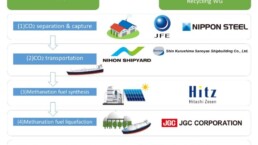

The “Ship Carbon Recycling Working Group(WG)” of Japan’s Carbon Capture & Reuse (CCR) Study Group has confirmed that carbon recycled methane produced by methanation technology (Note 1) can be recognized as zero emission ship fuel. A technical paper describing the details of the calculation procedure and evaluation conducted by the WG has been published in the latest issue of the journal of Japan Institute of Marine Engineering.
Carbon recycling, which is the process of capturing and reusing emitted CO2, is becoming increasingly important as one of the pathways to realize a carbon-neutral society.
To explore the feasibility of the concept of utilizing methanation technology for zero-emission ship fuels(Note2), the WG was formed within Japan’s CCR Study Group, and started its activity in July 2020.
Since it is a basic premise for the WG’s activity that carbon recycled methane can be recognized as zero-emission fuel, the WG firstly worked on the evaluation of its potential.
While International Maritime Organization (IMO) has yet to develop the rules for calculating emissions from the onboard fuel combustion of carbon recycled methane (Tank to Propeller), the importance to be cognizant of CO2 emissions in the fuel supply process(Well to Tank) has been noted.
The WG has assumed and evaluated (Note 4) the following four processes as the supply chain for carbon-recycled methane fuel: (1) CO2 separation and capture, (2) CO2 transportation, (3) methanation fuel synthesis, and (4) methanation fuel liquefaction. As a result, the CO2 emission per unit calorific value of carbon-recycled methane fuel by methanation was calculated as approximately 27-gCO2/MJ (regarded as Well to Propeller).
This figure is comparable to other alternative fuel candidates generally recognized as zero-emission fuels, confirming that carbon-recycled methane can be recognized as zero emission ship fuel. In addition, further reduction to approximately 20-gCO2/MJ is expected by improving the efficiency of the separation and capture technology, and using electricity produced from renewable energy.
A technical paper describing the details of the calculation procedures and evaluation involved in this study was published in the journal of Institute of Japan Marine Engineering, Vol. 56, No. 4.
In order to verify the feasibility of carbon recycled methane as a ship fuel, the WG will continue to work on issues such as CO2 transportation by large-scale liquified CO2 carrier vessels, supply of hydrogen from renewable energy, prevention of methane slip (Note 5), supply infrastructure of liquefied methanation fuel, and economic viability.
(Note 1) Methanation is a technology for synthesizing methane, the main component in natural gas, by causing a chemical reaction between hydrogen and CO2 in a reactor vessel filled with a catalyst. It uses emitted CO2 separated and captured from industrial facilities. As the CO2 generated when combusting synthesized methane is considered to be offset by the separated and captured CO2, it is expected that CO2 emissions can be significantly reduced by using hydrogen generated by electrolyzing water with electricity derived from renewable energy.
(Note 2) IMO considering measures to reduce GHG emissions in international shipping, adopted the IMO GHG initial strategy in April 2018, aiming to improve carbon intensity of the sector by at least 40% by 2030 and reduce annual GHG emissions by at least 50% in 2050, both compared to 2008 levels, and eventually phase out GHG emissions as early as possible within the century. Carbon recycled methane by methanation has gathered attention as a highly expected technology for the realization of GHG zero emission.
(Note 3) The CCR Study Group was established with the objectives of proposing effective carbon neutral measures to reduce the use of fossil fuels by offering alternative energies such as synthetic methane, which is generated by combining CO2 generated by industries with renewable energy-derived hydrogen, and contributing to the establishment of a new energy supply system by 2050. https://ccr-tech.org/
(Note 4) The assumed supply chain in the study spans multiple countries, the consideration may be necessary to which country emitted CO2, including ocean-going shipping transportation, should be allocated, but that has yet to be determined as no international framework or agreement has been formed.
(Note 5) Methane slip is the unburned and exhausted methane from the main engine. Methane is GHG with 25 times greenhouse effect of CO2



Related News.
Navigating the Multi-Orbit Era: In Conversation with Intellian’s Jon Harrison at SMM 2026
At SMM 2026 in Hamburg, the rapid evolution of maritime satellite communications took centre stage. Across the exhibition halls, discussions among…
Cyprus ports need joint energy and investment strategy, shipping agents chief says
Cyprus needs a coordinated strategy for shipping, energy and environmental protection to support port investment and modernisation, Cyprus shipping…

MASO Public Affairs introduces MASO Regulatory Intelligence
A new subscription service helping businesses understand what is changing and what it means for them MASO Public Affairs introduces MASO Regulatory…
Anglo-Eastern helps turn CMBTECH’s ammonia ambition into an operational reality
From early feasibility study and risk-based design to newbuilding supervision, crew readiness and technical management, Anglo-Eastern drew on its…

Escalation of attacks threatens to derail recovery in Middle East oil exports
World oil demand is forecast to fall by 2.5 mb/d y-o-y in 4Q26 and 2.6 mb/d on average in 2026. As the Iran war manifests itself through restricted…
New study finds shipping pays twice its share to EU ETS earmarked revenues should triple to help build market for sustainable fuels and technologies
Shipping is responsible for around 10% of EU ETS emissions but pays almost 20% of the ETS bill. Unlike other sectors, it has never received free…
MSARC strengthens maritime mass rescue readiness through training and national live exercise off Dakar, Senegal
Joint MSARC–FHAS programme combines three days of SAR training with a national multi-agency live exercise The Maritime Search and Rescue Council ,…
Sogese report deliveries are still being delayed as container freight rates fluctuate
FOR IMPORTERS Spot rates into the Mediterranean are back at January levels, Far East to Europe reliability sits at pandemic lows, and nearly…

Glencore begins trading on Australian Securities Exchange
Glencore has begun trading on the Australian Securities Exchange under the ASX code GLC. Gary Nagle, Glencore’s CEO, said it was an exciting day for…
BIMCO Shipping Number of the Week
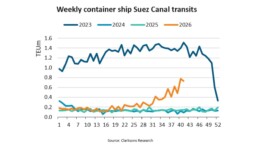
Suez Canal container ship transits exceed 50% of pre-disruption levels "During the first two weeks of October, weekly container ship capacity…
Subscribe to our newsletter!
if you dont want to swim alone in the ocean of news, sign up for the newsletter, and you will receive daily all the important news of world shipping!
