World first as WindFloat Atlantic Windfarm is classed by ABS
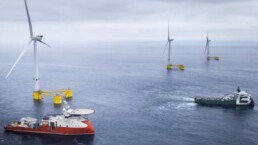

WindFloat Atlantic has become the world’s first classed offshore windfarm, after its three 8.4MW floating turbines were accepted by the ABS Class Committee.
The three ABS-classed, SEMI Submersible Type units designed by Principle Power housing MHI Vestas turbines make a total of 25 MWs of floating offshore wind power. WindFloat Atlantic, of which Ocean Winds is the majority shareholder, is continental Europe’s first larger scale floating wind farm, 20 kilometers off the coast of Viana do Castello, Portugal.
“It’s a historic first and, we believe, the first of many more to come. ABS has made a significant contribution both to this project and the development of offshore floating wind in Portugal. It underscores the potential of Class and industry working together for the safe adoption of new technologies. ABS has supported innovation in offshore energy since 1958. This landmark project underlines how we continue to support promising offshore technology more than 60 years later,” said Matt Tremblay, ABS Senior Vice President, Global Offshore.
“The WindFloat Atlantic project is again showing its technology reliability. Having achieved formal ABS classification for the three floating platforms is therefore an important milestone for the project shareholders and also for the offshore floating wind industry,” said Jose Pinheiro, Ocean Winds Southern Europe BU Country Manager.
The landmark is the latest step in a journey that began with the earliest days of floating wind in Portugal when ABS supported development of the 2MW WindFloat 1 that was installed in 2012.
The WindFloat Atlantic project is developed by the Windplus consortium, which is jointly owned by Ocean Winds (50:50 JV owned and created by EDP Renewables and ENGIE), Repsol, and Principle Power Inc.
Thanks to their floating foundations, floating offshore wind farms are not subject to the same depth restrictions as fixed structures and can be at any depth. With the development of larger turbines above 10 MWs and research focused on shallow water moorings, the floating technology may even be an alternative to traditional bottom- founded technologies in intermediate water depths in the future.
ABS is the leading classification organization for floating offshore wind and continues to lead the development of design standards and concepts for floating offshore wind turbine foundations. ABS certified the first commercial-sized semisubmersible floating offshore wind turbine and released the ABS Guide for Building and Classing Floating Offshore Wind Installations in 2013. ABS was the first class society to venture offshore, certifying the world’s first mobile offshore drilling unit in 1958 and classing the first jackup, semisubmersible, drillship, FPSO, TLP and spar.



Related News.
Global study finds Cyprus ranks SEVENTH and set for $1.1 billion AI GDP boost
Cyprus beats India and New Zealand to come SEVENTH in major AI study – with potential €1.1 billion GDP boost and youth jobs opportunity Some 86% of…

Global shipping’s trillion dollar climate bill according to Zero Carbon Analytics
A new study by Zero Carbon Analytics finds that emissions from international shipping cost the global economy around USD 963 billion between 1990…

Keeping Children Safe Online at Sea Seafy® earns friendly WiFi Certification across 26 vessels
Seafy becomes Friendly WiFi’s first partner in the maritime sector, helping protect kids from harmful content online. Friendly WiFi is delighted…

ShipManager joins Star Information Systems to accelerate the maritime industry’s transition to cloud
CFARER, a DNV Company selects Star Information Systems as the longterm home for ShipManager and its cloud future Star Information Systems (Star)…

Seafarer experience must shape maritime technology, initial STEER Project report finds
New research finds technology can shift rather than remove risk as The Nautical Institute, with support from Lloyd’s Register Foundation, calls for…

New LR service targets cargo disruption when trade routes fail
New LR Advisory service helps ports, governments and logistics operators respond to disruption, protect critical cargo flows and strengthen trade…
DORIC WEEKLY INSIGHT 06 NOVEMBER 2026
Please find below the DORIC Market Insight for the week ending 06th November 2026. Weekly Report 06.11.2026
BIMCO Shipping Number of the Week
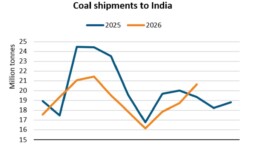
Coal shipments to India drop 7%, but limited recovery may lie ahead "Between January and October, coal shipments to India dropped 7% y/y due to the…

Hapag-Lloyd marks 20 years in South Africa and targets further growth
South Africa has become a cornerstone of Hapag-Lloyd's business in Africa Hapag-Lloyd surpasses 1 million TEU in Africa for the first time in its…
Subscribe to our newsletter!
if you dont want to swim alone in the ocean of news, sign up for the newsletter, and you will receive daily all the important news of world shipping!
