The world’s first flying hydrogen boat is a fact! TU Delft students on to world championships.
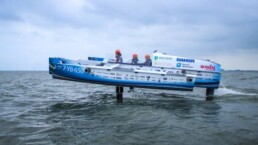

The TU Delft Solar Boat Team has spent a year working towards their dream: realizing
the first flying hydrogen boat with their project Hydro Motion. The 20 students have
pulled it off: a seaworthy boat, fully equipped with a hydrogen system and super
strong hydrofoils under the boat. At a speed of 22 kilometers per hour, the hydrofoils
make the boat, a trimaran weighing over 1000 kilograms, fly above the water. After the
design, production and testing period, it is time for the final phase of this project: it is
time to race! The team will compete in the World Championship next week on the open
sea in Monaco, which takes place from July 8 to 10. The students will be going for the
win of the challenging long-distance race, competing against other sustainably
powered boats. The Hydro Motion boat is an impressive inspiration for the maritime
sector.
Sailing and flying on the long-distance race Full of courage, the 20 students began the exciting year. It would be a huge job to realize the boat within one year. Rick van Wilsem, Chief Engineer, says enthusiastically, “We succeeded, we can say that with certainty. The entire boat has come out of the water. We are proud to announce with the team that we have made the world's first foiling hydrogen boat!”
From July 8 to 10, the student team will compete for the world title in Monaco. This is
because the students are competing in the Open Sea Class of the Monaco Energy Boat
Challenge. They strive to win the long-distance race with the innovative boat. With this they want to demonstrate the potential of hydrogen powered boats.
It will be a hugely exciting race where the team will compete against formidable opponents from around the world, students but also companies. Electric and hydrogen powered boats will compete against each other in three parts; maneuverability, the sprint and as the most important race the long-distance race. The team has set its sights on the latter race. The hydrogen boat has been optimized to take on this challenge: sailing for 6 hours straight on the open sea without refueling. The team that covers the most distance is the winner. The race can be followed through the website and the social media channels of the TU Delft Solar Boat Team. The team is now busy with the final preparations for the world championships in Monaco. For example, a race simulation is being performed, in which everyone can prepare his or her role for the race. The team is really looking forward to it!
The team is testing the hydrogen boat in the Netherlands in preparation for the race in Monaco.
The Hydro Motion hydrogen boat
The boat the team has been working on this year is an impressive sight: a seaworthy, over 8-meter-long trimaran, equipped with a complete hydrogen system, the smartest electronics, all the components to propel the boat powerfully, and the strongest hydrofoils. The boat is operated by three pilots and reaches speeds of up to 40 kilometers per hour. In the student’s boat, hydrogen gas is stored under high pressure in an on-board tank. The fuel cell combines this hydrogen with oxygen from the air to generate electricity. This powers the engine and sails the boat.
But how does this huge hydrogen boat get into the air? Attached underneath the boat are
three super strong hydrofoils. These operate below the surface of the water in a similar way to the wings of an airplane. At the take-off speed of 22 kilometers per hour, they elevator the weight some 40 centimeters above the waves, a spectacular sight. When the hulls of the boat fly above the water, they experience drastically less resistance than in the water. In this way, the boat uses very little energy. Efficiency is of great importance during the challenging long-distance race that awaits the team in Monaco.
Team members put the cap on the boat; it protects the hydrogen tank.
The team’s mission
The TU Delft Solar Boat Team is a multidisciplinary team consisting of 20 students. They all put their studies aside for a year for the Hydro Motion project. Last summer the close-knit team was formed with whom they work closely together day in and day out, learning a lot and making progress. The students are working on this cool project with an important mission.
They want to inspire the maritime industry, currently a large consumer of fossil fuels, towards a green future. Previously, the team made solar boats, as the name implies. After 15 years, a big step was taken with the transition to hydrogen. With the help of alumni and partner companies, the students took on the new challenge. They switched from generating green energy to storing it. Being able to store green energy on board is an essential step to greening shipping. Especially for larger ships and long distances, there is a need for a medium that can store a lot of green energy in little volume. Hydrogen is a good option for this.



Related News.

Global study finds Cyprus ranks SEVENTH and set for $1.1 billion AI GDP boost
Cyprus beats India and New Zealand to come SEVENTH in major AI study – with potential €1.1 billion GDP boost and youth jobs opportunity Some 86% of…

Global shipping’s trillion dollar climate bill according to Zero Carbon Analytics
A new study by Zero Carbon Analytics finds that emissions from international shipping cost the global economy around USD 963 billion between 1990…
Keeping Children Safe Online at Sea Seafy® earns friendly WiFi Certification across 26 vessels
Seafy becomes Friendly WiFi’s first partner in the maritime sector, helping protect kids from harmful content online. Friendly WiFi is delighted…
ShipManager joins Star Information Systems to accelerate the maritime industry’s transition to cloud
CFARER, a DNV Company selects Star Information Systems as the longterm home for ShipManager and its cloud future Star Information Systems (Star)…
Seafarer experience must shape maritime technology, initial STEER Project report finds
New research finds technology can shift rather than remove risk as The Nautical Institute, with support from Lloyd’s Register Foundation, calls for…
New LR service targets cargo disruption when trade routes fail
New LR Advisory service helps ports, governments and logistics operators respond to disruption, protect critical cargo flows and strengthen trade…

DORIC WEEKLY INSIGHT 06 NOVEMBER 2026
Please find below the DORIC Market Insight for the week ending 06th November 2026. Weekly Report 06.11.2026
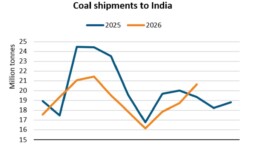
BIMCO Shipping Number of the Week
Coal shipments to India drop 7%, but limited recovery may lie ahead "Between January and October, coal shipments to India dropped 7% y/y due to the…
Hapag-Lloyd marks 20 years in South Africa and targets further growth
South Africa has become a cornerstone of Hapag-Lloyd's business in Africa Hapag-Lloyd surpasses 1 million TEU in Africa for the first time in its…
Subscribe to our newsletter!
if you dont want to swim alone in the ocean of news, sign up for the newsletter, and you will receive daily all the important news of world shipping!
