Konecranes launches new generation of energy-efficient mobile harbor cranes as global trade accelerates
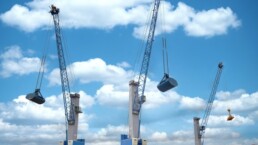

- New Generation 6 high-performance model portfolio targets growing global bulk and general cargo handling market demand as COVID-19 pandemic eases
- Engineered for electric power, new cranes can also run on battery power, cutting fuel and maintenance costs and helping Konecranes’ customers meet their low-carbon targets
- New interactive MHC Product Advisor lets customers configure the right crane for their requirements, easing the impact of COVID-19 restrictions on face-to-face meetings
- Sales of the new products have now started
Konecranes today launched its sixth generation of mobile harbor cranes, refreshing and reinforcing its industry-leading portfolio as global trade accelerates and the industry seeks more sustainable lifting solutions to reduce its climate impact.
Generation 6 marks the first comprehensive revamp of Konecranes Gottwald’s mobile harbor crane portfolio in 15 years, and comes as growth in the global bulk and general cargo handling market accelerates. Research from Drewry Maritime Advisors forecasts the global bulk and general cargo handling market, excluding RoRo and vehicle traffic, to grow 6.8% year-on-year in 2021 to 7.4 billion tonnes. Drewry expects growth to continue in coming years, reaching 8.5 billion tonnes by 2025, a compound annual growth rate of 3.5%.
Konecranes, which launched the world’s first mobile harbor crane in 1956 and is a pioneer in Ecolifting™, has worked closely withcustomers around the world while developing the new cranes. The result is a range of products that can eco-efficiently service essentially any type of vessel and any kind of cargo – containers, general cargo, project cargo and bulk – in any location, either on the quay or on a barge. Sales are now underway.
“Konecranes is a pioneer and leader in high-performance mobile harbor cranes, and today’s launch underscores that pedigree at a time when growth in the global bulk and cargo handling market gathers pace and customers are seeking more sustainable solutions,” said Konecranes President and CEO Rob Smith.
“These cranes represent the best of Konecranes in terms of technology and durability, and thus also strongly support our commitment to sustainability. The carbon footprint of our customers is just as important as our own, and we aim to reduce it through low-carbon, eco-efficient solutions and by extending product lifecycles in ports, factories and everywhere our products and services are used,” Smith said.
Freedom to move – with lower emissions
Reflecting Konecranes’ commitment to a decarbonized and circular world for customers and society at large, Generation 6 is designed for electrical power use; power can be sourced from an onshore grid, meaning no direct carbon emissions during operation. Operators can also choose a new battery solution that also reduces emissions and gives greater flexibility by permitting crane operation independent from the grid. For quays without a power supply, a common occurrence in developing markets, the cranes come with fuel-saving diesel generators and Konecranes’ latest hybrid drives.
“Stevedores globally, big and small, are increasingly focused on reducing the carbon footprint of their operations in the near term. Growing trade and the need to replace old equipment will likely mean increased demand from ports around the world for more efficient cargo handling equipment to support increases in productivity, reduction of costs and CO2 emissions,” said Dinesh Sharma, Director at Drewry Maritime Advisors.
In addition to lower emissions, the design of the crane advances circularity through a more durable design: its robust construction doubles the cranes’ service life in container operation compared to earlier generations, and more powerful lifting capacity curves and high working speeds ensure greater efficiency and faster cargo turnaround times. The long-lasting design not only saves the resources needed to build new cranes – it supports resale values when customers choose to renew their fleets.
A truly connected fleet, designed by the customer
The new products also reflect Konecranes’ technology leadership. The new cranes will be equipped with smart crane features for safe, ergonomic and efficient crane operation, and will come equipped with TRUCONNECT remote monitoring, which collects condition, usage and operating data from control systems and sensors to help with maintenance planning and predicting possible component or equipment failure. Customers will also get access to the yourKONECRANES customer portal for a comprehensive view of equipment maintenance needs and performance.
These capabilities reflect Konecranes’ investment in the growing opportunities of data. The company has a data science laboratory in Lyon, France, as part of its continuing drive to digitalize products, services, and operations, and has tapped the real-time insights from its tens of thousands of connected devices and pieces of equipment around the world to balance demand and supply in real time and navigate through the COVID-19 pandemic.
Konecranes today also launched its online self-service Product Advisor, which gives customers the chance to configure their own cranes, facilitating the purchasing process at a time when face-to-face meetings – the main way the industry has done business for decades – can be difficult due to the pandemic.



Related News.

Greece has the most to lose from delays in shipping’s green transition, new analysis finds
UCL and WWF Greece report finds the IMO Net-Zero Framework offers Greek ship owners the clarity they need, and the best protection against a…

Snow Land joins Cool Carriers as the world’s first reefer with a gate rudder, a new chapter for sustainable and efficient reefer shipping
Cool Carriers, the world’s largest operator of specialised reefer vessels, took delivery of Snow Land from Kitanihon Shipbuilding in Japan on 12…

IBIA launches Marine Energy Outlook Survey as Annual Convention in New York
IBIA - The International Bunker Industry Association officially launched its Marine Energy Outlook Survey during the IBIA Annual Convention in New…

Why did ITF staff vote to strike again?
Staff at the International Transport Workers’ Federation (ITF) headquarters in London have voted to give their union a strike mandate. According to…

Nearly half of maritime crew tickets booked a week ahead are cancelled
Two new C Teleport reports show when maritime and aircrew teams book crew flights, how often they cancel, and what late booking costs, with a…

Kpler completes $1.5bn+ Sixth Street investment and continues accelerating growth
Investment backs Kpler's bold ambition to shape the future of global trade intelligence. Kpler, a leading provider of global physical trade…

How SAL and DNV are strengthening heavy-lift shipping
From classification and newbuilding support to operational tools and advisory expertise, SAL and DNV have been collaborating for decades. The…

PSA Singapore breaks ground on Tuas Port Phase Two to strengthen Global Trade Connectivity
PSA Singapore marked the groundbreaking of Tuas Port Phase Two, a significant step in the development of the world’s largest fully automated…

 …

BIFA welcomes UK–EU trade progress and calls for clarity on implementation
The British International Freight Association (BIFA) has welcomed progress made at today's UK–EU Summit in Brussels, highlighting the potential…
Subscribe to our newsletter!
if you dont want to swim alone in the ocean of news, sign up for the newsletter, and you will receive daily all the important news of world shipping!
