

Diminishing attractiveness of a career at sea, coupled with rising man-berth ratios and continued fleet growth will lead to the highest shortfall of officers to crew the world’s merchant fleet in over a decade by 2026, with important implications for both hiring and future manning cost inflation, according to the latest Manning Annual Review and Forecast report published by global shipping consultancy Drewry.
The current officer supply shortfall is estimated to equate to around 3% of the global pool, which is broadly manageable and is not noticeably impacting hiring, but is to some extent masked by the temporary idling of vessels in certain sectors such as cruise, due to the Covid-19 pandemic. Ratings supply is much more elastic due to lower entry requirements and short training periods.
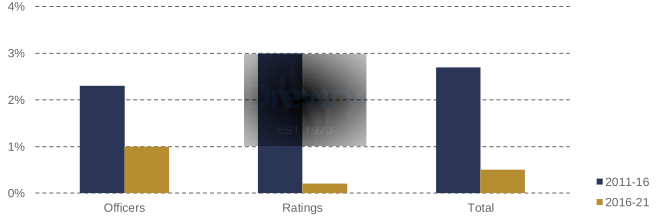
However, looking ahead to 2026 the supply / demand gap is expected to widen to a deficit equating to over 5% of the global officer pool and the highest level since 2013. The principal reason for this is the slowdown in officer supply as the attractiveness of a career at sea is diminishing. In the five years to 2016 the supply of seafarers available to crew the global merchant fleet was growing at an average annual rate of 2.7%, according to Drewry estimates. However, over the last five years this growth rate has shrunk to just 0.5% annually (see chart).
“With the ongoing negative effects of life at sea brought about by the Covide-19 pandemic, some seafarers may bring retirement plans forward, while others may look for work ashore,” said Drewry’s head of manning research Rhett Harris. “It has been the case for a number of years that quality officers have been difficult to recruit and retain. This situation is expected to get worse as the growth in supply fails to keep pace with an expanding world fleet.”
Changes in seafarer supply (2011-16 Vs 2016-21, % CAGR)
Despite these trends, underlying aggregate manning costs, excluding the impact of Covid-19, are expected to rise moderately in 2021, according to Drewry estimates, increasing just 0.4% over the year, a similar pace to last year. Looking further ahead, tightening labour market conditions and better affordability will drive up crewing costs, but increases will remain below the prevailing rate of consumer price inflation.
“While ratings supply has slowed, availability is relatively elastic and wage levels will remain driven by collective bargaining arrangements,” explained Harris. “By contrast, officer remuneration is more market driven but the widening shortage of officers is expected to affect the quality more than the quantity available for service. Drewry therefore expects employers currently paying low-wages will be more affected by fallout from the COVID-19 pandemic, as disgruntled seafarers are enticed to better paying owners or different roles ashore.
Source: Drewry



Related News.

Navigating the Multi-Orbit Era: In Conversation with Intellian’s Jon Harrison at SMM 2026
At SMM 2026 in Hamburg, the rapid evolution of maritime satellite communications took centre stage. Across the exhibition halls, discussions among…

Cyprus ports need joint energy and investment strategy, shipping agents chief says
Cyprus needs a coordinated strategy for shipping, energy and environmental protection to support port investment and modernisation, Cyprus shipping…

MASO Public Affairs introduces MASO Regulatory Intelligence
A new subscription service helping businesses understand what is changing and what it means for them MASO Public Affairs introduces MASO Regulatory…

Anglo-Eastern helps turn CMBTECH’s ammonia ambition into an operational reality
From early feasibility study and risk-based design to newbuilding supervision, crew readiness and technical management, Anglo-Eastern drew on its…

Escalation of attacks threatens to derail recovery in Middle East oil exports
World oil demand is forecast to fall by 2.5 mb/d y-o-y in 4Q26 and 2.6 mb/d on average in 2026. As the Iran war manifests itself through restricted…

New study finds shipping pays twice its share to EU ETS earmarked revenues should triple to help build market for sustainable fuels and technologies
Shipping is responsible for around 10% of EU ETS emissions but pays almost 20% of the ETS bill. Unlike other sectors, it has never received free…

MSARC strengthens maritime mass rescue readiness through training and national live exercise off Dakar, Senegal
Joint MSARC–FHAS programme combines three days of SAR training with a national multi-agency live exercise The Maritime Search and Rescue Council ,…

Sogese report deliveries are still being delayed as container freight rates fluctuate
FOR IMPORTERS Spot rates into the Mediterranean are back at January levels, Far East to Europe reliability sits at pandemic lows, and nearly…

Glencore begins trading on Australian Securities Exchange
Glencore has begun trading on the Australian Securities Exchange under the ASX code GLC. Gary Nagle, Glencore’s CEO, said it was an exciting day for…

BIMCO Shipping Number of the Week
Suez Canal container ship transits exceed 50% of pre-disruption levels "During the first two weeks of October, weekly container ship capacity…
Subscribe to our newsletter!
if you dont want to swim alone in the ocean of news, sign up for the newsletter, and you will receive daily all the important news of world shipping!
