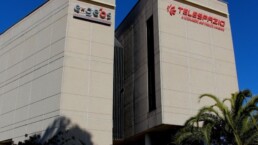
Telespazio is at the head of a consortium selected by the European Space Agency to study communication and navigation services for the Moon

- The international consortium includes satellite operators, manufacturing and service companies, SMEs, universities and research centres
- The services will rely on satellites and terrestrial stations to support space exploration and the development of the “Lunar Economy”
- “Communications and positioning are essential for the sustainable presence of men and women on the Moon and for beneficial effects on life on Earth,” says CEO Luigi Pasquali
Leveraging on the satellite communication and navigation services that are common on Earth, European Space Agency (ESA) has awarded a contract to a consortium led by Telespazio, a joint venture between Leonardo (67%) and Thales (33%), in the role of large mission integrator, to study how to design an equivalent infrastructure and service around the Moon.
The study is part of ESA’s Moonlight initiative, which aims at creating a financially sustainable Lunar Communication and Navigation Services (LCNS) and its associated infrastructure for lunar exploration. At the end of the study phase, ESA is planning to select an operator for the management of the LCNS system and the supply of services.
The contract between ESA and Telespazio was signed today at a digital event attended by the Director of Telecommunications and Integrated Applications at ESA, Elodie Viau, the Director of Human & Robotic Exploration Programme at ESA, David Parker, the Director of Navigation at ESA, Paul Verhoef, Telespazio’s CEO, Luigi Pasquali, and the President of the Italian Space Agency (ASI), Giorgio Saccoccia.
The consortium includes Inmarsat and Hispasat (satellite operators) and manufacturing companies such as Thales Alenia Space (a joint venture between Leonardo 67% and Thales 33%), OHB and MDA, ALTEC. SMEs (such as Nanoracks Europe and Argotec) and universities and research centres (such as SEE Lab SDA Bocconi and Politecnico di Milano) will also be involved.
The study will define the architecture and the model of the service provision for the future development of a complete (end-to-end) system that, relying on terrestrial infrastructure and space assets (such as satellites), will be able to guarantee services to the various platforms orbiting the Moon or located on its surface, e.g. rovers, landers or lunar bases that will be used in the upcoming missions. Over the next 10 years, there are estimated to be 80 public and private initiatives dedicated to lunar exploration. The proposal of the consortium guided by Telespazio is the answer to ESA’s intention to define an infrastructure that can support the needs and requirements of the world’s space agencies and of private and commercial companies that, in a not-too-distant future, will create a real “Lunar Economy”. For this reason, the project includes the creation of different standards and service models for lunar missions, based on the analysis of the market over the coming years and of user needs.
The project will also analyse if it is possible for the LCNS system to interoperate with LunaNet, the infrastructure currently being developed by NASA to support the missions of the Artemis programme.
Luigi Pasquali, the Coordinator of Leonardo’s Space Activities and CEO of Telespazio, said, “In the year of its sixtieth anniversary, Telespazio is proud to be leading a project that is so strategically relevant to the future of European and world space exploration, working with large, small and medium-sized businesses and academic centres. Communication and positioning services will be essential for the sustainable presence of men and women on the Moon and will be able to guarantee beneficial effects on life on Earth.”
Elodie Viau, ESA’s Director of Telecommunications and Integrated Applications, said: “A lasting link with the Moon enables sustainable space exploration for all our international partners, including commercial space companies. By using an ESA-backed telecommunications and navigation service for the Moon, explorers will be able to navigate smoothly and to relay to Earth all the knowledge gained from these lunar missions. A robust, reliable and efficient telecommunications and navigation system will make the dozens of individual missions planned for the Moon more cost-efficient and enable smaller countries to become space-faring nations, inspiring the next generation of scientists and engineers.”
Positioning and communication systems will play a key role in supporting exploration missions on our satellite, e.g. by guaranteeing astronauts and robotic systems are constantly in contact with control centres, in addition to ensuring the correct and accurate surface positioning of exploration vehicles, be they independent or under human control, or navigation during the cruising and landing phases of shuttles travelling between Earth and the Moon. In perspective, these services will also support the birth and development of the future “Lunar Economy”, in terms of space tourism and, for example, the possibility of using lunar mineral resources on site, which makes the exploration of other planets in the solar system cheaper and easier and, at the same time, limits the impact of mining activities on our own planet.



Related News.

Greece has the most to lose from delays in shipping’s green transition, new analysis finds
UCL and WWF Greece report finds the IMO Net-Zero Framework offers Greek ship owners the clarity they need, and the best protection against a…

Snow Land joins Cool Carriers as the world’s first reefer with a gate rudder, a new chapter for sustainable and efficient reefer shipping
Cool Carriers, the world’s largest operator of specialised reefer vessels, took delivery of Snow Land from Kitanihon Shipbuilding in Japan on 12…

IBIA launches Marine Energy Outlook Survey as Annual Convention in New York
IBIA - The International Bunker Industry Association officially launched its Marine Energy Outlook Survey during the IBIA Annual Convention in New…

Why did ITF staff vote to strike again?
Staff at the International Transport Workers’ Federation (ITF) headquarters in London have voted to give their union a strike mandate. According to…

Nearly half of maritime crew tickets booked a week ahead are cancelled
Two new C Teleport reports show when maritime and aircrew teams book crew flights, how often they cancel, and what late booking costs, with a…

Kpler completes $1.5bn+ Sixth Street investment and continues accelerating growth
Investment backs Kpler's bold ambition to shape the future of global trade intelligence. Kpler, a leading provider of global physical trade…

How SAL and DNV are strengthening heavy-lift shipping
From classification and newbuilding support to operational tools and advisory expertise, SAL and DNV have been collaborating for decades. The…

PSA Singapore breaks ground on Tuas Port Phase Two to strengthen Global Trade Connectivity
PSA Singapore marked the groundbreaking of Tuas Port Phase Two, a significant step in the development of the world’s largest fully automated…

 …

BIFA welcomes UK–EU trade progress and calls for clarity on implementation
The British International Freight Association (BIFA) has welcomed progress made at today's UK–EU Summit in Brussels, highlighting the potential…
Subscribe to our newsletter!
if you dont want to swim alone in the ocean of news, sign up for the newsletter, and you will receive daily all the important news of world shipping!
