How does Orbital Altitude affect satellite network performance?
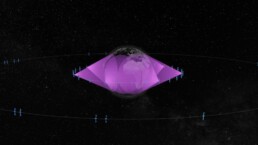

Combining cutting-edge technology with market-proven success
Thousands of satellites orbit the earth – but not all satellite networks are created equal. Satellite services vary depending on which orbit they operate in, making an understanding of each orbit’s characteristics and capabilities critical to decision-of which satellite network is right for you.
Satellites orbiting the Earth fall into one of three categories:
Geostationary Earth Orbit (GEO) satellites orbit at 35,786 km above the surface of the earth. They match the Earth’s rotation as they travel, remaining above the same point on the ground. Hundreds of GEO satellites are in orbit today, delivering services such as weather data, broadcast TV, and some data communications. Due to their size and altitude, only three GEO satellites are required to cover the entire surface of the earth.
Medium Earth Orbit (MEO) satellites occupy the space between 5,000 and 12,000 km above earth and are typically used for GPS and other navigation applications. More recently, these constellations have also been deployed to deliver reliable connectivity services to government agencies, commercial enterprises, and remote areas where laying fibre is not viable (such as cruise, airplanes and offshore platforms). Their lower altitude enables lower latency compared to GEO satellites but necessitates more spacecraft – between eight and 20 – for complete coverage.
Low Earth Orbit (LEO) satellites operate between 850 and 2000 km. This orbit is densely populated with thousands of satellites in operation today, primarily addressing science, imaging, and low-bandwidth telecommunications needs, including the Hubble space telescope, military observation satellites and Earth Observation missions. While LEO satellites deliver the lowest latency of the three orbits, LEO networks require an exponentially higher number of satellites for full coverage, and atmospheric drag reduces satellite lifespan.
New Opportunities with MEO
SES had already established our leadership role in the GEO market when we acquired MEO operator, O3b Networks, in 2016 a move that allowed us to expand our global reach and provide an unprecedented level of connectivity to the world’s most underserved regions. Today, we operate 20 satellites in medium earth orbit, enabling fibre-equivalent broadband in a wide range of scenarios:
- Enabling 4G LTE services for residents of Gilgit-Bastistan, a Pakistani territory characterised by harsh weather and a mountainous and rocky terrain
- Powering Carnival Corporation’s Ocean guest experience platform, which allows passengers on its Princess Cruises MedallionClass ships to open cabin doors, order food and beverages, book excursions and navigate the vessel via a wearable RFID tag connected to a network of sensors throughout the ship
- Supporting real-time collaboration across MODEC’s fleet of floating production, storage and offloading vessels off the coast of Brazil for improved production and enhanced operational efficiency
SES is taking that success to the next level with O3b mPOWER, our next-generation MEO constellation. Designed with unmatched system-level flexibility to support bandwidth-intensive and latency-sensitive cloud workloads, O3b mPOWER delivers dedicated, private connections just one hop away from cloud service providers. Furthermore, it is designed to minimise size and power usage with advanced digital payload technology and resource control software, so these satellites ensure the services you receive today can be economically scaled up—both in speed and number of customers served.
O3b mPOWER is built on commercially proven technology and based on a market-proven business case. For our customers, this means eliminating business and operational risk, and having the confidence to move their business growth forward and modernise their networks. It also leverages software innovation to deliver cloud-scale service level agreements (SLAs), automate service delivery where and when it’s needed, and seamlessly interoperate with existing networks to accelerate time to market for our customers
What about LEO?
The last few years have seen an emergence of interest in LEO satellites, with LEO operators promising low-latency connectivity that may even outperform terrestrial networks. While latency is indeed a major determiner of data performance, LEO’s limited coverage, complex inter-satellite networking, and elaborate ground infrastructure challenge the logistics of achieving high performance.
MEO satellite technology, on the other hand, is already established and proven. As the only satellite operator with assets in multiple orbits, SES can provide the connectivity our customers need, when they need it. O3b mPOWER takes that capability to the next level with an architecture that automatically switches data paths among MEO, GEO and terrestrial networks to meet application requirements, provide resilience or expand coverage.



Related News.

Hong Kong Global Maritime Trade Summit to return for third edition
The International Chamber of Shipping, in collaboration with the Transport and Logistics Bureau of the Government of Hong Kong and the Hong Kong…

Appetite for US crude oil exports climbs despite high freight
South Korea tops US crude destinations at 568,600 b/d VLCC rates to Asia double, closing arbitrage window European refining margins…

Shipping stocks Rally as Hormuz Traffic plunges 75%
Ship traffic through the Strait of Hormuz — a critical chokepoint handling about 20% of global crude oil and liquefied natural gas shipments — has…

Diana Shipping announces Time Charter Contract for m/v G P Zafirakis with Classic Maritime
Diana Shipping, a global shipping company specializing in the ownership and bareboat charter-in of dry bulk vessels, announced that, through a…
New IMO ESP Code framework for Remote Inspection Techniques
The International Maritime Organisation, through Resolution MSC.584(111) , has adopted amendments to the International Code on the Enhanced…

ABS opens Offshore & Marine Support Center in Bergen
ABS has expanded its capabilities in the Norwegian maritime market with the opening of a cutting-edge support center in Bergen, bringing advanced…

MOL holds giant step memorial ceremony and beach cleanup at Kashima Coast
Memorial and Reflection 20 Years After the Accident: Learning from the Past to Foster an Even Stronger Safety Culture Mitsui O.S.K. Lines, announced…
KEZAD-based Arabian Gulf Steel Industries achieves lowest verified Carbon Footprint for Rebar
CARES UK verified Environmental Product Declaration confirms 139 kg CO₂e per tonne for rebar produced at AGSI’s KEZAD Abu Dhabi facility Arabian…
Indian Register of Shipping announces launch of first fleet support ship INS Surya
Indian Register of Shipping continues to strengthen its role in supporting the Indian Navy and India’s naval shipbuilding capabilities through the…

VLCCs Climbing the Record Charts
LR2 The TC1 75kt MEG/Japan index decreased by only a single point this week to WS928. The corresponding Baltic round-trip TCE fell by $2,000 to…
Subscribe to our newsletter!
if you dont want to swim alone in the ocean of news, sign up for the newsletter, and you will receive daily all the important news of world shipping!
