How battery-powered and low emissions tugboats will benefit the LNG Canada project
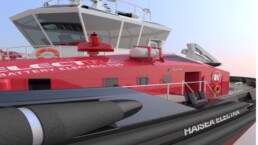

How battery-powered and low emissions tugboats will benefit the LNG Canada project, local and Indigenous communities, and the environment.
At LNG Canada, we’re committed to protecting the environment in which we operate. That means looking after both land and sea, and relying on local knowledge, cutting-edge technologies and innovation.
We’re proud to be working with local First Nations and companies who know the B.C. coast better than anyone. And we’re very excited about a unique partnership formed between the Haisla Nation and North Vancouver-based Seaspan ULC.
Majority-owned by the Haisla Nation, the new venture is called HaiSea Marine, which has a major contract with LNG Canada to build and operate escort tugs and harbor tugs required for our export facility in Kitimat.
With the agreement, various marine and land-based positions will be created, providing long-term employment to community members interested in a maritime career.
HaiSea Marine will provide ship-assist and escort services to LNG carriers navigating Douglas Channel and approaches in Kitimat Harbour. The neighbouring Gitxaala Nation and Gitga’at Nation will also benefit from the project.
The escort and harbour tugboats are being designed by Vancouver-based naval architects and marine engineers Robert Allan Ltd. (RAL) and feature leading edge technology.
What will make these vessels so special? Using battery-electric power and natural gas instead of diesel fuel, they’ll form one of the greenest tug fleets ever assembled
At 28 metres in length, with approximately 70 tonnes bollard pull and 5240 kWh of battery capacity each, the first-of-class ElectRA 2800 battery-electric harbour tugs will perform the majority of their ship-berthing and unberthing missions on battery power. Bollard pull is primarily used for measuring the strength of tugboats, with most commercial harbour tugs having around 60 to 65 tonnes-force.
With ample clean hydroelectric power available in Kitimat, the harbour tugs will be able to recharge from dedicated shore charging facilities at their berths between jobs, effectively reducing emissions to near-zero. Because of their battery propulsion, they are also expected to be exceptionally quiet, both onboard and underwater.

The RAstar 4000 DF
The larger RAstar 4000 DF vessels will be the most powerful Azimuth Stern Drive (ASD) escort tugs on Canada’s west coast, and will rank among the world’s highest-performing escort tugs.
At 40 metres in length (roughly half the length of a football field) and with over 95 tonnes of bollard pull, they will generate indirect forces of approximately 200 tonnes. ASD tugs are equipped with two stern engines capable of generating a 360°, all-directional propulsion force.
The RAstar 4000 DF escort tugs will perform the majority of their missions using natural gas as their primary fuel. This allows major emissions reductions compared to conventional diesel tugs of the same power, in compliance with the most stringent emissions standards in the international marine industry. In addition to these environmental benchmarks, the escort tugs will be capable of pollution response/oil spill recovery, fire fighting of marine terminal fires, person overboard response, and emergency towage of vessels.
As a fleet, the new escort and harbour tugs are expected to reduce carbon dioxide emissions by up to 10,000 tonnes per annum compared to diesel-powered alternatives, with major reductions of nitrogen oxides, sulphur oxides, carbon monoxide, and particulate matter as well. In addition, all of the new tugs will be equipped with the external fire-fighting capability of 2,400 m3/hr (pumping enough water to fill one Olympic-sized swimming pool every hour).
“As majority owner of HaiSea Marine, we’re excited about the opportunities Haisla members will have working locally in the marine industry,” says Crystal Smith, Chief Councillor of the Haisla Nation. “It’s extremely important to us that aside from being one of the most powerful tug fleets on the west coast, it will also be one of the greenest ever assembled, anywhere.”
HaiSea’s Senior Project Manager, Captain Jordan Pechie, says the new partnership is a perfect fit. “Seaspan and the Haisla have hundreds of years of combined experience in these waterways,” he notes. “Our mandate is to operate at the highest level of safety and environmental standards, which will allow this legacy to thrive for generations to come.”
RAL President and CEO Mike Fitzpatrick also welcomes the opportunity to work with the Haisla Nation, noting that his firm already has a long-standing relationship with Seaspan. “We value highly the many quality shipyards with whom we have forged close working relationships over many years, and who have helped immeasurably to demonstrate the quality of our brand,” he says.
The new tugs will arrive well in time for LNG Canada’s first cargo at mid-decade.
“The ElectRA 2800 and RAstar 4000 DF tugboats will be a welcome sight in Kitimat Harbour and Douglas Channel,” says Captain Mark Turner, LNG Canada’s Marine Superintendent. “They represent our commitment to federal and provincial authorities, First Nations, communities and joint venture partners, and demonstrate our operational safety philosophy, environmental stewardship with respect to zero emissions and underwater noise mitigation.”



Related News.
Hong Kong Global Maritime Trade Summit to return for third edition
The International Chamber of Shipping, in collaboration with the Transport and Logistics Bureau of the Government of Hong Kong and the Hong Kong…

Appetite for US crude oil exports climbs despite high freight
South Korea tops US crude destinations at 568,600 b/d VLCC rates to Asia double, closing arbitrage window European refining margins…
Shipping stocks Rally as Hormuz Traffic plunges 75%
Ship traffic through the Strait of Hormuz — a critical chokepoint handling about 20% of global crude oil and liquefied natural gas shipments — has…
Diana Shipping announces Time Charter Contract for m/v G P Zafirakis with Classic Maritime
Diana Shipping, a global shipping company specializing in the ownership and bareboat charter-in of dry bulk vessels, announced that, through a…
New IMO ESP Code framework for Remote Inspection Techniques
The International Maritime Organisation, through Resolution MSC.584(111) , has adopted amendments to the International Code on the Enhanced…

ABS opens Offshore & Marine Support Center in Bergen
ABS has expanded its capabilities in the Norwegian maritime market with the opening of a cutting-edge support center in Bergen, bringing advanced…
MOL holds giant step memorial ceremony and beach cleanup at Kashima Coast
Memorial and Reflection 20 Years After the Accident: Learning from the Past to Foster an Even Stronger Safety Culture Mitsui O.S.K. Lines, announced…
KEZAD-based Arabian Gulf Steel Industries achieves lowest verified Carbon Footprint for Rebar
CARES UK verified Environmental Product Declaration confirms 139 kg CO₂e per tonne for rebar produced at AGSI’s KEZAD Abu Dhabi facility Arabian…
Indian Register of Shipping announces launch of first fleet support ship INS Surya
Indian Register of Shipping continues to strengthen its role in supporting the Indian Navy and India’s naval shipbuilding capabilities through the…

VLCCs Climbing the Record Charts
LR2 The TC1 75kt MEG/Japan index decreased by only a single point this week to WS928. The corresponding Baltic round-trip TCE fell by $2,000 to…
Subscribe to our newsletter!
if you dont want to swim alone in the ocean of news, sign up for the newsletter, and you will receive daily all the important news of world shipping!
