LNG and Hydrogen Emerge as Future Frontrunners According to Stakeholder Survey – ABS Simplifies Options into Three Pathways
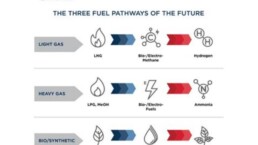

ABS Chairman, President and CEO Breaks Down Future Fuel Choices for Shipowners
LNG and hydrogen are viewed as frontrunners to be the fuels that will help shipping reach IMO decarbonization ambitions, according to a new ABS survey.
LNG was the solution to the 2050 emissions target for 47 percent of respondents to the ABS Future Fuels LinkedIn Survey, while hydrogen was the answer for 40 percent. Just eight percent opted for ammonia and five percent for methanol.
LNG was again the dominant fuel option to get the industry to 2030 targets, securing the support of 64 percent of respondents, against 22 percent for hydrogen and seven percent each for ammonia and methanol.
The results illustrate the challenges facing shipowners in developing fleets that meet and exceed IMO targets.
“Owners of internationally trading ships are facing increasingly complex investment decisions as they try to navigate the most efficient course to the low-carbon future, which is why ABS has moved to simplify the landscape by identifying three fuel pathways potentially open to shipping,” said Christopher J. Wiernicki, ABS Chairman, President and CEO.
“The first pathway is defined as ‘Light Gas’, using generally light, small molecule fuels with high energy content, but more demanding, mainly cryogenic fuel supply systems and storage. This group includes the relatively mature methane (as LNG) solution leading towards bio-derived or synthetic methane, and ultimately to hydrogen as fuel,” said Wiernicki.
“On this pathway, if methane slip is discounted, LNG can reduce GHG emissions by approximately 20 percent; bio-methane can be carbon neutral, while hydrogen is a zero-carbon fuel. Hydrogen can serve as the ultimate solution along this pathway, but it will necessitate significant technical advances, which may require a decade or more, until it becomes a practical solution.
“The second pathway is defined as ‘Heavy Gas’, by using generally heavier, more complex molecules, but with less demanding fuel supply and storage requirements than the light gas pathway. This group includes LPG, methanol and ethanol, leading to bio-derived or synthetic LPG/methanol and ultimately to ammonia.
He added: “On this pathway, methanol can reduce CO2 by approximately 10 percent, while bio-methanol can be carbon neutral, and ammonia is a zero-carbon fuel. While ammonia shows considerable promise as a fuel, the technology for its application still needs to be developed, and regulations must account for its particular safety considerations.
“The third pathway hinges on bio/synthetic fuels that are derived from renewable sources and can produce liquid fuels. These fuels have similar properties to diesel oil and thus are much less demanding in terms of new infrastructure and technologies onboard and can be utilized with minimal changes to current ship designs.
In the future, a third generation of biofuels, such as lignocellulosic or algae-based fuels could potentially provide the industry with almost 500 million tons of fuels annually, more than the current annual bunker demand. This group includes electro/synthetic Gas-to-Liquid (GTL) fuels produced though either carbon capture and electrolysis, or from converting biomass to syngas and then to liquid fuels such as methanol or diesel.”
But which particular pathway makes sense for a shipowner to focus on will depend on the operational profile and trade of the vessel, cautioned Wiernicki.
“In all likelihood, the fleet of the future will be fueled by a variety of choices, including oil, that will be selected depending on the owner’s operational preferences,” he said. “Although we are fuel and technology agnostic, ABS focuses on working across the board to help owners not only reach their decarbonization and sustainability targets but hit them successfully, while maintaining a laser focus on safety.”



Related News.

OL Shipping Group in Tokyo: Capt. Eberhard Koch calls for realistic solutions to Maritime Decarbonisation
An intensive and engaging couple of days in Tokyo brought together leading figures from the international maritime community, providing a valuable…
Regatta for Peace one of the largest ever in Cyprus
Cyprus will host the first European stop on a global sailing journey leading up to the 2027 America’s Cup in Naples. More than 120 sailors…
The propulsion technology powering the marine energy transition
The marine industry is under increasing pressure to future-proof fleets, balancing the need to reduce emissions and improve efficiency. Propulsion…
Signal Ocean acquires Lgmar
Signal Ocean announced the acquisition of Lgmar, the Athens-based company behind Telix, a maritime email and communication platform in daily use…

Canada clean power push challenged by interprovincial grid limits, says GlobalData
Canada is entering a pivotal phase of power-sector expansion as federal tax credits, the phase-out of coal-fired generation, and accelerating…

Maritime safety depends on human factors and leadership, not procedures alone
Interim survey findings point to a gap between seafarers’ perceptions of risk and injury data Seafarers may misjudge when and where they are most at…

New BIMCO contracts tackle ship recycling and energy-saving retrofits
BIMCO adopted two new contractual solutions designed to help you manage important operational and regulatory challenges: the revised…
Stena Line to acquire vessel and make changes to its network
Stena Line has reached an agreement to acquire the RoRo vessel Somerset from CLdN. Subject to closure and transfer, the vessel would begin operating…

DORIC WEEKLY INSIGHT 16 OCTOBER 2026
Please find below the DORIC Market Insight for the week ending 16th October 2026. Weekly Report 16.10.2026
Important information for port clients and freight carriers effective November 1, a new traffic overpass and port checkpoint will open for traffic to the Port of Riga on Kundziņsala
Starting November 1 of this year, a new traffic overpass connecting Tvaika Street to Kundziņsala will open to facilitate traffic to and from the Port…
Subscribe to our newsletter!
if you dont want to swim alone in the ocean of news, sign up for the newsletter, and you will receive daily all the important news of world shipping!
