Inmarsat: pioneers in global navigation


You may not realise it but satellites orbiting space have become an indispensable and central part of our daily lives. From weather satellites that bring us our daily forecasts to those that beam our favourite TV and radio programmes; the inflight Wi-Fi you have come to expect on your flight, to the connectivity seafarers depend upon for safety at sea. And then, of course, there are Global Navigation Satellite Systems (GNSS) such as the US Global Positioning System (GPS), which we all rely on to get us from A to B, safely and accurately.

Inmarsat has over 40 years’ experience of providing global, mobile satellite connectivity on land, at sea and in the air, and has been at the heart of every major innovation in satellite technology that’s in use today including GNSS.
Over 30 years ago we were at the forefront of pioneering the concept of enhancing satellite navigation systems such as GPS in Medium Earth Orbit (MEO) with separate satellite signals from geostationary orbit (GEO) to boost the accuracy and dependability of GPS data for safety-related users such as aircraft and ships. This concept is called Satellite Based Augmentation System (SBAS).
First prototype
Working with the European Space Agency (ESA) on its NavSat system studies in 1989, Inmarsat developed specifications for navigation payloads on GEO satellites and built the first prototype Wide Area Augmentations System (WAAS) Signal Generator (SIGGEN) equipment with NAVSYS Corporation. This was deployed at the Goonhilly Earth Station in Cornwall and used to transmit an L-band signal over the Inmarsat Atlantic Ocean Region MARECS satellite to a software-based GPS receiver installed at our Test and Development Laboratory in London.
Following the successful outcome of this work, the Inmarsat-3 satellite constellation, which launched in the 1990s, featured navigation transponders on all spacecraft for SBAS service provision. Inmarsat then pioneered the SBAS service business with contracts signed with a number of national and international institutional customers. This was followed by a new generation of navigation transponders on the Inmarsat-4 satellite constellation further consolidating the UK’s leadership in global satnav service provision.
More recently, we have deployed our satellite and navigation systems experience to help the UK Government via a key role to develop system design and operations options as part of the UK GNSS programme.
Increased accuracy
Today, the increased accuracy and integrity that SBAS provides is critical for aviation and is widely used by the geospatial industry. Air navigation SBAS systems in use include WAAS (USA); EGNOS (Europe); MSAS (Japan); GAGAN (India) and SDCM (Russia). Additional SBAS systems under development are SPAN (Australia/New Zealand) and KAAS (South Korea).
Our Inmarsat-4 transponders remain in service for the European Geostationary Navigation Overlay System (EGNOS) and for Geoscience Australia as part of the Southern Positioning Augmentation Network (SPAN). Inmarsat navigation transponders have also been used by the Federal Aviation Authority’s (FAA) Wide Area Augmentation System (WAAS).
But, being Inmarsat, we don’t stop innovating and pioneering the next generation of satellite technology that can relied upon by governments, organisations and industries the world over.
Looking ahead
We are working in partnership with ESA once more on Iris, a revolutionary satellite-based communication system to deliver secure, high bandwidth data link communications over Europe.

Using near real-time reporting of 4D trajectory optimisation to allow aircraft to accurately report latitude, longitude, altitude, true heading and ground speed, Iris will modernise air traffic management (ATM) and is a critical element of the Single European Skies ATM Research (SESAR) masterplan to alleviate airspace congestion, reduce flight times and delays, and enhance safety and security.
This is just one example of Inmarsat’s ground-breaking programmes. With our fully funded technology roadmap in place which will see a further seven satellites launched by 2024 to provide increased capabilities and redundancies to our satellite networks, and a ground network expansion unrivalled in our history, we are investing in the power of satellite technology to improve the world we live in for decades to come.
We look forward to helping our customers around the world to harness the power of satellite communication and satellite navigation technology to address the growing societal, security and economic needs in the digital age.



Related News.

5th CSN Greece ICT Conference, Athens 19th November 2026 “Intelligent Skies, Secure Seas: The AI Impact on ICT” – Save the date
About the Conference The 5th CSN Greece Shipping ICT Conference, titled “Intelligent Skies, Secure Seas: The AI Impact on ICT”, will take place on…
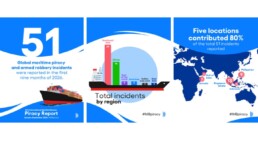
Maritime piracy incidents remain at historic lows despite Somali piracy concerns
The ICC International Maritime Bureau (IMB) has reported the lowest level (51) of piracy and armed robbery incidents since 1992 in the first nine…
Piraeus Port Authority main sponsor of Ferry Shipping Summit 2026
With the participation of more than 200 delegates from several European countries, the Ferry Shipping Summit 2026 took place on 8–9 October 2026 in…

EuroDry announces order for the construction of a third modern 82,000 DWT Kamsarmax Bulk Carrier
EuroDry , an owner and operator of drybulk vessels and provider of seaborne transportation for drybulk cargoes, announced that it has signed a…

India urges Russia, Ukraine to protect Black Sea shipping
India has urged both Russia and Ukraine to ensure safe passage for commercial shipping through the Black Sea as attacks on merchant vessels put…

PD Ports strengthens its commitment to the River Tees with multi-million pound Marine investment
PD Ports has officially opened a new multi-million-pound Marine facility on the banks of the River Tees, reinforcing its long-term commitment to the…

Maritime leaders head to Shanghai for the Annual Summit 2026
Shared seas, shifting horizons Maritime trade stands at a turning point. The rules-based order on which shipping has long depended is under…
Indian Register of Shipping grants type approval to Medha Energy’s 92 kWh LTO Lithium-Ion battery system
Indian Register of Shippinghas successfully completed the Type Approval process for the 92 kWh Lithium-Ion Battery System developed by M/s Medha…

KLine opens a Singapore New Hub for Consolidated Ship Management and Maritime Talenτ
Three Companies, One Roof — Singapore's New Hub for Consolidated Ship Management and Maritime Talenτ A ceremony for around 280 guests sets the stage…

ASA explores measures to Safeguard Free and Safe Navigation at Critical International Maritime Chokepoints
The Asian Shipowners’ Association which accounts for 56% of the world’s fleet capacity and consists of China, Cook Islands, Hong Kong, Japan, Korea…
Subscribe to our newsletter!
if you dont want to swim alone in the ocean of news, sign up for the newsletter, and you will receive daily all the important news of world shipping!
