NOAA, U.S. Navy will increase nation’s unmanned maritime systems operations
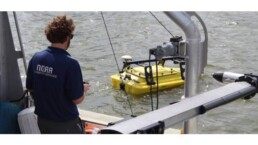

NOAA and the United States Navy have signed a new agreement to jointly expand the development and operations of unmanned maritime systems in the nation’s coastal and world’s ocean waters. This will enable NOAA to leverage the Navy’s expertise, infrastructure, best practices and training to accelerate its science, service and stewardship mission.
“With the strengthening of our ongoing partnership with the Navy, NOAA will be better positioned to transition unmanned maritime technologies into operational platforms that will gather critical environmental data that will help grow the American Blue Economy,” said retired Navy Rear Adm. Tim Gallaudet, Ph.D., assistant secretary of commerce for oceans and atmosphere and deputy NOAA administrator.
NOAA conducts research and gathers data about the global ocean and atmosphere to forecast weather, predict climate, protect the ocean and sustainably manage marine resources. These missions rely on a continuous process of testing and evaluation of new technologies such as unmanned systems to improve data gathering.
The Naval Meteorology and Oceanography Command’s mission is to define the physical environment from the bottom of the ocean to the stars to ensure the U.S. Navy has freedom of action to deter aggression, maintain freedom of the seas and win wars. For over twenty years, Naval Oceanography has been a global pioneer in the development and use of unmanned systems.
“This agreement lays the foundation for collaboration, engagement, and coordination between NOAA and the U.S. Navy that our nation has never seen before,” said RDML John Okon, Commander Naval Meteorology and Oceanography Command. “It will help us take advantage of each other’s strengths to advance each of our strategic and operational mission priorities.”
The new arrangement corresponds with rapid expansion and innovation in the use of unmanned systems across the government, academia and private enterprise. A timely example of how NOAA and the Navy are working together with unmanned systems is the ocean unmanned glider project to improve hurricane prediction. For the third year, NOAA, the Navy, academia and private industry are deploying unmanned ocean gliders from the Caribbean Sea to the eastern seaboard that demonstrate unmanned maritime system’s observations can improve hurricane intensity forecasts.
The new pact formalizes the Commercial Engagement Through Ocean Technology Act of 2018, that directs NOAA to coordinate with the Navy on a wide range of functions including research of emerging unmanned technologies, protocols for acquisition of these systems, and sharing facilities for testing and evaluation. It is an annex to the broader NOAA and Navy Memorandum of Agreement signed in 2013.
Additionally, this agreement is among NOAA’s follow up actions from the November 2019 White House Summit on Partnerships in Ocean Science and Technology and is an outcome of the NOAA Unmanned Systems Strategy. It also aligns with the Executive Order on Maintaining American Leadership in Artificial Intelligence.



Related News.
India joins ISF Verify, bringing trusted digital certification within reach of 30 per cent of the global seafarer workforce
Agreement with the world’s second-largest seafarer supply country marks a major milestone for global digital certification. The Directorate General…

OpenGate Capital to acquire Maersk Training, the Global Safety Training and Gas-Safety Services Business of Maersk
OpenGate Capital, a global private equity firm, announced today that it has signed a definitive agreement to acquire Maersk Training and its…

Can AI Save the Planet? Planet Classroom examines AI’s Climate Impact, Energy Demands and Clean Energy Solutions
C. M. (Cathy) Rubin and The Nest Campus CEO Peter Gilmer explore AI's growing environmental footprint, billions in climate investment, and the…

Smart Port Market Size to be valued at USD 23.10 Billion by 2034; Increasing Volume of International Maritime Trade to Boost Market Development: Fortune Business Insights™
The global smart port market size was valued at USD 3.4 billion in 2025 and is expected to be worth USD 4.2 billion in 2026. The market is projected…

Closer cooperation with India can strengthen Danish shipping
Minister of Business and Competitiveness Martin Lidegaard is leading a Danish business delegation to India. Green shipping is among the…

IRClass Academy and PIP Makassar strengthen Executive Maritime Capability through IMPDP 2026
Indian Register of Shipping , through its professional training and development arm IRClass Academy, has further strengthened its engagement in…

MOL, Sharp, IOM Implement Solar Panel Donation Project
Move Will Enhance Living Conditions in Power-short Areas of Kenya Mitsui O.S.K. Lines, announced the donation of solar power panels to communities in…

Intermodal Report Week 44 2026
Pls find below the Intermodal Report - Week 44 2026 Intermodal Report Week 44 2026

Allied Weekly Market Review Week 44
Pls find below the Allied - Weekly Market Review - Week 44 ALLIED - Weekly Market Report- Week 44

Nor-Shipping partners with Marketing in Maritime to deliver Marketing & Communications day and awards in 2027
Nor-Shipping is partnering with Marketing in Maritime to deliver a dedicated Marketing & Communications Day and awards initiative at the 2027…
Subscribe to our newsletter!
if you dont want to swim alone in the ocean of news, sign up for the newsletter, and you will receive daily all the important news of world shipping!
