The Flemish government, Port of Antwerp and SeReAnt together improve the water quality at the Port of Antwerp
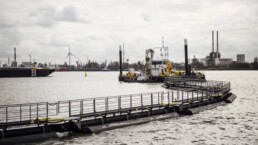

Sludge treatment plant AMORAS processes most polluted dredging sludge
Pollution from ship paint
The Flemish government and Port of Antwerp are keeping the docks of the port of Antwerp accessible for contemporary shipping together. Every year, enormous quantities of sludge are dredged for this purpose and then processed by the AMORAS dewatering installation. “But there was one type of sludge we couldn’t process yet: sludge with elevated organotin concentrations or Tributyltin, or TBT sludge for short,” says Yi-Bin Shan, Head of the Maritime Access Department at the Department of Mobility and Public Works. “TBT had been used worldwide in ship paint since the 1970s to prevent the growth of mussels and algae on hulls, but has been completely banned since 2003. After all, the product is enormously harmful to the environment and is also difficult to break down. The sludge has been storing TBT like a sponge all these years and is gradually releasing this contamination. This is disrupting the metabolism and hormone action of molluscs in particular, such as snails and mussels.”
Only port in the world
“Along with the University of Antwerp, we have been investigating for several years how to get TBT out of the port,” says Jacques Vandermeiren, Port of Antwerp’s CEO. “We are proud that we can finally tackle this historical pollution. Currently, the water quality in the docks scores below the European standard. This project will greatly improve it. As a port authority, we believe it’s important to take responsibility in respect of society. This makes us the only port in the world that not only removes polluted sludge, but also processes it sustainably.” The Flemish government and Port of Antwerp are jointly releasing the necessary resources for dredging and processing the most polluted dredging sludge. “Flanders makes 25 million euros available annually for the operation of AMORAS. We are now making an additional investment of 700,000 euros a year to dispose of TBT spoil in an ecologically responsible manner. This way, we can increase the accessibility of the port, an important task for the Flemish government,” says Flemish Minister Lydia Peeters. “Port of Antwerp has invested 1 million euros in the preliminary phase of this project and will release 1.5 million euros a year for the effective processing of TBT spoil,” port alderman Annick De Ridder continues. “Port of Antwerp wants to be an inspiration for other ports and take a pioneering role in the field of sustainability”.
800,000 m³ of sludge over the next five years
Processing the total quantity of polluted sludge at the port of Antwerp is a long-term task. A pilot project was started in 2018 after obtaining the necessary permits and some modifications to the water treatment plant. “We have added an extra step to our processes and installed activated carbon filters. These filter the toxic substances out of the water after it passes through our treatment plant,” says Yi-Bin Shan, Head of Maritime Access. “During that pilot project, we had already dredged, transferred and processed 185,000 m³ of heavily contaminated sludge on AMORAS. In this way, we were able to properly map out the impact on the installation and all possible risks. Now, there is an agreement to remove 800,000 m³ of sludge from the harbour docks over the next five years and process it into 500,000 tonnes of filter cake. We’ll first remove the sludge that obstructs nautical access and the worst TBT hotspots in the older, southern part of the port. Then we’ll deal with the other areas.”
How will this work?
- The contaminated TBT spoil is dredged at the port. With a 15 m³ environmental grab, the spread of pollution in the surrounding water is avoided.
- The dredging sludge is transported in 2,400 m³ transport containers to the AMORAS processing plant.
- SeReAnt, the contractor operating the AMORAS plant, extracts the sludge from the transport containers and pumps it into the treatment plant.
- Coarse dirt and sand are removed.
- The waste water is purified via a water treatment plant. TBT sludge is also purified by activated carbon. Then the water flows back into the docks.
- The sludge is processed into a dry end product: filter cakes that are safely stored on site.
AMORAS: innovative cooperation between government, port and dredging companies
Through AMORAS, the Flemish government and Port of Antwerp are working together on the sustainable and long-term storage and processing of maintenance dredging sludge from the Antwerp docks. AMORAS stands for Antwerp Mechanical Dewatering, Recycling and Application of Sludge. The Department of Mobility and Public Works provides 80% of the funds, while Port of Antwerp provides the other 20%. Since 2011, the dewatering plant has been processing 450,000 tonnes of dry matter into filter cakes every year. The temporary trade association SeReAnt operates the installation. SeReAnt is a collaboration between the environmental companies DEC of Deme Group and Envisan of Jan De Nul Group. AMORAS is constantly looking for solutions for re-using the dry matter obtained from non-polluted dewatered sludge in useful applications. There are several routes, but the concrete industry in particular is showing interest in the filter cakes.



Related News.
Navigating the Multi-Orbit Era: In Conversation with Intellian’s Jon Harrison at SMM 2026
At SMM 2026 in Hamburg, the rapid evolution of maritime satellite communications took centre stage. Across the exhibition halls, discussions among…
Cyprus ports need joint energy and investment strategy, shipping agents chief says
Cyprus needs a coordinated strategy for shipping, energy and environmental protection to support port investment and modernisation, Cyprus shipping…

MASO Public Affairs introduces MASO Regulatory Intelligence
A new subscription service helping businesses understand what is changing and what it means for them MASO Public Affairs introduces MASO Regulatory…
Anglo-Eastern helps turn CMBTECH’s ammonia ambition into an operational reality
From early feasibility study and risk-based design to newbuilding supervision, crew readiness and technical management, Anglo-Eastern drew on its…

Escalation of attacks threatens to derail recovery in Middle East oil exports
World oil demand is forecast to fall by 2.5 mb/d y-o-y in 4Q26 and 2.6 mb/d on average in 2026. As the Iran war manifests itself through restricted…
New study finds shipping pays twice its share to EU ETS earmarked revenues should triple to help build market for sustainable fuels and technologies
Shipping is responsible for around 10% of EU ETS emissions but pays almost 20% of the ETS bill. Unlike other sectors, it has never received free…
MSARC strengthens maritime mass rescue readiness through training and national live exercise off Dakar, Senegal
Joint MSARC–FHAS programme combines three days of SAR training with a national multi-agency live exercise The Maritime Search and Rescue Council ,…
Sogese report deliveries are still being delayed as container freight rates fluctuate
FOR IMPORTERS Spot rates into the Mediterranean are back at January levels, Far East to Europe reliability sits at pandemic lows, and nearly…
Glencore begins trading on Australian Securities Exchange
Glencore has begun trading on the Australian Securities Exchange under the ASX code GLC. Gary Nagle, Glencore’s CEO, said it was an exciting day for…
BIMCO Shipping Number of the Week
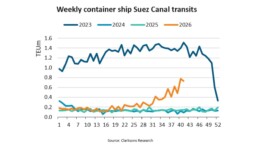
Suez Canal container ship transits exceed 50% of pre-disruption levels "During the first two weeks of October, weekly container ship capacity…
Subscribe to our newsletter!
if you dont want to swim alone in the ocean of news, sign up for the newsletter, and you will receive daily all the important news of world shipping!
