Maritime cyber attacks increase by 900% in three years
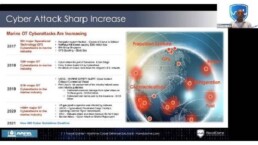

Cyber-attacks on the maritime industry’s operational technology (OT) systems have increased by 900% over the last three years with the number of reported incidents set to reach record volumes by year end.
Addressing port and terminal operators during an online forum last week, Robert Rizika, Naval Dome’s Boston-based Head of North American Operations, explained that in 2017 there were 50 significant OT hacks reported, increasing to 120 in 2018 and more than 310 last year. He said this year is looking like it will end with more than 500 major cyber security breaches, with substantially more going unreported.
Speaking during the 2020 Port Security Seminar & Expo, a week-long virtual conference organised by the American Association of Port Authorities, Rizika said that since NotPetya – the virus that resulted in a US$300 million loss for Maersk – “attacks are increasing at an alarming rate”.
Recalling recent attacks, he told delegates that in 2018 the first ports were affected, with Barcelona, then San Diego falling under attack. Australian shipbuilder Austal was hit and the attack on COSCO took down half of the shipowner’s US network.
He said this year a US-based gas pipeline operator and shipping company MSC have been hit by malware, of which the latter incident shut down the shipowner’s Geneva HQ for five days. A US-based cargo facility’s operating systems were infected with the Ryuk ransomware, and last month the OT systems at Iran’s Shahid Rajee port were hacked, restricting all infrastructure movements, creating a massive back log.
Reports of this attack have gone some way in raising public awareness of the potential wider impact of cyber threats on ports around the world. Intelligence from Iran, along with digital satellite imagery, showed the Iranian port in a state of flux for several days. Dozens of cargo ships and oil tankers waiting to offload, while long queues of trucks formed at the entrance to the port stretching for miles, according to Naval Dome.
Emphasising the economic impact and ripple effect of a cyber-attack on port infrastructures, Rizika revealed that a report published by Lloyd’s of London indicated that if 15 Asian ports were hacked financial losses would be more than US$110 billion, a significant amount of which would not be recovered through insurance policies, as OT system hacks are not covered.
Going on to explain which parts of the OT system – the network connecting RTGs, STS cranes, traffic control and vessel berthing systems, cargo handling and safety and security systems, etc., – are under threat, Rizika said all of them.
“Unlike the IT infrastructure, there is no “dashboard” for the OT network allowing operators to see the health of all connected systems. Operators rarely know if an attack has taken place, invariably writing up any anomaly as a system error, system failure, or requiring restart.
“They don’t know how to describe something unfamiliar to them. Systems are being attacked but they are not logged as such and, subsequently, the IT network gets infected,” Rizika explained.
“What is interesting is that many operators believe they have this protected with traditional cyber security, but the fire walls and software protecting the IT side, do not protect individual systems on the OT network,” he said.
An example would be the installation of an antivirus system on a vessel bridge navigation system (ECDIS) or, alternatively, a positioning system in a floating rig DP (Dynamic Positioning), or on one of the dock cranes on the pier side of the port.
“The antivirus system would very quickly turn out to be non-essential, impairing and inhibiting system performance. Antivirus systems are simply irrelevant in places where the attacker is anonymous and discreet,” he said.
“Operational networks, in contrast to information networks, are measured by their performance level. Their operation cannot be disconnected and stopped. An emergency state in these systems can usually only be identified following a strike and they will be irreparable and irreversible.”
Where OT networks are thought to be protected, Rizika said they are often inadequate and based on industrial computerised system, operating in a permanent state of disconnection from the network or, alternatively, connected to port systems and the equipment manufacturer’s offices overseas via RF radio communication (wi-fi) or a cellular network (via SIM).
“Hackers can access the cranes, they can access the storage systems, they can penetrate the core operational systems either through cellular connections, wi-fi, and USB sticks. They can penetrate these systems directly.”
Rizika said that as the maritime industry moves towards greater digitalisation and increases the use of networked, autonomous systems, moving more equipment and technologies online, more vulnerabilities, more loopholes, will be created.
“There will be a whole series of new cyber security openings through which people can attack if systems are not properly protected.
“If just one piece of this meticulously-managed operation goes down it will create unprecedented backlog and impact global trade, disrupting operations and infrastructure for weeks if not months, costing tens of millions of dollars in lost revenues.”
Naval Dome also predicts that cyber criminals, terrorists and rogue states will at some point begin holding the environment to ransom. “One area we see becoming a major issue is cyber-induced environmental pollution. Think about it: you have all these ships in ports, hackers can easily over-ride systems and valves to initiate leaks and dump hazardous materials, ballast water, fuel oil, etc.,” Rizika warned.
Offering advice on the first steps port operators need to take to protect their OT systems, he said a deep understanding of the differences between the two spaces is vital.
“There is a disconnect between IT and OT security. There is no real segregation between the networks. People can come in on the OT side and penetrate the IT side. We are actually seeing this now. Successful IT network hacks have their origins in initial penetration of the OT system.”
In a pre-recorded message broadcast during Naval Dome’s presentation, Rear Admiral (Retd) Shiko Zana, the CEO of Ashdod Port, said: “We have become more aware of the growing cyber threat to OT systems. Naval Dome has a unique cyber defence solution capable of protecting against both internal and external cyber attack vectors. The solution provides protection for OT systems.”



Related News.

India joins ISF Verify, bringing trusted digital certification within reach of 30 per cent of the global seafarer workforce
Agreement with the world’s second-largest seafarer supply country marks a major milestone for global digital certification. The Directorate General…

OpenGate Capital to acquire Maersk Training, the Global Safety Training and Gas-Safety Services Business of Maersk
OpenGate Capital, a global private equity firm, announced today that it has signed a definitive agreement to acquire Maersk Training and its…

Can AI Save the Planet? Planet Classroom examines AI’s Climate Impact, Energy Demands and Clean Energy Solutions
C. M. (Cathy) Rubin and The Nest Campus CEO Peter Gilmer explore AI's growing environmental footprint, billions in climate investment, and the…

Smart Port Market Size to be valued at USD 23.10 Billion by 2034; Increasing Volume of International Maritime Trade to Boost Market Development: Fortune Business Insights™
The global smart port market size was valued at USD 3.4 billion in 2025 and is expected to be worth USD 4.2 billion in 2026. The market is projected…

Closer cooperation with India can strengthen Danish shipping
Minister of Business and Competitiveness Martin Lidegaard is leading a Danish business delegation to India. Green shipping is among the…

IRClass Academy and PIP Makassar strengthen Executive Maritime Capability through IMPDP 2026
Indian Register of Shipping , through its professional training and development arm IRClass Academy, has further strengthened its engagement in…

MOL, Sharp, IOM Implement Solar Panel Donation Project
Move Will Enhance Living Conditions in Power-short Areas of Kenya Mitsui O.S.K. Lines, announced the donation of solar power panels to communities in…

Intermodal Report Week 44 2026
Pls find below the Intermodal Report - Week 44 2026 Intermodal Report Week 44 2026

Allied Weekly Market Review Week 44
Pls find below the Allied - Weekly Market Review - Week 44 ALLIED - Weekly Market Report- Week 44

Nor-Shipping partners with Marketing in Maritime to deliver Marketing & Communications day and awards in 2027
Nor-Shipping is partnering with Marketing in Maritime to deliver a dedicated Marketing & Communications Day and awards initiative at the 2027…
Subscribe to our newsletter!
if you dont want to swim alone in the ocean of news, sign up for the newsletter, and you will receive daily all the important news of world shipping!
