Live Aid, 35 Years Later: Celebrating Satellite History
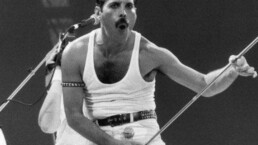

Monday, July 13 marks the 35th anniversary of Live Aid, a benefit concert that raised money for the relief of famine-stricken countries in Africa.
The 16-hour “super concert” featured more than 75 acts, including Queen, Run DMC, Paul McCartney, Madonna and Elton John performing in two spots: Wembley Stadium in London and JFK Stadium in Philadelphia.
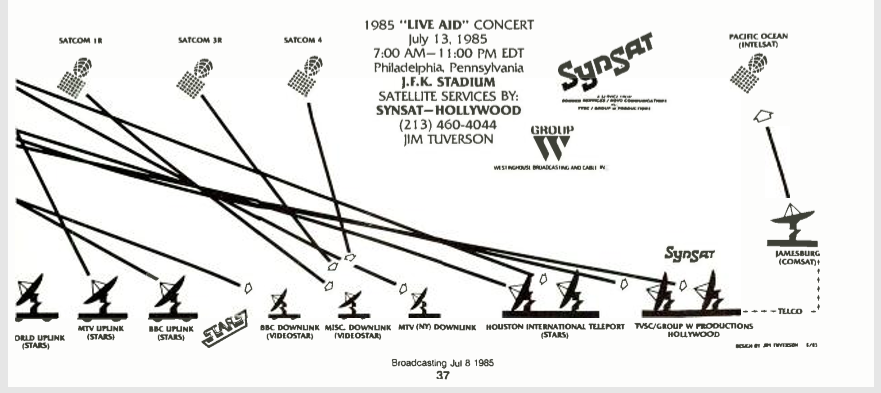
A crowd of more than 150,000 watched in-person at these sites but, in an astounding technological feat, 13 satellites, including five Intelsat satellites, beamed the broadcast live to televisions and radios across the globe.
According to historical accounts, it was one of the largest-scale satellite link-ups and television broadcasts of all time, with an estimated audience of 1.9 billion, across 150 nations.
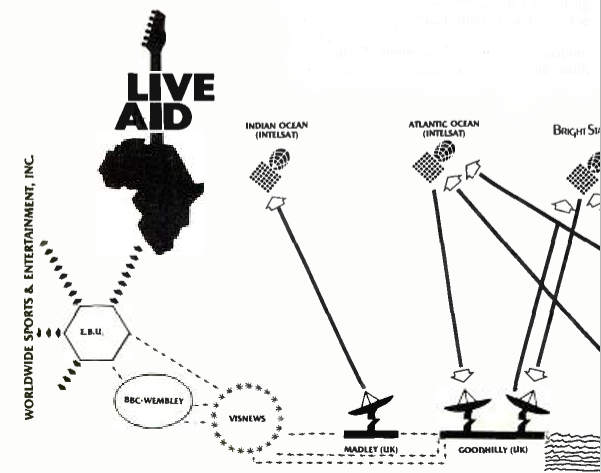
Intelsat’s global satellite network was integral to powering this historical event.
In fact, according to a 1985 article from Broadcasting Magazine,“11 channels on five Intelsat satellites were among the six satellites used for the international transmission of the event.”
The broadcast required between 13-16 hours of transmission time. “No one has ever required such massive amounts of time,” said Jim Tuverson, head of Television Videotape Satellite Communications Group’s West Coast operation, at the time.
In a 1989 interview with the Smithsonian, Live Aid’s producer, Hal Uplinger, talked about the “complicated” logistics and satellite set up:
“It was a little complicated. Our major coordinating control point was Philadelphia. Everything, including Wembley, came into Philadelphia before it went to be seen on the BBC. The stadium in Philadelphia was simply an ideal place control, because there was an area in back of the stadium. We had, I think, 35 trailers there and an entire field of satellite dishes that controlled our uplinks and downlinks. We were able to have a place where we could control all communications. From there it simply becomes a logistical situation to put the proper people to handle the proper jobs and to make sure that it all comes together from a master control truck. It was from this master control point that we had a world feed truck and a USA truck. We were feeding MTV as well. Then, of course, with all the rest of the vehicles, there were the video tape units or whatever else was necessary. Our problem was time. We didn’t have enough time. Yet the fact that we didn’t have the time probably made it possible.”
Uplinger won the 1989 Computerworld Smithsonian Award in the Media, Arts & Entertainment Category for his production of the “Live Aid Concert.”
The event itself raised more than $125 million in famine relief for Africa, as well as global awareness of a critical humanitarian issue.
From Live Aid to the moon landing, Intelsat has transmitted the biggest moments in the world for everyone to share. Learn more about our next-generation global broadcast capabilities at www.intelsat.com/solutions/media/.
To revisit the Live Aid experience on its 35th anniversary, click here.



Related News.

Navigating the Multi-Orbit Era: In Conversation with Intellian’s Jon Harrison at SMM 2026
At SMM 2026 in Hamburg, the rapid evolution of maritime satellite communications took centre stage. Across the exhibition halls, discussions among…

Cyprus ports need joint energy and investment strategy, shipping agents chief says
Cyprus needs a coordinated strategy for shipping, energy and environmental protection to support port investment and modernisation, Cyprus shipping…

MASO Public Affairs introduces MASO Regulatory Intelligence
A new subscription service helping businesses understand what is changing and what it means for them MASO Public Affairs introduces MASO Regulatory…

Anglo-Eastern helps turn CMBTECH’s ammonia ambition into an operational reality
From early feasibility study and risk-based design to newbuilding supervision, crew readiness and technical management, Anglo-Eastern drew on its…

Escalation of attacks threatens to derail recovery in Middle East oil exports
World oil demand is forecast to fall by 2.5 mb/d y-o-y in 4Q26 and 2.6 mb/d on average in 2026. As the Iran war manifests itself through restricted…

New study finds shipping pays twice its share to EU ETS earmarked revenues should triple to help build market for sustainable fuels and technologies
Shipping is responsible for around 10% of EU ETS emissions but pays almost 20% of the ETS bill. Unlike other sectors, it has never received free…

MSARC strengthens maritime mass rescue readiness through training and national live exercise off Dakar, Senegal
Joint MSARC–FHAS programme combines three days of SAR training with a national multi-agency live exercise The Maritime Search and Rescue Council ,…

Sogese report deliveries are still being delayed as container freight rates fluctuate
FOR IMPORTERS Spot rates into the Mediterranean are back at January levels, Far East to Europe reliability sits at pandemic lows, and nearly…

Glencore begins trading on Australian Securities Exchange
Glencore has begun trading on the Australian Securities Exchange under the ASX code GLC. Gary Nagle, Glencore’s CEO, said it was an exciting day for…

BIMCO Shipping Number of the Week
Suez Canal container ship transits exceed 50% of pre-disruption levels "During the first two weeks of October, weekly container ship capacity…
Subscribe to our newsletter!
if you dont want to swim alone in the ocean of news, sign up for the newsletter, and you will receive daily all the important news of world shipping!
