Ongoing LSFO sediment issues lead to bunker alerts warns Hill Dickinson


It is nearly a month from the implementation date of regulation 14.1.3 of Marpol Annex VI, and while it is too early to draw concrete conclusions, a nuanced picture is emerging of the effect of the change.
Regulation 14.1.3 Marpol Annex VI, lowers the sulphur content for marine fuel for use onboard vessels not fitted with exhaust gas cleaning equipment from 3.5% m/m to 0.50% m/m and took effect of 1 January 2020 (the sulphur cap). Regulation 14.4.3 Marpol Annex VI limiting sulphur content to 0.10% m/m in Emission Control Areas remains in place.
In the opening weeks of 2020 there have been very few reports of enforcement action taken against vessels for noncompliance with the sulphur cap. Consequently, the transition has been smoother than expected from a port state control perspective. This is in no small amount attributable to the efforts of the key stakeholders (owners, charterers, insurers and bunker suppliers) to prepare to be compliant as of 1 January 2020.
While this suggests a high level of compliance, it is only part of the picture. Claims relating to the sulphur content of fuel as well as the quality of some blended low sulphur fuels are already being made.
Compliance with regulation 14.1.3 means using a fuel with a sulphur content of 0.50% m/m maximum. If the sulphur content exceeds that threshold, owners may be exposed to enforcement action. Consequently, the frequency of owners having samples tested for sulphur content has increased. Where the bunkers are found to be marginally in excess of the limit, problems are arising largely owing the difference between regulation 14.3.1 and most supply contracts. An on-specification supply for sulphur content will, usually, from a suppliers point of view be deemed to be up to 0.53% m/m, since that reflects the laboratory margin of confidence for testing. As a result, a time-consuming and costly stand-off can occur while the sulphur content issue is resolved and decisions made regarding the need to de-bunker and obtain alternative bunkers.
In addition, over the past four weeks there have been a number of alerts issued concerning sediment issues, in particular, in low sulphur fuels supplied in Singapore, Piraeus, Amsterdam, Rotterdam, Miami and San Vincente. The propensity to sediment can cause engine problems, from sludging of filters to engine damage and blackouts in the worst circumstances.
Quality claims relating to bunkers are not a new phenomenon, but in the past, they have tended to be localised. The spread of alerts concerning sediment, suggests a potentially wider issue concerning the stability of some blended low sulphur fuel.
Liability, depending on the reasons for sedimentation, may not be straightforward. While charterparties and bunker supply contracts will contain a specification for the fuel, usually by reference to the ISO 8217 standard, some organic compounds which cause sedimentation may not be caught by the Table 2 parameters (although the issue may be caught by clause 5.3 of ISO 8217).
Where shipowners have devolved the responsibility to provide bunkers to the vessel to their time charterers, the time charterers obligation as a matter of English law is twofold; (a) to provide bunkers in accordance with the contractual specification and (b) to provide bunkers which are fit for purpose. As such, if the bunkers are within specification but are causing sedimentation, or are otherwise not fit to be consumed by the vessel, owners will have recourse against their time charterers.
The position is not necessarily the same under bunker supply contracts, particularly if there are clear provisions excluding claims relating to fitness for purpose, which can make it difficult to pursue the supplier.
From a practical point of view, the usual advice to owners to ensure that they have clean bunker tanks, avoid co-mingling of bunkers and to monitor sampling during the supply applies. Time charterers arranging the supply of bunkers (or owners if dealing direct with the suppliers) need to ensure that they understand the supply contract and have the time bar and sampling provisions firmly in mind in order to preserve their rights of recourse against the supplier, if available.
Looking ahead, enforcement action and quality issues will remain live topics as the shipping industry adjusts to the sulphur cap, the next pinch point will be Sunday 1 March 2020 when the carriage ban takes effect. While the use onboard of high sulphur fuel is now impermissible unless the vessel is fitted with exhaust gas cleaning systems, high sulphur fuel may be carried until 1 March. Owners have a little over a month in which to arrange to de-bunker high sulphur fuel and would be best advised to start planning those operations (if not already in hand) now, so as to avoid the consequences of missing the deadline.



Related News.
Navigating the Multi-Orbit Era: In Conversation with Intellian’s Jon Harrison at SMM 2026
At SMM 2026 in Hamburg, the rapid evolution of maritime satellite communications took centre stage. Across the exhibition halls, discussions among…
Cyprus ports need joint energy and investment strategy, shipping agents chief says
Cyprus needs a coordinated strategy for shipping, energy and environmental protection to support port investment and modernisation, Cyprus shipping…

MASO Public Affairs introduces MASO Regulatory Intelligence
A new subscription service helping businesses understand what is changing and what it means for them MASO Public Affairs introduces MASO Regulatory…
Anglo-Eastern helps turn CMBTECH’s ammonia ambition into an operational reality
From early feasibility study and risk-based design to newbuilding supervision, crew readiness and technical management, Anglo-Eastern drew on its…
Escalation of attacks threatens to derail recovery in Middle East oil exports
World oil demand is forecast to fall by 2.5 mb/d y-o-y in 4Q26 and 2.6 mb/d on average in 2026. As the Iran war manifests itself through restricted…
New study finds shipping pays twice its share to EU ETS earmarked revenues should triple to help build market for sustainable fuels and technologies
Shipping is responsible for around 10% of EU ETS emissions but pays almost 20% of the ETS bill. Unlike other sectors, it has never received free…

MSARC strengthens maritime mass rescue readiness through training and national live exercise off Dakar, Senegal
Joint MSARC–FHAS programme combines three days of SAR training with a national multi-agency live exercise The Maritime Search and Rescue Council ,…
Sogese report deliveries are still being delayed as container freight rates fluctuate
FOR IMPORTERS Spot rates into the Mediterranean are back at January levels, Far East to Europe reliability sits at pandemic lows, and nearly…
Glencore begins trading on Australian Securities Exchange
Glencore has begun trading on the Australian Securities Exchange under the ASX code GLC. Gary Nagle, Glencore’s CEO, said it was an exciting day for…
BIMCO Shipping Number of the Week
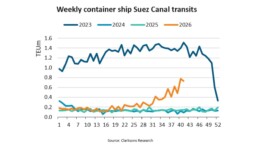
Suez Canal container ship transits exceed 50% of pre-disruption levels "During the first two weeks of October, weekly container ship capacity…
Subscribe to our newsletter!
if you dont want to swim alone in the ocean of news, sign up for the newsletter, and you will receive daily all the important news of world shipping!
