New DNV GL joint industry report offers recommendations for enhanced battery safety on vessels


In collaboration with the Norwegian, Danish and US maritime authorities, battery manufacturers, system integrators, suppliers of fire extinguishing systems, shipyards and shipowners, DNV GL has released a new report on battery safety in ships. The report assesses explosion and fire risks in maritime battery installations and the effectiveness of fire extinguishing systems in the event of a battery fire.
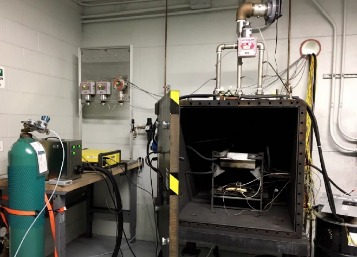
DNV GL’s large battery destructive test chamber in Rochester
“Batteries onboard ships are both environmentally friendly and cost-effective solutions that we wish to see more of in the future. This project has been important in learning the risks of these systems and using the new insight to improve safety requirements,” says Lars Alvestad, Acting Director of the Norwegian Maritime Authority.
A battery fire can produce very hot fires, as well as the risk of explosion due to gases produced by the battery. DNV GL’s new report presents the results of research on what happens during a fire in a battery compartment, the release of gases, and the usefulness of various extinguishing systems in combatting the fire and preventing explosions. One of the most important findings concerns ventilation systems, which are critical to avoiding an accumulation of explosive gas. The report concludes that ventilation alone will not adequately mitigate gas accumulation if a significant portion of the battery system ignites.
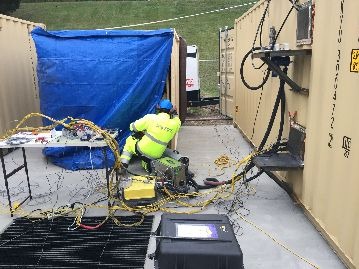
Data acquisition of the battery module fire tests
“In addition to fire suppression and ventilation, the battery design must have preventative safety barriers so that the fire and gas emissions are limited to as small a part of the battery system as possible,” says Henrik Helgesen, Project Manager for the research project and Senior Consultant at DNV GL.
The report provides new recommendations on ventilation systems, based on a newly created model which identifies the appropriate size and type of ventilation system based on a vessel’s battery installation. Early fire and gas detection are also essential, meaning that the gas sensor should be located as close to the battery as possible.
Launched in 2017, the research project draws on the experience of a wide range of maritime stakeholders. “It is very important for us to work closely with all parts of the industry and understand the full picture as we work to promote safety in our regulatory development work,” says Denis Cederholm-Larsen, Senior Ship Surveyor at the Danish Maritime Authority.
The following partners have contributed to the research:
- The Norwegian Maritime Authority
- The Danish Maritime Authority
- The United States Maritime Administration (MARAD)
- Norwegian Defence Research Establishment (FFI)
- Corvus Energy, supplier of maritime battery systems
- FIFI4MARINE, supplier of Lithium-ion fire extinguishing systems
- Nexceris, developer of technology for battery gas sensors
- Kongsberg Maritime (former Rolls Royce Marine AS), supplier of propulsion technology
- ABB, supplier of propulsion technology
- Stena, ship owner and ferry operator
- Scandlines, ship owner and ferry operator
- Marioff, supplier of fire extinguishing systems
- Leclanché, supplier of battery systems
- Super-B, supplier of battery systems
- Damen, ship yard
- DNV GL
Source: DNV GL



Related News.

Hong Kong Global Maritime Trade Summit to return for third edition
The International Chamber of Shipping, in collaboration with the Transport and Logistics Bureau of the Government of Hong Kong and the Hong Kong…

Appetite for US crude oil exports climbs despite high freight
South Korea tops US crude destinations at 568,600 b/d VLCC rates to Asia double, closing arbitrage window European refining margins…

Shipping stocks Rally as Hormuz Traffic plunges 75%
Ship traffic through the Strait of Hormuz — a critical chokepoint handling about 20% of global crude oil and liquefied natural gas shipments — has…

Diana Shipping announces Time Charter Contract for m/v G P Zafirakis with Classic Maritime
Diana Shipping, a global shipping company specializing in the ownership and bareboat charter-in of dry bulk vessels, announced that, through a…

New IMO ESP Code framework for Remote Inspection Techniques
The International Maritime Organisation, through Resolution MSC.584(111) , has adopted amendments to the International Code on the Enhanced…

ABS opens Offshore & Marine Support Center in Bergen
ABS has expanded its capabilities in the Norwegian maritime market with the opening of a cutting-edge support center in Bergen, bringing advanced…

MOL holds giant step memorial ceremony and beach cleanup at Kashima Coast
Memorial and Reflection 20 Years After the Accident: Learning from the Past to Foster an Even Stronger Safety Culture Mitsui O.S.K. Lines, announced…

KEZAD-based Arabian Gulf Steel Industries achieves lowest verified Carbon Footprint for Rebar
CARES UK verified Environmental Product Declaration confirms 139 kg CO₂e per tonne for rebar produced at AGSI’s KEZAD Abu Dhabi facility Arabian…
Indian Register of Shipping announces launch of first fleet support ship INS Surya
Indian Register of Shipping continues to strengthen its role in supporting the Indian Navy and India’s naval shipbuilding capabilities through the…

VLCCs Climbing the Record Charts
LR2 The TC1 75kt MEG/Japan index decreased by only a single point this week to WS928. The corresponding Baltic round-trip TCE fell by $2,000 to…
Subscribe to our newsletter!
if you dont want to swim alone in the ocean of news, sign up for the newsletter, and you will receive daily all the important news of world shipping!
