Maersk harnesses wind power to cut fuel consumption by 8.2%
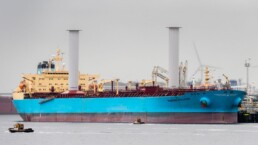

A Maersk Tankers product tanker has achieved fuel savings of 8.2 per cent in a one-year period by harnessing wind power.
A joint project including Maersk Tankers, Norsepower, the Energy Technologies Institute (ETI), and Shell International Trading and Shipping Company, fitted the product tanker Maersk Pelican with two Norsepower Rotor Sails in August 2018. From 1 September 2018 to 1 September 2019, the vessel reduced its fuel consumption by 8.2 per cent and cut CO2 emissions by around 1,400 tonnes. The savings were confirmed by comparing detailed performance information to a baseline established with full scale measurements and computational analysis done for the vessel prior to the Rotor Sail installation.
The Rotor Sails are large, cylindrical mechanical sails that operate based on the Magnus effect. Wind hits the spinning Rotor Sails, causing air to accelerate on one side of the Rotor Sail and decelerate on the other. The difference in the speed of air flow results in a direct pressure difference, creating a lifting force that is perpendicular to the wind flow direction. This generates a forward thrust, propelling the vessel.
Independent experts from Lloyd’s Register’s (LR’s) Ship Performance Group have analysed and validated the performance data during the project to ensure an impartial assessment. In addition, technical and operational insights for performance studies will also be published.
“During the one-year trial period on Maersk Pelican, crew and operators have reported positively on the usability, safety and performance of the Rotor Sails in all conditions,” said Tommy Thomassen, chief technical officer at Maersk Tankers.
“Maersk Tankers and the industry have developed and tested a number of technological solutions, which contribute to reducing fuel consumption and associated emissions. We see wind technology as one of the technologies that can give us a real breakthrough in reducing CO2 and help us achieve our emission-reduction target of 30 per cent by 2021. We will closely follow the development around the financial and commercial viability of the technology for potential future installations on some of our other larger vessels, while we have decided that Maersk Pelican will continue to sail with the Rotor Sails.”
Dr. Chris Craddock, technical advisory & ship performance manager, Lloyd’s Register, said, “As the independent performance verifier of the Norsepower Rotor Sail, LR sees our role as a trusted independent expert, assessing the return on investment for new technologies that address the challenges of decarbonisation. Wind power technologies are part of the solution, and the Norsepower Rotor Sail has proven itself to save fuel and reduce emissions.”
Tuomas Riski, CEO at Norsepower sees great opportunities for the technology: “With the Maersk Pelican, there are three vessels in daily commercial operation using Norsepower’s Rotor Sails. Each of these cases represents a very different vessel type and operational profile, demonstrating the widespread opportunity to harness the wind through Rotors Sails across the maritime industry.”
In a simulation model, Norsepower shows that with the currently installed Rotor Sails operating in global average wind conditions of all shipping routes, yields a savings potential up to 12 per cent on fuel and emissions, including CO2. Based on the same simulation model, Norsepower estimates that applying Rotor Sail technology to the entire global tanker fleet would reduce annual CO2 emissions by more than 30 million metric tonnes, which corresponds to emissions of about 15 million passenger cars.
Darryl Hylands, programme manager, HDV, Energy Technologies Institute (ETI) said, “Successfully demonstrating this technology at scale shows its capability to significantly reduce fuel costs and environmental impact of the shipping industry. On certain routes during the trial the vessel achieved fuel savings way beyond the average of 8.2 per cent even with average wind conditions. There is a clear potential to achieve higher fuel savings, and hence CO2 savings, on routes with more favourable wind conditions, which further improves the commercial viability of the technology.”
Source: VPO Global



Related News.

Highly successful conclusion of the 2nd CSN Northern European Crewing Conference in Hamburg: Crewing 5.0 in Focus
We are delighted to report the highly successful conclusion of the 2nd CSN Northern European Crewing Conference, which took place on the 22nd of…

Dualog launches secure messaging for ship and shore
Dualog has launched Dualog Chat, a secure messaging service built for shipping. The first service in Workspace by Dualog, Chat gives crews and shore…

India and the Widening Tanker Freight Squeeze
This week’s Tanker Market Monitor tracks India’s return to Iraqi supply as Gulf oil movements recover amid persistent shipping risk. Yanbu is…
Star Bulk announces strategic partnership with Hermes World Maritime
Star Bulk Carriers Corp. (the "Company" or "Star Bulk") (Nasdaq & Euronext Athens: SBLK), today announced that it has entered into a strategic…

Thai Cave Rescue Diver Chris Jewell to Bring Lessons in Risk and Safety to IMCA Global Summit
The International Marine Contractors Association (IMCA) will launch its new strategy to 2030 as hundreds of offshore leaders and technical…

Port call optimisation pilot projects reveal significant emissions savings potential
Commercial ships spend between 4% and 6% of their operating year waiting outside ports. That idle time is one of the clearest inefficiencies in…

Port Houston celebrates Historic Project 11 Milestone
Houston Ship Channel expansion strengthens safety, efficiency, and regional prosperity Port Houston joined federal, state, and local elected…
Global VLCC Spot Earnings rise to $805,000/Day
Clarksons Research, the data and analytics arm of the Clarksons Group, continue to track and monitor shipping activity and markets impacted by the…

IMO adopts frameworks to assess marine geoengineering research activities
New guidance will help governments evaluate marine geoengineering research proposals to ensure they are safe for the environment. The…
BIMCO adopts addendum to support investments in retrofit projects
The shipping industry is working to improve fuel efficiency and ship performance to address decarbonisation requirements, new regulations and rising…
Subscribe to our newsletter!
if you dont want to swim alone in the ocean of news, sign up for the newsletter, and you will receive daily all the important news of world shipping!
